🚨JUST IN: SPFL Release OFFICIAL STATEMENT on Scottish Football as International Break Ends
Scottish football is preparing to return to domestic action following the international break, but the resumption of the league comes with several unresolved disciplinary issues that could continue to dominate the headlines.
While supporters are eager to see their teams return to action, Celtic, Rangers and Aberdeen remain among the clubs dealing with significant consequences arising from incidents involving supporters. The situations differ from club to club, with sanctions, ticket restrictions and appeals forming part of a wider debate about discipline and safety in Scottish football.
For the Scottish Professional Football League (SPFL), the challenge is to ensure that the competition resumes smoothly while clubs, supporters, security personnel and football authorities address issues that have affected the game in recent months.

The international break has provided a pause in the Scottish Premiership calendar, but it has not brought an end to the controversies surrounding some of the country’s biggest clubs.
With domestic football scheduled to resume on October 17 and 18, attention will once again turn to the pitch. However, the disciplinary situations involving Celtic, Rangers and Aberdeen mean that there will be plenty to discuss away from the football itself.
SPFL Faces Renewed Attention as Scottish Football Returns
The end of the international break marks an important moment for clubs competing in the Scottish Premiership.
Managers will be looking to regain momentum, players will be returning from international duty, and supporters will be eager to see their teams continue their campaigns.
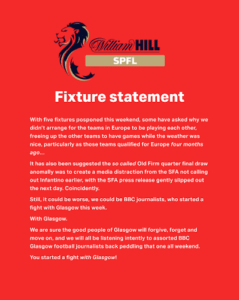
According to the SPFL’s published fixture schedule, Premiership action returns on Saturday, October 17, with Aberdeen hosting St Mirren, Hibernian facing Falkirk, Kilmarnock meeting Motherwell, St Johnstone taking on Dundee United, and Dundee playing Rangers.
Celtic are scheduled to host Hearts on Sunday, October 18.
The return of these fixtures will bring renewed attention to the title race, the battle for European qualification and the fight to avoid relegation.
However, the football will not be the only talking point.
Several disciplinary matters remain relevant to Scottish clubs, and the consequences of earlier incidents could continue to affect supporters and matchday arrangements.
It is important to distinguish between the different cases. The SPFL has issued a specific decision concerning away supporters at Celtic-Rangers matches, while Aberdeen has received a separate sanction following incidents at Kilmarnock. Celtic and Rangers are also contesting Scottish FA sanctions arising from their Scottish Cup quarter-final meeting in March.
These are separate matters rather than a single new punishment announced for all Scottish clubs.
Nevertheless, they underline the continuing pressure on clubs to maintain order and ensure that supporters behave responsibly.
Celtic and Rangers Still Dealing With the Consequences of Old Firm Disorder
One of the most significant disciplinary controversies in Scottish football stems from the Scottish Cup quarter-final between Rangers and Celtic at Ibrox on March 8, 2026.
The match ended goalless before Celtic progressed after a penalty shoot-out, but the aftermath became the focus of a major disciplinary investigation.
Supporters from both clubs entered the pitch, and confrontations followed. Pyrotechnics and missiles were also reported during the disorder, prompting widespread concern about stadium safety.
Police Scotland made 43 arrests following the incidents.
The subsequent independent review examined the circumstances surrounding the disorder and highlighted serious concerns about crowd management, security and the behaviour of supporters.
The consequences have extended beyond the original match.
In August, the Scottish FA’s disciplinary process resulted in both clubs being ordered to play their next home Scottish Cup fixtures behind closed doors. They were also ordered to make compensatory payments of £100,000 each to the opposition club for those matches.
Both clubs appealed against the sanctions, with an appeal hearing scheduled for October 26, 2026.
This means the disciplinary dispute remains an important talking point as Scottish football returns from the international break.
The distinction is significant: the sanctions have been imposed, but the appeals remain unresolved at the time of writing.
For supporters, the prospect of a major domestic cup fixture being played without spectators is a serious concern. Home matches are among the most important occasions in a club’s calendar, generating atmosphere, revenue and opportunities for supporters to follow their teams.
For the authorities, however, the case raises a broader question: what measures are necessary to prevent similar incidents from happening again?
The outcome of the appeals could provide further clarity about the penalties facing both Glasgow clubs.
Until then, the situation remains under scrutiny.
SPFL Confirms No Away Supporters at Celtic-Rangers Matches for the Remainder of the Season
The disciplinary fallout has also affected arrangements for meetings between Celtic and Rangers in SPFL competitions.
In an official statement published on September 4, the league confirmed that there would be no away supporters at Celtic-Rangers matches in SPFL competitions for the remainder of the 2026/27 season.
The decision followed discussions involving the SPFL, both clubs and Police Scotland, as well as consideration of the findings from the independent review of the March incident.
Before the decision, Celtic and Rangers had agreed to away allocations equivalent to five per cent of available stadium capacity for their SPFL meetings.
However, arrangements for the new season came under review following the disorder at Ibrox.
For the September 13 Premier Sports Cup meeting at Ibrox, Rangers proposed a reduced allocation for visiting Celtic supporters. Celtic rejected that proposal and asked the SPFL to determine the arrangements.
Following further discussions, the league confirmed that away supporters would not be permitted at the clubs’ SPFL meetings for the remainder of the season.
The SPFL described the arrangement as temporary and stated that the position could be reviewed if circumstances materially changed.
It also confirmed that arrangements for matches between the clubs beyond the current campaign would be considered well in advance of the 2027/28 season.
The decision represents a significant change for one of Scottish football’s biggest rivalries.
Celtic and Rangers matches traditionally attract enormous attention, and away supporters contribute to the atmosphere and spectacle surrounding these encounters.
However, the authorities have placed safety and security at the centre of their decision.
For supporters hoping to attend future Old Firm fixtures, the immediate position is clear: the no-away-supporters arrangement applies to their SPFL meetings for the remainder of the current season, subject to review.
The controversy is likely to continue, particularly as supporters debate whether restrictions on away allocations are the best way to address crowd disorder.
The authorities must now balance the desire to preserve the atmosphere of these fixtures with the responsibility to protect everyone attending them.
Aberdeen Also Sanctioned Following Incidents at Kilmarnock
Celtic and Rangers are not the only clubs facing disciplinary consequences.
Aberdeen have also been sanctioned following incidents involving their supporters during their Premier Sports Cup quarter-final against Kilmarnock at BBSP Rugby Park on September 12.
The match finished 1-1 before Aberdeen won 3-1 on penalties to secure their place in the semi-finals.
However, proceedings into two serious incidents subsequently concluded with a sanction imposed by the SPFL.
According to the league’s official statement, the incidents involved a large-scale organised and illegal pyrotechnics display and a pitch incursion.
As a consequence, Aberdeen received an immediate reduction of 500 tickets from their allocation for the Premier Sports Cup semi-final against Rangers at Hampden Park on Saturday, October 31.
The club was also required to cover the cost of those tickets as part of the sanction.
The punishment is particularly relevant because Aberdeen’s semi-final represents a major occasion for the club and its supporters.
Reaching the latter stages of a domestic cup competition offers the opportunity to compete for silverware and gives fans a chance to support their team at a national stadium.
A reduction in the available ticket allocation means fewer supporters can attend than would otherwise have been possible.
It also sends a message about the consequences of serious supporter misconduct.
For Aberdeen, the immediate challenge is to prepare for the semi-final while dealing with the consequences of the disciplinary decision.
For the wider Scottish game, the case adds to the discussion about the responsibilities clubs have when incidents occur among their supporters.
The sanction should not be confused with the separate penalties imposed on Celtic and Rangers. Each case has its own circumstances and disciplinary process.
Nevertheless, the cases illustrate that disciplinary action can affect clubs at different levels of Scottish football, regardless of their position in the league or their standing among supporters.
Could More Clubs Face Disciplinary Consequences?
The return of domestic football naturally raises questions about whether further disciplinary problems could emerge during the coming weeks.
The confirmed cases involving Celtic, Rangers and Aberdeen demonstrate that incidents involving supporter behaviour can have consequences extending beyond the match in which they occur.
Potential consequences may include restrictions on ticket allocations, financial penalties or other disciplinary measures, depending on the circumstances and the rules applied by the relevant governing body.
However, there is no basis for claiming that every Scottish club is facing a new sanction following the international break.
Nor should the existing cases be presented as evidence that the SPFL has announced a blanket punishment affecting the entire league.
The more accurate picture is that several clubs are dealing with separate disciplinary matters, while the authorities continue to emphasise safety, security and responsible supporter conduct.
That distinction matters because disciplinary decisions can have significant implications for clubs and their supporters.
A restriction on away tickets, for example, can affect the number of fans travelling to a match. A closed-door order can remove the home crowd from an important fixture. Financial penalties can also place additional costs on clubs.
The circumstances of each case must therefore be considered individually.
As the Scottish Premiership resumes, clubs will be expected to focus on their footballing objectives while ensuring that matchday operations remain safe and properly managed.
International Break Ends, but the Pressure Continues
For managers, players and supporters, the end of the international break offers an opportunity to refocus on domestic football.
Celtic will want to maintain their competitive ambitions, Rangers will be looking to make progress in the league and Aberdeen will be preparing for their upcoming fixtures and cup commitments.
Yet the wider circumstances mean that the return to action will not be exclusively about results.
Celtic and Rangers must continue dealing with the implications of their Scottish FA disciplinary cases, including the appeals scheduled for October 26.
Their SPFL meetings will also remain subject to the temporary no-away-supporters arrangement.
Aberdeen, meanwhile, must contend with the reduction in their ticket allocation for the Premier Sports Cup semi-final against Rangers.
These situations have different origins, but they share one important feature: decisions made by football authorities can affect the matchday experience long after the original incident has taken place.
Supporters will inevitably have differing views about the fairness and effectiveness of the punishments.
Some will argue that strong sanctions are necessary to deter dangerous behaviour and protect the reputation of Scottish football.
Others may question whether restrictions on ticket allocations and closed-door matches penalise ordinary supporters who played no part in the incidents.
That debate is likely to continue as the relevant authorities review the cases and clubs seek clarity about their positions.
Ultimately, the priority must be to ensure that supporters can attend matches without fear of violence or serious disorder.
Football authorities, clubs, police and supporters all have a role to play in achieving that objective.
What Happens Next for Scottish Football?
The next few weeks could prove important for the clubs involved in these disciplinary matters.
The Scottish Premiership resumes on October 17 and 18, bringing domestic football back into focus after the international break.
Aberdeen’s Premier Sports Cup semi-final against Rangers is scheduled for October 31, with the reduced ticket allocation forming part of the consequences of the incidents at Kilmarnock.
Meanwhile, Celtic and Rangers are awaiting the outcome of their Scottish FA appeals, scheduled for October 26.
Those proceedings could provide further clarity about the penalties imposed following the disorder at Ibrox.
The SPFL’s decision on away supporters will also remain relevant throughout the season, although the league has stated that the arrangement is subject to review if circumstances materially change.
For now, the key developments are confirmed sanctions, continuing appeals and restrictions affecting particular fixtures.
There has been no single announcement establishing new punishments for every Scottish club simply because the international break has ended.
Nevertheless, the return of domestic football provides a timely reminder that the consequences of supporter misconduct can extend well beyond the final whistle.
Scottish football is ready to return, but the disciplinary questions surrounding some of its biggest clubs remain unresolved.
One thing is certain: the coming weeks will bring more attention to the relationship between supporter behaviour, stadium safety and the responsibility of clubs to ensure that football remains a safe environment for everyone.
The focus may be returning to the pitch, but Celtic, Rangers and Aberdeen still have important issues to address away from it.