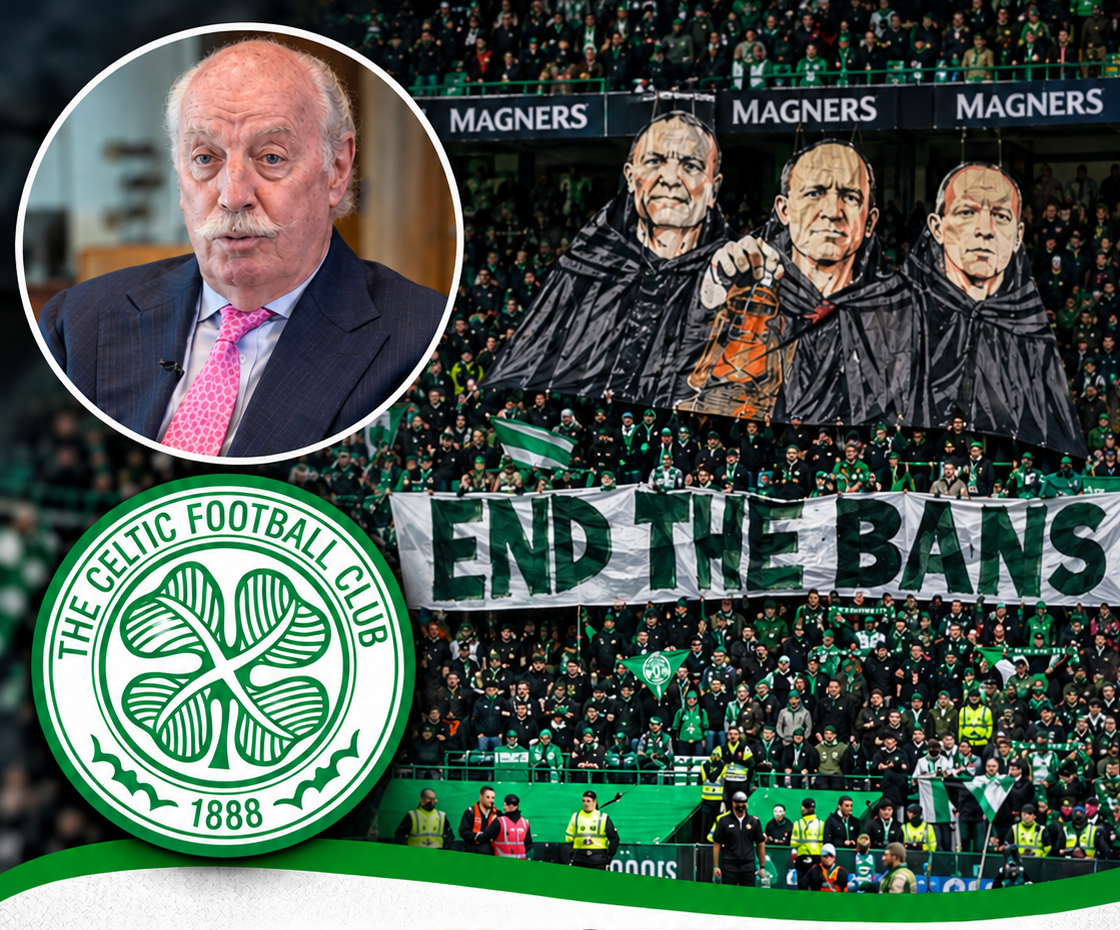
Celtic are facing a major storm away from the football pitch, and the latest developments have sent tensions between the club’s hierarchy and a section of its supporters to another level.
The Green Brigade have announced a boycott of Celtic’s remaining home Europa League matches and Scottish Cup fixtures, delivering another significant blow to an already fractured relationship between the club and some of its most passionate supporters.
At the centre of the growing controversy is Dermot Desmond, Celtic’s principal shareholder, whose influence over the club has become a major source of frustration among critics of the current leadership.
What began as anger over the direction of the club has developed into a much wider confrontation involving supporters, the board and manager Martin O’Neill.
And with neither side showing obvious signs of backing down, the question now is whether Celtic can find a way to bring everyone together before the dispute becomes even more damaging.
THE GREEN BRIGADE MAKE THEIR MOVE — CELTIC HIT BY A MAJOR BOYCOTT
The Green Brigade have made their position clear.
The prominent Celtic supporters’ group announced that it would withdraw from the Home Cup Ticket Scheme and refuse to attend the remaining home Europa League matches. The boycott also covers Scottish Cup fixtures, whether played at home, away or at Hampden.
The group intends to review its position at the end of the season, although it has left the door open to reconsidering the decision earlier if meaningful progress is made.
This is not simply a decision to miss a few football matches.
For a group known for its passionate support, organised displays and intense atmosphere at Celtic Park, withdrawing from important fixtures represents a significant statement.
The Green Brigade believe the relationship between supporters and the club’s leadership has deteriorated to an unacceptable level.
Their complaint centres on what they describe as restrictions on their activities, the threat of bans, difficulties organising displays and a lack of meaningful engagement with the people responsible for running the club.
They have also expressed anger over the club’s response to the recent protest targeting Desmond.
The message from the group is that continuing as normal would mean accepting a situation they believe needs to change.
Their decision has therefore placed additional pressure on the Celtic hierarchy to address the growing division.
However, the boycott does not extend to Scottish Premiership matches, and the Green Brigade have stressed that their decision is not intended to force other supporters to follow their example.
That distinction matters.
The group is making a statement about its relationship with the club rather than calling on every Celtic supporter to abandon the team.
Nevertheless, the potential consequences are significant.
European nights and domestic cup matches are important occasions for Celtic, and the absence of a prominent supporters’ group could become another visible reminder of the problems developing behind the scenes.
DERMOT DESMOND BECOMES THE CENTRE OF THE STORM
Much of the anger surrounding Celtic’s current situation has focused on Desmond.
As the club’s principal shareholder, he occupies an influential position in Celtic’s leadership structure. His role has increasingly attracted criticism from supporters who believe the club needs a different approach to communication, governance and its long-term direction.
The latest controversy intensified after a protest against Desmond at the Alfred Dunhill Links Championship at St Andrews.
During the golf tournament on 3 October, supporters threw tennis balls bearing images of Desmond towards him while he was participating in the event.
Security subsequently escorted him away from the area.
The incident attracted considerable attention and immediately raised questions about how far supporters were prepared to go to express their frustration.
Celtic responded with a strongly worded statement condemning the protest.
The club argued that the incident had damaged its reputation and crossed the line between legitimate criticism and unacceptable disruption. It also warned that individuals established to have been involved in planning, facilitating or participating in the incident could face indefinite bans.
The club further questioned whether the Celtic Fans Collective could credibly claim to represent the wider support.
That response created another flashpoint.
Rather than ending the dispute, the exchange of statements deepened the divisions between the club and supporters who already believed their concerns were not receiving sufficient attention.
The Green Brigade subsequently criticised the club’s response, arguing that it unfairly connected their group to an incident for which they said they were not responsible.
The result has been an increasingly bitter disagreement over accountability, supporter treatment and the future relationship between Celtic’s leadership and its fanbase.
CELTIC’S BOARDROOM WAR IS BECOMING IMPOSSIBLE TO IGNORE
The controversy is no longer limited to one protest or one announcement.
It has developed into a broader debate about how Celtic should be run and how much influence supporters should have when expressing concerns about the club’s direction.
Critics of the leadership argue that supporters deserve meaningful communication rather than statements released only after a controversy has erupted.
They want greater engagement and a clearer explanation of the club’s long-term plans.
The Celtic Trust has also raised concerns about the board’s handling of supporter relations, calling for an apology over comments made by Ross Desmond at a previous annual general meeting.
The Trust has proposed resolutions addressing the board’s conduct, strategic planning and security arrangements.
These developments suggest that dissatisfaction extends beyond a single supporters’ group.
Different sections of the fanbase may disagree about the methods used to express their frustrations, but questions about communication, leadership and the club’s future have become increasingly prominent.
For Celtic, that creates a difficult challenge.
A football club depends on more than the players and coaching staff. Its supporters contribute to its identity, atmosphere and commercial strength.
When sections of that support feel alienated, the consequences can extend beyond matchday.
The club must now contend with a dispute that touches on its reputation, its relationship with its fanbase and the expectations supporters have of those making decisions at the top.
The central question is whether both sides can establish a meaningful dialogue before the disagreement becomes even more entrenched.
MARTIN O’NEILL BREAKS HIS SILENCE — AND HIS WORDS HAVE SPARKED ANOTHER DEBATE
While the dispute has largely centred on the board and supporters, Martin O’Neill has also found himself drawn into the controversy.
The Celtic manager publicly criticised the behaviour displayed during the St Andrews protest.
O’Neill made it clear that he disagreed with the incident, arguing that it did not represent the values he associated with Celtic.
He also expressed sadness over the Green Brigade’s decision to boycott upcoming matches.
For the manager, the situation is particularly frustrating because he wants the club to rediscover a sense of unity.
O’Neill recalled previous moments when Celtic supporters and the team appeared united, highlighting the atmosphere surrounding the club’s European adventures and the celebrations following last season’s final match.
Those memories remain powerful for many supporters.
However, the current situation is very different.
The manager has acknowledged that Celtic has experienced similar divisions before, and he now faces the challenge of keeping the team focused while a major dispute unfolds around the club.
His comments have also highlighted the difficulty of the position he occupies.
O’Neill is responsible for preparing the team, managing players and delivering results. Yet he has also become one of the most prominent voices responding to questions about the club’s wider problems.
He wants Celtic to win football matches and restore a sense of togetherness.
But victories alone may not resolve a dispute rooted in disagreements over leadership, communication and supporter treatment.
Even if Celtic enjoy a strong run of results, the underlying questions will remain until the relationship between the board and its critics improves.
WHY THE BOYCOTT COULD BECOME A MAJOR PROBLEM
The absence of the Green Brigade from upcoming cup and European fixtures could have a noticeable effect on the atmosphere surrounding Celtic.
The group is associated with coordinated chanting, large displays and the kind of vocal backing that can make European nights at Celtic Park particularly intense.
Its absence would not mean that the stadium becomes empty or that other supporters stop backing the team.
Nevertheless, it could change the atmosphere at important matches and create another visible reminder of the dispute.
There is also a wider concern about how the disagreement might develop.
If the club maintains its current position while the Green Brigade continues its boycott, both sides could find themselves increasingly committed to defending their decisions.
That would make compromise more difficult.
The club has a responsibility to protect its staff, shareholders and supporters from unacceptable behaviour. At the same time, supporters must have legitimate avenues through which they can criticise decisions and demand answers.
Finding the right balance is not straightforward.
The recent incident at St Andrews has made the situation even more complicated because the protest itself and the wider complaints about supporter treatment have become closely connected in public debate.
Some supporters may condemn the methods used during the protest while still believing that the club needs to address the concerns that contributed to the wider unrest.
Others may believe the club is justified in taking a firm position against disruptive behaviour.
These disagreements mean there is no guarantee that a single announcement or meeting will settle the matter.
What Celtic needs is a credible way forward that addresses legitimate concerns without excusing unacceptable conduct.
THE BIG QUESTION: WILL DERMOT DESMOND AND THE BOARD RESPOND?
This is where the controversy could take its next important turn.
The Green Brigade have indicated that they would review their boycott if adequate progress were made before the end of the season.
That provides a potential opening for dialogue.
However, the group has not announced that the boycott will be lifted, and there has been no confirmed resolution to the wider dispute.
For now, Celtic’s leadership must decide how it wants to approach the growing dissatisfaction.
Maintaining a firm stance may demonstrate that the club will not tolerate disruptive behaviour. But if supporters continue to feel excluded from meaningful discussions, the underlying tension could persist.
Equally, the Green Brigade must consider whether its chosen approach will help achieve the changes it wants.
A boycott can attract attention and demonstrate the depth of dissatisfaction, but it can also create further distance between supporters and the club they want to influence.
Neither side can guarantee the outcome.
What is clear is that the relationship needs attention if Celtic is to move beyond the present controversy.
Supporters want to feel that their concerns are being heard. The club wants to protect its reputation and maintain order. Both objectives will be difficult to achieve without some form of constructive engagement.
The coming weeks could therefore prove important in determining whether the dispute begins to cool or develops into an even larger confrontation.
CELTIC MUST NOW FIND A WAY FORWARD
For a club with Celtic’s history, ambition and passionate following, the current situation is deeply uncomfortable.
The Green Brigade have announced a boycott. Desmond has become the focus of renewed criticism. The club has issued a strong condemnation of the St Andrews protest, and O’Neill has publicly expressed his disappointment over the division.
Meanwhile, other supporters’ organisations are raising their own questions about the club’s leadership and future direction.
The football team must continue competing while these disagreements unfold.
That is the immediate challenge facing O’Neill and his players.
They cannot resolve every boardroom dispute, but their performances may help restore some positive energy around Celtic Park.
Still, the club should not assume that results alone will make the controversy disappear.
The concerns raised by supporters involve questions that go beyond the scoreline.
The coming months could determine whether Celtic’s leadership and its critics find common ground or remain locked in a prolonged dispute.
For now, the Green Brigade’s decision has made one thing clear: the relationship between sections of Celtic’s support and the club’s leadership has reached a serious point of tension.
The next move matters.
Will the club open the door to meaningful engagement, or will the boycott continue as both sides stand their ground?
One thing is certain: Celtic’s biggest battle at this moment is not happening on the pitch. It is happening over the future relationship between the club and its supporters. 🍀🔥