GARY NEVILLE SINGLES OUT TWO COVENTRY PLAYERS WHO SHOULD ALWAYS START TOGETHER
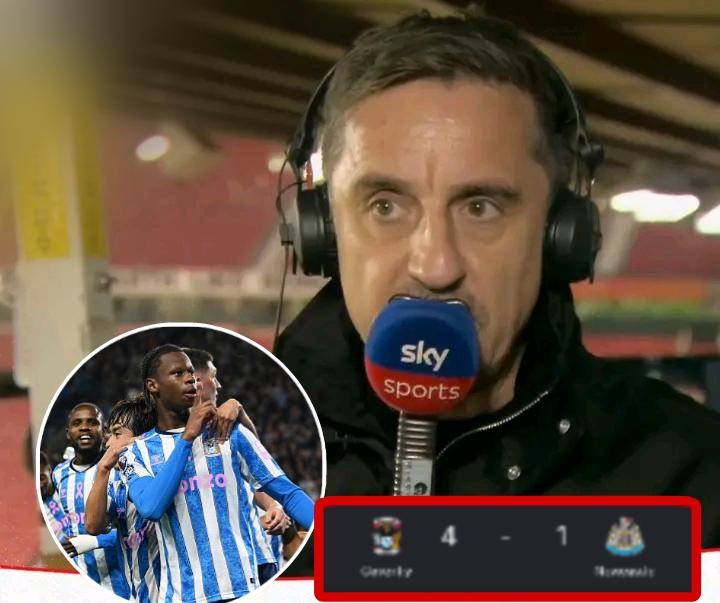
Gary Neville has sparked a major conversation among football fans after Coventry City’s outstanding 4–1 victory over Newcastle United, with Sidiki Chérif and Ellis Simms emerging as two players at the centre of the discussion.
Coventry City delivered a memorable performance at the Coventry Building Society Arena, producing four goals in a result that will give Frank Lampard plenty of reasons to be optimistic about the direction of his team.
After months of questions about whether Coventry could compete consistently at Premier League level, the emphatic victory over Newcastle provided an encouraging response. The Sky Blues combined attacking determination with intelligent movement, punished defensive mistakes and demonstrated that they possess players capable of changing the outcome of a match.
However, beyond the result itself, attention has turned towards two players whose contributions highlighted the importance of having different attacking options available.
Sidiki Chérif scored Coventry’s second goal early in the second half, while Ellis Simms came off the bench to score the third. Their performances have fuelled debate about whether Lampard should find a way to get both players involved together more regularly.
For supporters who have watched Coventry struggle to find consistency in attack, the question is becoming increasingly interesting: could Chérif and Simms form a partnership that makes the Sky Blues considerably more dangerous?
⚽ SIDIKI CHÉRIF SHOWS WHY COVENTRY NEED HIS ATTACKING ENERGY
Chérif’s goal was one of the defining moments of Coventry’s victory.
Having taken the lead through Jack Rudoni’s first-half penalty, Coventry needed to maintain their intensity after the interval. Newcastle were always capable of responding, and another goal would give the hosts greater control over the contest.
Chérif delivered precisely the kind of attacking moment that Lampard would have wanted.
His goal doubled Coventry’s advantage and placed Newcastle under immediate pressure. Instead of allowing the visitors to settle into the second half and build confidence, Coventry gave them another problem to solve.
The goal was important not only because of the scoreline but also because of what it represented for Coventry’s attacking approach.
Chérif offered an attacking threat that could stretch Newcastle’s defensive structure. His ability to threaten the opposition goal gave Coventry another dimension, particularly at a stage when the visitors needed to become more adventurous.
When a team is protecting a lead, it can sometimes become too cautious. Players begin dropping deeper, possession becomes less purposeful and the opposition gradually gains confidence.
Coventry avoided that trap by continuing to threaten Newcastle.
Chérif’s contribution demonstrated the value of having a forward who can turn attacking opportunities into decisive moments. Rather than simply helping Coventry retain possession, he provided the end product that allowed the home side to establish a commanding position.
For Lampard, that is an encouraging sign.
The manager needs players who can make an impact when the pressure is high, particularly against opponents who have enough quality to punish mistakes.
Chérif’s performance also raises questions about how Coventry should structure their attack in future matches. If he continues to produce goals and create problems for defenders, Lampard will have a strong argument for giving him a prominent role.
🔥 ELLIS SIMMS MAKES HIS CASE AFTER COMING OFF THE BENCH
If Chérif helped Coventry take control of the contest, Simms demonstrated why substitutes can become decisive weapons.
The Coventry forward entered the match and scored the team’s third goal, restoring a comfortable advantage after Sven Botman’s goal had given Newcastle renewed hope.
Botman’s strike had threatened to change the atmosphere inside the stadium.
At 2–1, Newcastle had a reason to believe they could recover. One more goal would have brought the visitors level, potentially turning a comfortable Coventry evening into a tense battle.
Simms had other ideas.
His goal restored Coventry’s two-goal cushion and changed the mood once again. Rather than allowing Newcastle to build momentum, Coventry delivered a response that put the pressure back on the visitors.
That contribution underlined the importance of having a striker ready to make an immediate impact.
Coming off the bench is not always straightforward. A substitute must adjust quickly to the pace of the match, understand the spaces available and take advantage of opportunities that might not come frequently.
Simms did exactly what Coventry needed.
His finish rewarded the team’s attacking work and gave Lampard another reason to value the depth of his squad.
For supporters, the goal also created a selection dilemma.
Should a player who can make such an impact from the bench remain a substitute, or should his performance earn him a place in the starting lineup?
There is no simple answer. A player can be extremely effective as an impact substitute, while another may offer greater value from the opening whistle.
Nevertheless, Simms’ goal has strengthened the argument that Coventry must find ways to use his attacking qualities more consistently.
The important question is not simply whether he should start every game. It is whether Coventry can create a system in which his strengths complement those of Chérif.
🗣️ WHY THE CHÉRIF-SIMMS PARTNERSHIP IS ATTRACTING ATTENTION
The most interesting aspect of Coventry’s victory is the possibility of combining two forwards who contributed to the same result in different circumstances.
Chérif scored the second goal, helping Coventry establish control after half-time. Simms then came from the bench to score the third, responding at a crucial moment after Newcastle had reduced the deficit.
Their contributions highlight two different ways of influencing a match.
One forward can stretch a defence, exploit space and threaten the goal while the opposition is still trying to establish its rhythm. Another can provide fresh energy, attack tired defenders and capitalise on spaces that emerge later in the contest.
If Coventry can bring those qualities together, the team could become more difficult to defend against.
A potential partnership would require careful tactical planning from Lampard.
Chérif could be encouraged to use his movement to pull defenders away from dangerous areas, while Simms could occupy central positions and provide a direct target inside the penalty area.
Alternatively, the two could rotate their positions depending on the situation, preventing opposition defenders from becoming comfortable with their movements.
Such a system would demand communication, intelligent positioning and a willingness to work for the team.
It would also require Coventry’s midfielders to supply the forwards with quality passes and create opportunities between the opposition’s defensive and midfield lines.
The Newcastle result provides encouraging evidence that Coventry have attacking options capable of making a difference.
However, one performance alone cannot establish whether a partnership will work consistently over an entire season.
Lampard must consider their fitness, tactical suitability, performances in training and the strengths of upcoming opponents before making a final decision.
👀 GARY NEVILLE’S EXPECTED QUESTION: WHY NOT START THEM TOGETHER?
Neville has built a reputation as a prominent football analyst who examines tactical decisions, individual performances and the choices managers make under pressure.
A discussion about Coventry’s attacking options would naturally raise a question familiar to his analysis: are managers sometimes overlooking combinations that could give their teams a greater attacking threat?
In Coventry’s case, Chérif and Simms provide an interesting example.
Chérif’s goal showed his ability to contribute during the starting phase of a match, while Simms’ strike demonstrated the value he can bring when introduced later.
The temptation would be to conclude that both should immediately become automatic starters.
But Lampard has to look beyond the goals.
Starting two forwards together could increase Coventry’s presence in the penalty area and create more opportunities for crosses, through balls and second balls.
It could also force opposition centre-backs to divide their attention rather than concentrating on a single central striker.
There are potential disadvantages, too.
If Coventry commit too many players forward, they could leave spaces in midfield and become vulnerable to counterattacks. The manager must ensure that the attacking partnership does not weaken the team’s defensive balance.
That is why the ideal solution may depend on the opponent.
Against teams that defend deep, playing two forwards could help Coventry occupy the penalty area and create more scoring opportunities.
Against stronger opponents who dominate possession, Lampard might prefer a more compact formation, using one striker and introducing the second forward when the game opens up.
The important point is that Coventry now have options.
Rather than relying on a single attacking approach, Lampard can consider different combinations according to the circumstances.
💥 NEWCASTLE’S DEFEAT PROVIDES A WARNING FOR FUTURE OPPONENTS
Newcastle will have plenty to analyse after conceding four goals.
Although Botman’s strike briefly gave the visitors hope, Coventry responded decisively and prevented the match from developing into a late contest.
The home side’s ability to score through different attacking options will be particularly encouraging for Lampard.
Rudoni converted the early penalty, Chérif doubled the lead, Simms restored the two-goal advantage and Stephen Mfuni completed the scoring.
That spread of contributions suggests Coventry can receive attacking production from several players rather than depending entirely on one individual.
For opposing managers, that creates a different challenge.
Focusing all their defensive attention on one forward may leave another player with the space to influence the game.
If Chérif and Simms develop an effective understanding, Coventry could become more unpredictable in the final third.
Their partnership would still need to prove itself over multiple matches, but the ingredients are there for Lampard to explore.
🔵 WHAT THIS MEANS FOR FRANK LAMPARD
Lampard’s immediate priority will be to ensure Coventry build on the victory rather than treating it as an isolated result.
A 4–1 win can provide confidence, but maintaining that standard requires consistency, tactical discipline and intelligent squad management.
The manager must decide how best to use Chérif and Simms without disrupting the balance that helped Coventry defeat Newcastle.
He could start both players in a future fixture, assess their understanding and adjust the formation if necessary. Alternatively, he could continue using Simms as an impact substitute while giving Chérif more responsibility from the opening whistle.
Either approach could work, depending on the players’ form and the opposition.
What would be difficult to ignore, however, is the attacking potential Coventry displayed during this match.
Chérif helped establish the advantage, Simms responded when Newcastle threatened to make the contest interesting, and Mfuni subsequently completed the scoring.
The performance offered Lampard several selection questions to consider ahead of Coventry’s next challenge.
CONCLUSION: COVENTRY HAVE A PARTNERSHIP WORTH EXPLORING
Coventry City’s 4–1 victory over Newcastle United was an important statement, and the contributions of Sidiki Chérif and Ellis Simms added another dimension to the discussion surrounding Lampard’s attacking options.
Chérif’s goal demonstrated his ability to influence a match from the starting phase, while Simms showed that he can deliver a decisive contribution after entering from the bench.
Together, their performances have created a compelling tactical question: could Coventry become even more dangerous by starting both forwards together?
The answer will depend on how well their qualities complement each other and whether Lampard can build a balanced system around them.
For now, Coventry supporters have reasons to be encouraged. Their team has demonstrated that it can score goals, respond to pressure and punish opponents when opportunities arise.
And if Chérif and Simms can turn their individual contributions into a consistent partnership, Coventry may have discovered an attacking combination worth watching closely.