The Tartan Army has spoken — and they want change NOW.
After Scotland’s humiliating group-stage collapse at the 2026 World Cup, the knives are out for Steve Clarke in a way that could END his seven-year reign. And the name on EVERYONE’S lips? The legendary Martin O’Neill. But there’s a BOMBSHELL twist nobody saw coming…
It was supposed to be the greatest chapter in Scottish football in nearly three decades. After a gut-wrenching 28-year exile from the World Cup, Scotland had FINALLY made it back to the biggest stage on earth — qualification secured with a stunning 4–2 victory over Denmark in November 2025. Flags were flying. Tears were flowing. A nation was dreaming.
And then… reality hit.
Like a bucket of ice-cold water poured over the most hopeful moment in a generation, Scotland’s 2026 World Cup campaign has disintegrated in the most Scottish way imaginable — passive tactics, catastrophic early goals, a 3–0 hammering by Brazil, and a manager who WALKED OUT of a post-match interview.
The fallout has been BRUTAL. And it may just be career-ending.
70 Seconds. That’s All It Took.
Scotland fans watching their side take on Morocco at Gillette Stadium in Foxborough, Massachusetts on June 19 barely had time to unwrap their scarves before the nightmare began. Just 70 seconds into the match, Ismael Saibari’s strike flew past Angus Gunn, and the Tartan Army’s worst fears were immediately confirmed: their team had shown up to a World Cup completely unprepared to compete.
From that moment, Clarke’s men spent the entire match chasing a game they never once controlled. The tactical setup was labelled “passive,” “defensive,” and “utterly uninspiring” by the Scottish media — a forensic dissection that has left Clarke with precious few defenders.
But if Morocco was bad, Brazil was a catastrophe of an entirely different magnitude.
Brazil Deliver The Death Blow — And Clarke STORMS OUT
June 25. Charlotte, North Carolina. Scotland’s must-win match against five-time world champions Brazil. Vinicius Junior — the most feared forward on the planet — was already licking his lips.
What followed was a 3–0 demolition. Vinicius struck twice. Matheus Cunha of Manchester United added a third. Scotland were not just beaten — they were ERASED
.
The statistics from Clarke’s three major tournaments now make for genuinely shocking reading: nine games, one win, six defeats, four goals scored, sixteen conceded. Their joint-top scorer across those three tournaments? Antonio Rüdiger — a German defender who put the ball into his own net.
Let that sink in.
Then came the moment that set social media ABLAZE. Clarke, visibly seething in his post-match BBC interview, gave clipped, near-incoherent answers before effectively abandoning the exchange. Fans watching at home couldn’t believe what they were seeing. Within hours, the clip had gone viral.
“You can be annoyed, not want to do this immediately after the game before you’ve even spoken to the players. I get that. But this is atrocious,” one furious supporter wrote on X.
Another raged: “Better managers than Steve Clarke have done these interviews with good grace, win or lose. When is the Scottish football media going to call out this guy — with his incomprehensible tactics, lack of preparation and deplorable attitude towards his media duties?”
The verdict was in. And it was DAMNING.
“For Sure, I Think We’re Going Home”
If Clarke had any remaining goodwill stored in the bank of Scottish football, he burned through it with a single sentence in his post-Brazil press conference.
“For sure, I think we’re going home.”
Not “we’re fighting until the last breath.” Not “we believe in our players.” Not even a vague attempt to project confidence. Just cold, immediate acceptance of defeat — delivered while Scotland’s fate was still mathematically alive.
It was a statement that encapsulated everything his critics have been saying for years: that this Scotland team plays NOT to win, but simply not to lose. That the mindset flows from the top down. That a defensive culture — fine for grinding out qualification points — is wholly inadequate on the world stage.
As former Scotland World Cup scorer Craig Burley put it, even the slim possibility of sneaking through as one of the best third-placed teams would be a “scandalous” reward for a campaign this dire.
Clarke did manage a heartfelt tribute to the fans — “the fans are fantastic, they’ve been absolutely brilliant” — and credit where it’s due: getting Scotland to America after a 28-year wait was a monumental achievement. But in football, as in life, you are judged on what you do when you get there. And Scotland, quite simply, showed up with nothing.
The Contract Bombshell That Changes EVERYTHING
Here’s where the story gets truly explosive.
Despite the carnage of three consecutive tournament group-stage exits — Euro 2020, Euro 2024, and now the 2026 World Cup — Steve Clarke is not simply out of a job. In a move that shocked many at the time and looks positively baffling now, Clarke signed a brand new four-year contract ahead of the 2026 World Cup, tying him to the Scotland national team all the way through to 2030.
-
That means the Scottish FA faces an enormous financial decision. Sacking Clarke won’t just be a football call — it will cost them. Significantly.
But with public pressure at BOILING POINT, with pundits, journalists, and fans all screaming for change, can the SFA really justify keeping a manager whose three-tournament record reads as one of the worst in the history of Scottish international football? The political pressure alone may be overwhelming enough to force their hand, regardless of the compensation bill.
The clock is ticking. And it’s ticking LOUDLY.
The Man Scotland Wants: Martin O’Neill
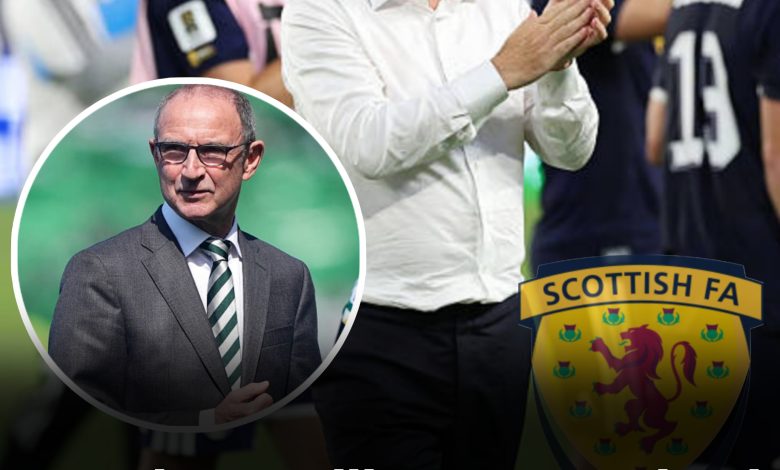
And so to the name that has been whispered in pubs, debated on radio phone-ins, and shouted across Scottish football Twitter since the Brazil defeat: Martin O’Neill.
The 74-year-old Northern Irish legend is currently riding the crest of an extraordinary wave, having just signed a permanent contract as Celtic manager after delivering a stunning domestic double — the Scottish Premiership title AND the Scottish Cup — in circumstances that were, frankly, the stuff of footballing fairy tales.
When Brendan Rodgers shocked Scottish football by resigning in October 2025, O’Neill stepped in as interim. He was so impressive that even when Wilfried Nancy was brought in on a permanent basis, Nancy’s disastrous 33-day tenure — six defeats from eight matches — saw O’Neill recalled AGAIN in January 2026. He then engineered a comeback for the ages: dragging Celtic back from six points behind in the title race to championship glory on the final day, before the Scottish Cup was added for good measure.
Nine major trophies at Celtic. A tactician who builds teams with identity, structure, and PASSION. A man who has never once been accused of setting up to merely survive. If any figure in Scottish football right now exudes the kind of transformative energy that the national team desperately needs, it is O’Neill.
The only problem? He just signed a new deal at Celtic Park. A one-year contract, with an option to extend. He is NOT available for the Scotland job.
Or is he?
The Plot Twist Nobody Is Talking About
Here’s what makes this situation uniquely combustible: O’Neill’s Celtic deal is short. One year, plus an option. By the summer of 2027 — should the SFA act swiftly — O’Neill could theoretically be free, or at minimum, in contract talks. The idea of approaching him, or at least planting the seed, is not as far-fetched as it sounds.
Moreover, O’Neill’s profile has never been higher. At 74 years old, he has defied every expectation, every age-related cynicism, every whisper that his best days were behind him. On the Celtic touchline, he looks, as former player Kenny Miller put it, exactly like he did 25 years ago — sharp, animated, demanding.
Scotland fans know what O’Neill brings. They’ve watched him transform clubs that were struggling — Leicester City, Celtic twice over, the Celtic of 2026. They know the difference between a team that plays with fire and a team that plays with fear. And right now, the national side plays with fear.
Could O’Neill be lured to the Scotland dugout? Could the SFA — with their financial muscle and the emotional pull of leading a nation — make a compelling enough case? The idea is catnip to the Tartan Army, and the rumour mill is already running red hot.
The Verdict: Is Clarke Finished?
Steve Clarke brought Scotland to three major tournaments. That is, genuinely, a remarkable achievement for a nation that had gone 23 years without qualifying for a single one before his appointment in 2019. It would be wrong, historically dishonest even, to dismiss that legacy entirely.
But football is unforgiving. And the pattern that has emerged under Clarke at tournaments — passive setups, early goal concessions, no identifiable attacking philosophy, an inability to adapt — has now repeated itself three times across three tournaments. Nine games. One win. Sixteen goals against.
At some point, the qualification record stops being enough. At some point, fans reasonably ask: what is the POINT of getting there if we’re going to be humiliated every single time?
The post-match walkout. The “we’re going home” resignation. The statistics that would make even the most loyal supporter flinch. All of it points to a relationship between manager and nation that has broken beyond repair.
Whether the SFA acts swiftly or clings to the comfort of Clarke’s contract, one thing is now certain: Scottish football is at a crossroads. And the name the Tartan Army wants leading them down the right path?
Martin O’Neill. Whether it happens or not, the dream is alive — and Steve Clarke’s future has never looked more precarious.
WATCH THIS SPACE. Scottish football is about to get VERY interesting.
Published June 27, 2026 |