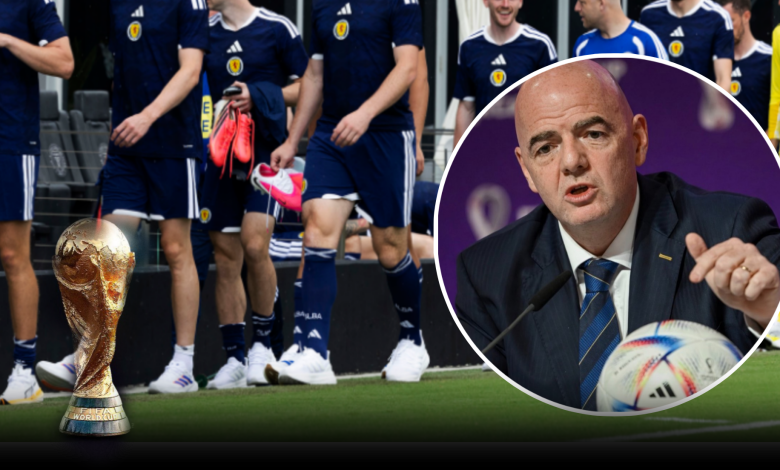
Scottish football supporters are once again at the centre of a fierce World Cup debate after FIFA’s latest decisions regarding the 2026 FIFA World Cup sparked a wave of outrage, arguments, and frustration across social media.
What should have been a moment of celebration for football fans around the world has instead become another talking point dividing opinion from Glasgow to Edinburgh.
The 2026 FIFA World Cup is already set to be unlike any tournament in history. Hosted jointly by the United States, Canada, and Mexico, it will feature a record-breaking 48 teams and 104 matches, making it the biggest World Cup ever staged. FIFA believes the expansion will create more opportunities for nations around the globe, while critics argue that it risks damaging the quality and prestige of football’s greatest competition.
For Scotland, a nation that has spent decades dreaming of consistent World Cup appearances, the expansion should have been good news.
Instead, many supporters believe FIFA’s latest approach has created fresh problems.
THE DECISION THAT STARTED THE FIRESTORM
FIFA’s expansion from 32 teams to 48 teams dramatically changes the landscape of international football.
The tournament will now consist of twelve groups of four teams, with the top two from each group progressing alongside the eight best third-placed teams. A new Round of 32 has also been added, increasing the total number of matches from 64 to 104.
On paper, that sounds exciting.
More nations.
More matches.
More stories.
More football.
But many fans aren’t buying it.
Critics argue that FIFA is prioritising money, television audiences, and commercial growth over the quality of the competition itself. They fear the expanded format will lead to weaker matches, player burnout, and a tournament that drags on for too long.
Across Scotland, the debate has exploded.
Supporters who spent years watching their national team struggle to qualify for major tournaments are now asking a difficult question:
“Does qualifying even mean the same thing anymore?”
“IT’S NOT THE SAME WORLD CUP”
One of the biggest complaints from fans revolves around the feeling that FIFA has diluted the competition.
For decades, reaching the World Cup was viewed as one of the greatest achievements in football.
Now, with sixteen additional nations qualifying, some supporters believe the achievement has been devalued.
Many have pointed out that countries which previously had little realistic chance of qualification are now benefiting from the expanded slots available to every confederation. FIFA, however, insists that the changes allow more countries to experience football’s biggest stage and grow the sport globally.
The debate became even more heated after old comments from FIFA President Gianni Infantino resurfaced.
Infantino once jokingly suggested that expanding the World Cup was partly to help Scotland qualify after years of disappointment. While the comment was made in jest, many fans viewed it as proof that qualification standards had fundamentally changed.
Some laughed.
Others were not amused.
SCOTLAND’S RETURN TO THE BIG STAGE
Adding fuel to the discussion is the fact that Scotland have finally ended their long World Cup absence.
The Tartan Army has waited since 1998 to see Scotland return to football’s biggest tournament, and qualification has reignited excitement throughout the country. Scotland secured their place after a dramatic qualification campaign, giving supporters something they had dreamed about for nearly three decades.
Yet even this achievement has become tangled in the broader argument surrounding FIFA’s expansion.
Supporters celebrating qualification have found themselves defending Scotland’s place in the tournament against critics who argue that expansion has made qualification easier.
The result?
A civil war of opinions among football fans.
Some believe Scotland have earned every right to be there.
Others argue that the new format has fundamentally altered the challenge.
THE MONEY QUESTION NOBODY CAN IGNORE
Another issue causing anger among supporters is cost.
The 2026 World Cup stretches across three countries and sixteen host cities.
For travelling supporters, following their team could become an expensive nightmare.
Reports have highlighted the enormous costs facing fans who hope to attend multiple matches. Flights, accommodation, transportation, and match tickets could easily push expenses into the thousands of pounds.
Scottish supporters are famous for travelling in huge numbers.
The Tartan Army has built a global reputation for loyalty and passion.
But many fear that the financial realities of the 2026 tournament could make it difficult for ordinary fans to follow their national team in the way they traditionally have.
For some supporters, the World Cup is starting to feel like an event designed for corporations and wealthy tourists rather than ordinary football fans.
TICKET PRICES CREATE EVEN MORE OUTRAGE
As if concerns about travel costs weren’t enough, ticket pricing has become another major source of controversy.
FIFA has faced criticism over its pricing models, with concerns raised regarding transparency and affordability. Consumer advocates and legal authorities in parts of the United States have examined complaints related to ticket pricing practices surrounding the tournament.
Fans argue that football’s greatest event should be accessible to everyone.
Instead, many fear that attending matches is becoming increasingly difficult for ordinary supporters.
Across social media, frustration continues to grow.
And Scotland’s fanbase is among the loudest voices in the debate.
BIGGER DOESN’T ALWAYS MEAN BETTER
Supporters of FIFA’s plans argue that the expanded tournament will create unforgettable stories.
Nations that have never previously reached the World Cup will finally get their chance.
New rivalries will emerge.
New heroes will be created.
And football’s global reach will continue to grow.
But critics remain unconvinced.
They argue that adding more teams risks creating mismatches and less competitive games.
Some football analysts have also warned that a larger tournament could increase player fatigue, especially given the already packed football calendar.
For Scottish supporters, this debate hits particularly close to home.
Many spent years longing for qualification.
Now that Scotland are finally back, the discussion has shifted from celebrating qualification to questioning what qualification actually means in the new era.
THE TARTAN ARMY’S VERDICT
One thing is certain.
Scottish football fans are not staying quiet.
Whether they support FIFA’s vision or oppose it entirely, emotions are running high.
The expanded 2026 World Cup has already become one of the most controversial tournaments before a ball has even been kicked.
Some supporters see opportunity.
Others see greed.
Some see progress.
Others see dilution.
What nobody can deny is that FIFA’s decisions have ignited one of the fiercest debates in recent Scottish football history.
And with the 2026 World Cup approaching, the arguments are only going to get louder.
The tournament was supposed to unite football.
Instead, it has Scotland talking about everything except the football itself.
As the countdown continues, one question remains:
Has FIFA created the greatest World Cup ever…
Or have they gone too far?