Celtic may have opened their Scottish Premiership title defence with a valuable 1-0 victory over Dundee, but if anyone expected Martin O’Neill to be completely satisfied after the final whistle, they were mistaken.
The experienced Celtic manager struck a calm but honest tone in his post-match interview, admitting that while the result was exactly what the club needed, the overall performance still fell below the standards he expects from a team aiming to dominate both domestically and in Europe. His assessment was balanced rather than emotional: the three points were secured, but there is significant room for improvement before the challenges ahead become even tougher.
With a crucial UEFA Champions League play-off against Austrian champions LASK approaching, O’Neill knows Celtic cannot rely solely on narrow victories. His post-match comments reflected a manager already looking beyond Dundee and preparing his squad for far greater tests in the weeks ahead.
Three Points Were the Priority
Opening matches often bring nerves, regardless of the quality of the opposition.
Despite entering the game as overwhelming favourites, Celtic found Dundee to be extremely difficult opponents.
Steven Pressley’s side defended with discipline, remained organised throughout the contest and frustrated Celtic’s attacking players for long periods.
Although Celtic enjoyed the majority of possession, they struggled to convert that dominance into clear-cut chances.
The breakthrough finally arrived early in the second half when Benjamin Nygren met Kieran Tierney’s excellent cross with a composed header that proved to be the winning goal.
From that moment onwards, Celtic controlled much of the game but were unable to find the second goal that would have made the closing stages more comfortable.
Instead, Dundee continued to threaten, forcing goalkeeper Viljami Sinisalo into an excellent late save to preserve the clean sheet.
For O’Neill, the victory mattered enormously.
But the performance also highlighted several areas requiring immediate attention.
O’Neill’s Honest Admission
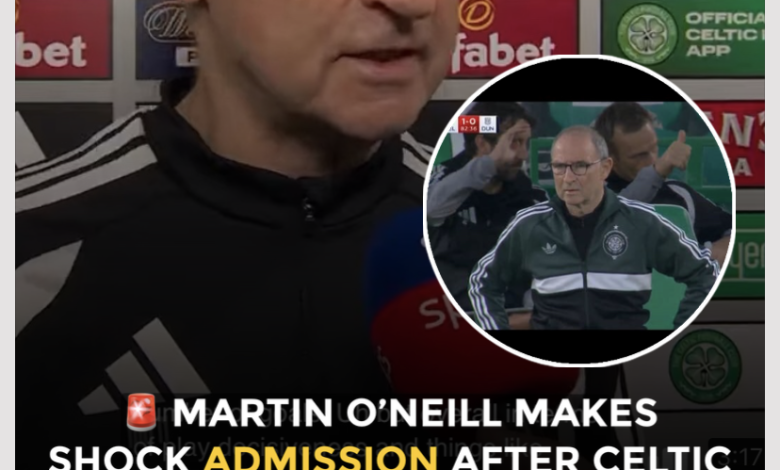
Following the match, Martin O’Neill made it clear that he was pleased with the result but not entirely satisfied with how his team performed.
Rather than celebrating the victory as a complete success, he acknowledged that Celtic lacked their usual rhythm in possession and were not clinical enough in front of goal.
The manager also defended new striker Kasper Høgh, whose competitive debut was challenging. O’Neill stressed that the forward is adapting to a new league and remains confident he will improve as he settles into the team.
That measured assessment summed up O’Neill’s managerial philosophy.
He understands that winning while playing below your best can often be a sign of championship quality.
However, he also knows that similar performances against stronger opponents could prove costly.
The Positives Celtic Can Build On
Despite the criticism of certain aspects of the display, there were plenty of encouraging signs.
Benjamin Nygren once again demonstrated his importance by scoring the decisive goal.
Kieran Tierney looked influential down the left flank, constantly providing dangerous deliveries into the box.
Callum McGregor controlled large periods of midfield possession.
Defensively, Cameron Carter-Vickers and his teammates remained solid whenever Dundee threatened.
Perhaps most importantly, Celtic recorded another clean sheet.
Those are foundations every successful team depends upon.
Areas That Need Improvement
Martin O’Neill’s post-match interview also hinted at the improvements he expects before Celtic face more demanding opposition.
Greater attacking sharpness
Celtic created opportunities but lacked the ruthlessness supporters have become accustomed to seeing.
Several promising attacks broke down because of poor decision-making in the final third.
Against Champions League opposition, those chances may be even harder to create.
Faster movement
There were periods when Celtic moved the ball too slowly, allowing Dundee time to regain their defensive shape.
O’Neill will almost certainly demand quicker passing and more movement between the lines.
Better finishing
Kasper Høgh missed opportunities on his debut, while other attackers also failed to convert promising situations.
O’Neill backed Høgh publicly, but the manager will expect the entire attacking unit to become more clinical in the coming weeks.
Squad depth
The Dundee match also highlighted why strengthening the squad remains an important objective.
Several key players continue attracting transfer interest, while injuries and fixture congestion could quickly test Celtic’s depth.
O’Neill has already urged the club to avoid selling important players before the Champions League play-off unless suitable replacements are already secured.
A Bigger Challenge Is Already Approaching
Although defeating Dundee represented the perfect way to begin the league season, everyone at Celtic knows the next few weeks will define much more than an opening weekend.
The Champions League qualifying play-off against LASK carries enormous financial and sporting importance.
Qualification would provide significant revenue, strengthen Celtic’s reputation and allow the club to compete among Europe’s elite once again.
O’Neill understands that the performance against Dundee, while enough to earn three points domestically, will not necessarily be enough in Europe.
That explains why his post-match interview focused less on celebration and more on improvement.
Transfer Window Could Shape Celtic’s Season
Another issue addressed around the club is the uncertainty surrounding several key players.
Alistair Johnston continues to attract Premier League interest, while Arne Engels has also been linked with a move away.
Martin O’Neill has publicly appealed for patience, arguing that Celtic should keep their strongest players until after the crucial European qualifiers if possible.
Keeping the core of the squad together could prove just as important as signing new players.
Continuity often becomes a decisive factor during major European ties.
Why O’Neill Isn’t Pressing the Panic Button
Some supporters left Celtic Park wanting a more convincing performance.
Others expressed concern over missed chances and the lack of attacking fluency.
Martin O’Neill, however, appears to be taking a more measured approach.
He recognises that opening-day fixtures are rarely perfect.
Fitness levels continue improving.
New signings require time to adapt.
Partnerships develop gradually over the opening weeks of the season.
Rather than criticising individual players publicly, O’Neill chose to encourage them while reinforcing the standards expected at Celtic.
That leadership style has been one of the defining features of his managerial career.
What Fans Should Expect Next
Based on O’Neill’s post-match comments and the performance against Dundee, supporters can expect several developments over the coming weeks:
- A more aggressive attacking approach as players build match fitness.
- Greater involvement from Kasper Høgh as he adapts to Scottish football.
- Continued emphasis on defensive organisation.
- Possible transfer activity before the window closes to strengthen the squad.
- Tactical adjustments ahead of the Champions League play-off against LASK.
If Celtic respond positively to O’Neill’s demands, the Dundee match could be remembered as an important stepping stone rather than a warning sign.
Final Thoughts
Martin O’Neill’s post-match interview after the 1-0 victory over Dundee revealed the mindset of a manager who refuses to be distracted by the league table after just one game. While many coaches would simply celebrate an opening-day win, O’Neill acknowledged that Celtic’s performance lacked the fluency, creativity and cutting edge expected of a team with ambitions of retaining the Scottish Premiership title and making an impact in Europe.
There were encouraging signs—Benjamin Nygren continued his impressive goalscoring form, the defence kept a clean sheet and the team showed patience against stubborn opposition. However, O’Neill’s biggest message was that improvement is non-negotiable. With a Champions League play-off against LASK on the horizon and transfer speculation surrounding key players, Celtic are entering one of the most important periods of their season.
If the Hoops can combine the resilience they showed against Dundee with sharper attacking football in the weeks ahead, Martin O’Neill will believe his side has every chance of competing successfully on both the domestic and European stages. The result against Dundee was a positive beginning—but according to the Celtic manager himself, it is only the start of a much bigger journey.