EFL Faces Questions After Controversial Penalty Decision in West Ham vs QPR Sparks Sack Calls
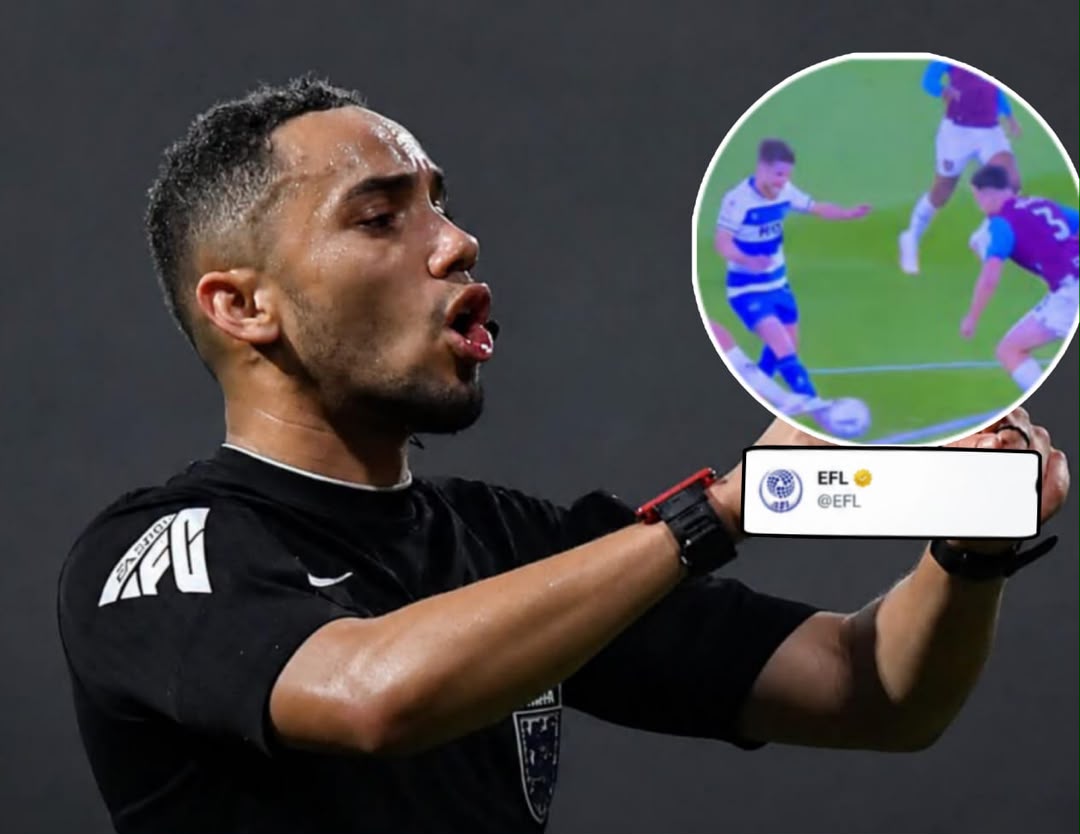
West Ham United’s 1-1 draw with Queens Park Rangers was overshadowed by a controversial penalty decision that left the Hammers frustrated and sparked calls from some supporters for the referee to face consequences.
The incident occurred during the first half at the London Stadium, when Tomas Soucek challenged QPR’s Paul Smyth inside the penalty area.
Referee Ruebyn Ricardo awarded a penalty, judging that Soucek had committed a foul. West Ham players immediately appeared unhappy with the decision, with Soucek later claiming that he had won the ball cleanly.
Nicolas Madsen converted the resulting spot-kick to give QPR the lead.
West Ham eventually equalised through Jarrod Bowen, but a late penalty miss ensured that the Hammers had to settle for a point.
The match has since reignited questions about refereeing standards, the absence of VAR in the Championship and whether officials should face greater scrutiny after controversial decisions.
However, claims that the EFL has formally confirmed the decision was correct require independent verification. The fact that a referee’s decision stands does not automatically mean the league has endorsed it as correct.
The Tackle That Sparked Controversy
The key incident came in the 18th minute.
Soucek slid in to challenge Smyth, with the West Ham midfielder appearing to make contact with the ball during the tackle.
Ricardo judged the challenge to be a foul and pointed to the penalty spot.
The decision immediately became a major talking point.
West Ham’s players believed Soucek had won the ball fairly, while the circumstances of the challenge prompted questions about whether the contact occurred inside the penalty area.
If a foul takes place outside the box, the correct decision would ordinarily be a free-kick rather than a penalty. If the referee judges that a foul occurred inside the area, a spot-kick can be awarded.
The distinction is crucial, particularly when the decision leads directly to a goal.
With no VAR available to review the incident, the referee’s on-field decision stood.
Madsen stepped up and converted, giving QPR an early advantage.
What Did the EFL Actually Say?
The supplied report claims that the EFL confirmed the decision was final and that no retrospective action would be taken.
That distinction matters.
There is a difference between confirming that a match result stands under the competition’s rules and formally declaring that a particular penalty decision was correct.
Without a verifiable official statement addressing the specific Soucek challenge, it would be premature to claim that the EFL has endorsed Ricardo’s decision.
What the incident does highlight is the limited scope for correcting a potentially significant error during a match without video review.
Once the penalty was awarded and converted, West Ham had to continue playing with the decision against them.
The Hammers could express their frustration, but they could not use VAR to ask for the incident to be reviewed.
Soucek Gives His Account
Soucek was reportedly unhappy with the decision and described the challenge as one in which he believed he had won the ball.
According to the supplied report, the West Ham midfielder said:
“I was so happy that I won the challenge and I got the ball.”
He also reportedly explained his immediate reaction to the referee’s decision.
“Straight away I didn’t know what the referee was doing. It was a massive, massive mistake.”
The report further claims that Soucek attempted to speak to Ricardo during the match but was unable to do so.
Soucek reportedly added:
“I asked to speak to him but he wouldn’t speak. After the game, he told me he was wrong.”
If accurately reported, that final claim would add another dimension to the controversy.
However, the alleged post-match admission should not be treated as independently confirmed without a verifiable recording or published interview.
If an official did acknowledge an error, it would understandably raise questions about how such incidents are reviewed and what lessons are taken from them.
West Ham Supporters Demand Accountability
West Ham supporters were quick to express their frustration following the penalty decision.
Some fans argued that Soucek had made a legitimate challenge and questioned how the referee could have awarded a penalty.
Others used the incident to renew calls for VAR to be introduced in the Championship.
One supporter reportedly demanded that the referee be dismissed, while another described the decision as one of the worst they had seen.
A further reaction focused on the financial and competitive consequences of an incorrect penalty.
For a club chasing promotion, every point can matter.
A penalty awarded against a team can change the course of a match, particularly when it arrives early and gives the opposition a lead.
Nevertheless, calls for an official to lose their job are opinions expressed in the heat of the moment. A controversial decision alone does not establish that dismissal is warranted.
The more constructive question is whether the decision can be properly reviewed and whether any improvements are needed.
Bowen Brings West Ham Back Into the Game
West Ham did not allow the penalty controversy to define the entire match.
The Hammers continued searching for an equaliser and eventually found one through captain Jarrod Bowen in the 70th minute.
According to the supplied match account, Bowen’s first effort was blocked before he reacted quickly to score from the follow-up.
The goal brought West Ham level and gave the home supporters renewed hope.
After conceding an early penalty, the Hammers had worked their way back into the contest.
The equaliser also demonstrated why the result remained open until the closing stages.
West Ham had an opportunity to take control of the match, but the final moments brought further drama.
Late Penalty Adds to the Frustration
West Ham were awarded a penalty of their own during stoppage time after Amadou Mbengue reportedly tugged Pablo’s shirt inside the area.
Bowen took responsibility for the spot-kick, offering the Hammers an opportunity to complete the comeback.
However, QPR goalkeeper Pierce Charles saved the penalty.
Charles then produced another save to deny Arne Engels, preserving the draw.
For West Ham, the sequence was particularly frustrating.
They had already been angered by the first-half penalty awarded against them. When the opportunity arrived to win the game late on, they could not take it.
Bowen’s miss meant the Hammers had to settle for a point.
Although the late penalty did not erase the earlier controversy, it ensured that West Ham’s result could not be attributed to that decision alone.
The VAR Debate Returns
The match has renewed the debate about whether the Championship should introduce a form of video review.
The supplied report claims clubs voted against introducing a Football Video Support system for the 2026/27 season.
Supporters of video review argue that it could help officials correct major mistakes involving penalties, red cards and goals.
The Soucek incident illustrates why that argument appeals to frustrated fans.
If a challenge is incorrectly judged to be a foul inside the penalty area, video review may offer an opportunity to reassess the decision.
However, introducing a review system also involves practical considerations.
Clubs must consider the cost of the technology, the time required for reviews, the effect on the flow of matches and the resources available at different grounds.
Football Video Support is also not necessarily identical to the full VAR system used in the Premier League and other competitions. The exact procedure depends on the competition’s regulations.
That means the discussion is not simply about whether video technology is desirable. It is also about which system would be practical and proportionate for the Championship.
Would VAR Have Changed the Outcome?
It is impossible to know with certainty what would have happened if video review had been available.
A review might have led to a different interpretation of Soucek’s challenge, depending on the available footage and the relevant rules.
If the penalty had been overturned, QPR would not have had the same opportunity to take the lead from the spot.
But football matches are influenced by many events.
West Ham might still have conceded later, while QPR could have created another scoring opportunity.
Likewise, the Hammers’ late penalty might have produced a different outcome if Bowen had converted.
The strongest argument for video review is therefore not that it guarantees a particular team will win. It is that it may help officials make more accurate decisions in important moments.
The Referee’s Position
The calls for Ricardo to be sacked reflect the anger surrounding the incident, but there is an important distinction between criticism of a decision and a judgement about an official’s overall performance.
Referees must make rapid decisions in difficult situations, often without the benefit of multiple camera angles.
That does not mean their decisions should be beyond criticism.
Significant errors should be open to appropriate assessment, and competitions should be transparent about the procedures used to review them.
However, any claim that Ricardo faces formal disciplinary action or dismissal would require reliable confirmation.
There is no basis in the supplied material alone to conclude that he has been sacked or that the EFL intends to dismiss him.
What the Draw Means for West Ham and QPR
According to the supplied report, West Ham moved to 16 points, leaving them second in the Championship behind Swansea City on 17.
QPR reportedly climbed to fifth on 14 points.
Those figures underline the importance of the result, particularly for West Ham as they pursue promotion.
The Hammers will be disappointed that they could not secure all three points at home.
However, the late penalty miss also means they had a clear opportunity to win the game after Bowen’s equaliser.
QPR, meanwhile, will take encouragement from earning a point away from home and from Charles’s late saves.
The visitors may also feel that they benefited from a decisive first-half moment, although the precise merits of the penalty remain disputed in the supplied account.
The Bigger Question for the Championship
The controversy highlights a problem that extends beyond one match.
When an important decision is made without video review, the discussion can continue long after the final whistle.
Supporters may feel that their team has been denied points, while players and managers are left to respond to an incident they cannot change.
If the referee subsequently acknowledges an error, that can intensify questions about accountability.
But the solution requires more than angry reactions on social media.
The EFL and its clubs would need to consider whether existing officiating procedures are sufficient, whether additional support for referees is necessary and whether a video-review system could be introduced without creating disproportionate costs or delays.
Any decision would need to balance accuracy, consistency, affordability and the experience of supporters attending matches.
Conclusion: West Ham Want Answers After QPR Draw
West Ham’s 1-1 draw with QPR produced drama at both ends of the match, but Soucek’s first-half challenge remains the central talking point.
Ricardo awarded a penalty, Madsen converted, and West Ham were left to chase the game.
Bowen’s equaliser restored parity before his stoppage-time penalty was saved, leaving the Hammers with a single point.
The reported comments attributed to Soucek have added to the controversy, particularly the claim that the referee later acknowledged an error. That allegation requires independent confirmation before it can be presented as an established fact.
Likewise, a claim that the EFL formally declared the penalty correct should not be confused with confirmation that the result stands under the rules.
What is clear from the supplied account is that the incident has reignited the debate about refereeing standards and the absence of VAR in the Championship.
West Ham supporters want greater accountability, while the wider competition faces an ongoing question about whether additional technology could help officials make better decisions.
For now, the result stands as a 1-1 draw.
The controversy, however, is likely to remain a talking point among West Ham supporters and Championship followers as the discussion over video review continues.