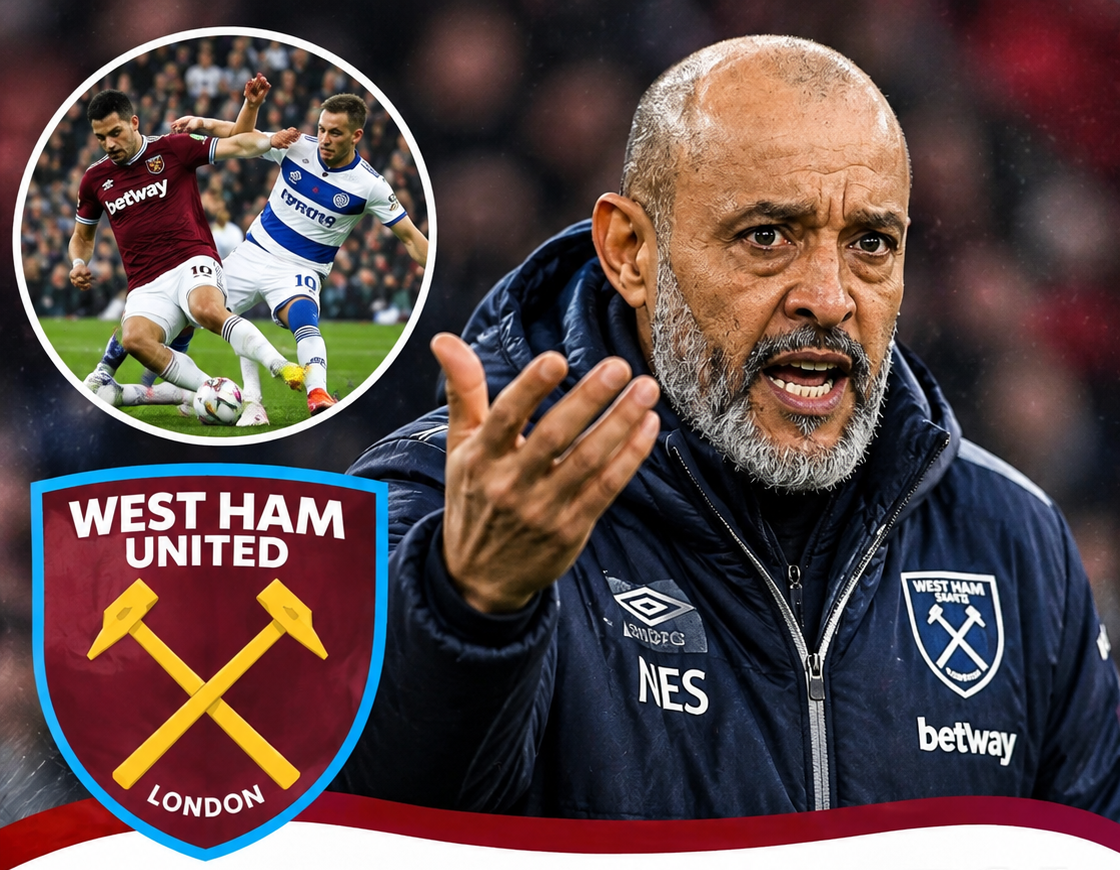
West Ham United’s frustrating encounter with Queens Park Rangers has erupted into a major talking point after a controversial penalty decision left supporters questioning the officials and manager Nuno Espírito Santo demanding answers. What should have been an opportunity for the Hammers to take control of their match instead became an afternoon filled with frustration, missed opportunities and arguments over one of the most important decisions on the pitch.
The final scoreline told only part of the story. Beneath the 1–1 draw was a match that delivered drama, tension and a painful reminder of how quickly football can turn against a team. West Ham fought their way back into the contest, but the circumstances surrounding QPR’s opening goal ensured that the result would be discussed long after the final whistle.
For Nuno, the situation was particularly frustrating. His team needed a strong performance, valuable points and a result that could build momentum. Instead, the Portuguese manager found himself facing difficult questions about the penalty decision, his team’s inability to secure victory and what must change in the matches ahead.
And with replays prompting further discussion among supporters, the controversy has become impossible to ignore.
THE PENALTY DECISION THAT CHANGED EVERYTHING
Football matches are often decided by small moments. A mistimed tackle, a defensive mistake or a split-second decision can completely change the direction of a contest.
For West Ham, the penalty awarded to QPR became precisely that kind of moment.
The incident involved Tomáš Souček and QPR’s Paul Smyth. The referee decided that the challenge warranted a penalty, giving QPR an opportunity to take the lead from the spot.
Nicolas Madsen stepped forward and converted the resulting kick, putting the visitors ahead and forcing West Ham to chase the game.
However, the decision immediately became a talking point.
Questions were raised about where the contact occurred and whether the challenge should have resulted in a penalty. Some replays appeared to suggest that the contact happened outside the penalty area, intensifying the debate about whether the officials had made the correct call.
For West Ham supporters, the location of the incident was crucial.
A free kick outside the box and a penalty inside it are two entirely different situations. One offers a chance to threaten the goalkeeper from a set-piece position; the other provides a direct opportunity to score from twelve yards.
That distinction can determine the outcome of an entire match.
West Ham were left with the feeling that a major decision had gone against them, while QPR took full advantage of the opportunity presented to them.
The question now is whether the controversy will remain a talking point or become a moment that defines West Ham’s frustrating afternoon.
NUNO ESPÍRITO SANTO FACES AN UNCOMFORTABLE AFTERNOON
Nuno Espírito Santo understands the pressure that comes with managing a club with West Ham’s ambitions.
Supporters expect performances that reflect the team’s quality, determination and desire to compete. When results fail to meet those expectations, the manager inevitably finds himself under scrutiny.
But controversial refereeing decisions introduce another layer of frustration.
Managers spend hours preparing their teams, studying opponents and identifying ways to win matches. They work on defensive organisation, attacking patterns and the positioning required to gain an advantage.
Yet a single contentious decision can undermine that preparation.
For Nuno, the penalty incident was an unwelcome distraction from the football he wanted his team to play.
The manager’s frustration reflected the wider concerns surrounding the decision, particularly the questions about the position of the challenge.
However, West Ham cannot afford to allow the controversy to become an excuse for everything that went wrong.
Even when a decision appears questionable, successful teams must find ways to recover, create opportunities and take control of the game.
That is the challenge facing Nuno now.
He must ensure that the players remain focused, that frustration does not become a distraction and that the squad understands the importance of responding positively.
West Ham need answers, but those answers must also come on the pitch.
REPLAYS SPARK QUESTIONS: WAS IT REALLY A PENALTY?
The controversy surrounding the decision has centred on one crucial question: did the incident happen inside the penalty area?
That is the detail supporters have focused on while examining the available replays.
When a referee awards a penalty, the decision carries enormous consequences. The attacking team receives one of football’s clearest scoring opportunities, while the defending side must immediately deal with the psychological impact of conceding.
If the decision is correct, the defending team has to accept it and move forward.
If the decision is wrong, the sense of injustice can linger throughout the match.
That is why the precise location of the contact matters so much.
A challenge that begins outside the penalty area does not automatically mean a penalty is incorrect; the key consideration is where the relevant offence occurred. However, if the offence itself takes place outside the box, the correct restart would ordinarily be a free kick rather than a penalty.
This is the distinction at the heart of the debate.
Supporters want clarity. They want to understand why the decision was made and whether the officials had the necessary information to reach the correct conclusion.
For West Ham, the incident was particularly damaging because it allowed QPR to take the lead in a match that ultimately finished level.
Nevertheless, the existence of a debate does not, by itself, prove that the referee was wrong. A definitive assessment would require a clear examination of the footage and the precise circumstances of the challenge.
Until those details are established, the controversy should be treated as a question requiring scrutiny rather than proof of an officiating error.
WEST HAM REFUSE TO DISAPPEAR AS BOWEN RESPONDS
Despite the frustration of falling behind, West Ham eventually found a way back into the contest.
Jarrod Bowen stepped forward when his team needed a response, scoring the equaliser in the 70th minute and giving the home supporters renewed hope.
The goal was a reminder of Bowen’s importance to the Hammers.
He is a player capable of changing a match through his movement, determination and ability to deliver in important moments. When West Ham need an attacking spark, his contribution can be decisive.
His equaliser also ensured that the penalty controversy did not become the only defining moment of the match.
West Ham had shown the determination to recover from a difficult situation.
However, the comeback was not enough to deliver the result they wanted.
The Hammers had an opportunity to turn the draw into a victory when Bowen was awarded a late penalty of his own. With the match approaching its conclusion, he stepped up hoping to complete the turnaround.
But QPR goalkeeper Pierce Charles saved his effort.
Suddenly, the opportunity to secure all three points had disappeared.
For Bowen, it was a painful ending to an afternoon in which he had already played a major role in West Ham’s recovery.
For Nuno, it was another frustrating moment in a match that offered his team opportunities to win but ultimately ended without the desired result.
The contrast was brutal.
West Ham had recovered from going behind, yet they could not find the decisive finish when victory was within reach.
THE LATE PENALTY MISS MAKES THE FRUSTRATION EVEN WORSE
If the first penalty created controversy, the second created heartbreak for West Ham.
Bowen’s late miss meant the Hammers were unable to complete their comeback, leaving them to settle for a 1–1 draw.
It was the kind of moment that can dominate post-match discussions because the opportunity was so clear.
A successful penalty would have given West Ham the chance to secure a dramatic victory. Instead, Charles produced the save that kept QPR in the game and denied the hosts the winning goal.
For supporters, the emotions were complicated.
There was frustration over the earlier penalty decision, disappointment at the failure to capitalise on the equaliser and disbelief that a late opportunity had gone begging.
Yet it would be unfair to place the entire responsibility for the result on Bowen.
Penalty kicks are moments of immense pressure. Even experienced players can miss them, particularly when the outcome carries significant consequences.
Bowen had already scored West Ham’s equaliser, and that contribution mattered.
The wider lesson is that West Ham must become more ruthless when opportunities present themselves.
Teams with serious ambitions cannot afford to depend on a single moment of fortune or allow promising situations to pass without taking advantage.
The Hammers had the chance to win. They could not finish the job.
WHAT DOES THE RESULT MEAN FOR NUNO’S PLANS?
The draw leaves Nuno with several issues to consider as he prepares his team for the next challenge.
The first concerns defensive discipline.
Regardless of the debate surrounding the penalty, West Ham must continue to work on avoiding situations that allow opponents to create dangerous incidents inside or around the penalty area.
Defenders and midfielders need to make calculated decisions, particularly when challenging opponents in crowded areas.
The second issue concerns attacking efficiency.
Bowen’s equaliser demonstrated that West Ham possess players capable of delivering important moments, but the late penalty miss highlighted how quickly a match can slip away when a decisive opportunity is wasted.
Nuno must find ways to ensure his team makes the most of its attacking situations.
The third issue is mental resilience.
Controversial decisions can frustrate players, but allowing that frustration to affect concentration can create additional problems.
West Ham must learn to separate what they cannot control from what they can.
They cannot change a referee’s decision after the match has ended. They can, however, improve their reactions, sharpen their performances and ensure that one frustrating result does not become the beginning of a damaging run.
That response will matter far more than the noise surrounding a single afternoon.
WEST HAM FANS WILL WANT ANSWERS
For supporters, the biggest concern is not simply that West Ham dropped points.
It is the manner in which the result unfolded.
They watched their team fall behind following a disputed penalty decision, fight back through Bowen and then miss a late opportunity to claim victory.
It was a rollercoaster of emotions, and the final result offered little satisfaction.
The refereeing debate will continue to attract attention because supporters naturally want decisions to be consistent and transparent.
However, there will also be questions about the team’s performance.
Could West Ham have created more clear-cut chances? Did they do enough to control the match? Why were they unable to convert their late opportunity into a winning goal?
These are the questions Nuno and his players must confront.
The penalty incident may explain some of the frustration, but it cannot answer every question raised by the draw.
West Ham need to demonstrate that they can overcome difficult circumstances without allowing individual moments to determine their entire performance.
That is the standard expected of a club seeking to achieve its objectives.
THE VERDICT: CONTROVERSY, FRUSTRATION AND A RESPONSE WEST HAM MUST DELIVER
West Ham’s 1–1 draw with QPR delivered everything supporters could have wanted from a dramatic football encounter, except the winning result.
The penalty awarded to QPR placed the officials under scrutiny. Bowen’s equaliser gave the Hammers hope, while his late penalty miss ensured that the afternoon ended in frustration.
For Nuno, the challenge is now to turn that frustration into motivation.
He must keep his players focused, improve the team’s efficiency in decisive moments and ensure that the next performance reflects a side determined to respond.
The controversy surrounding the penalty deserves proper examination, but West Ham’s future cannot depend on the outcome of a refereeing debate.
Their response on the pitch will ultimately determine whether this draw becomes a minor setback or the beginning of a more worrying pattern.
One thing is certain: the Hammers cannot afford to keep letting valuable opportunities slip away.
The next match will provide an opportunity to show whether they have learned the necessary lessons.
Will West Ham bounce back, or will this frustrating draw create even more pressure on Nuno Espírito Santo?
The debate is open, and West Ham supporters will be watching closely.