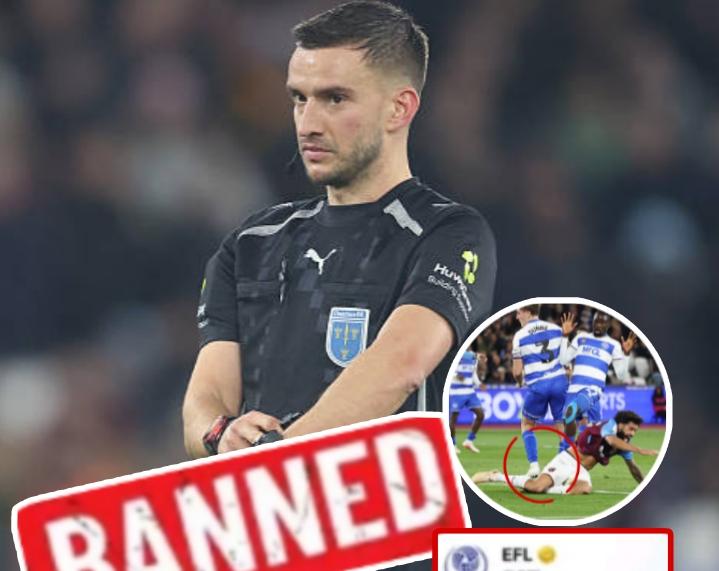
West Ham United’s controversial draw against Queens Park Rangers has reignited the debate over refereeing standards, with supporters demanding answers after a penalty decision that left the Hammers furious.
But the biggest question now is what happens if a referee is found guilty of deliberately manipulating a football match.
Could the official be suspended? Could he lose his position? And could the consequences extend beyond the Premier League?
These are the questions supporters want answered as the controversy surrounding West Ham’s 1–1 draw with QPR continues to generate discussion.
THE DECISION THAT LEFT WEST HAM FURIOUS
West Ham’s encounter with QPR at the London Stadium on Friday, 9 October, produced a controversial first-half moment that overshadowed much of the discussion after the final whistle.
With the game still goalless, Tomáš Souček challenged Paul Smyth during a QPR attack. Referee Ruebyn Ricardo awarded the visitors a penalty, judging Souček to have committed a foul inside the penalty area.
Nicolas Madsen converted the spot-kick to put QPR ahead.
However, television replays appeared to show Souček making contact with the ball and the challenge taking place outside the penalty area. The decision consequently attracted criticism from West Ham supporters and football commentators.
The absence of VAR in the Championship meant the decision stood.
West Ham fought back in the second half, with Jarrod Bowen equalising in the 70th minute. The Hammers subsequently had an opportunity to win the match from the penalty spot, but Bowen’s stoppage-time effort was saved by QPR goalkeeper Pierce Charles.
The match ended 1–1.
For West Ham, the result was frustrating enough. The circumstances surrounding QPR’s opening goal made the controversy even more difficult for supporters to forget.
SOUCEK’S CLAIM ADDS ANOTHER DIMENSION
The controversy continued after the match when Souček discussed his conversation with the referee.
According to a report published on 10 October, the West Ham midfielder said Ricardo acknowledged that he had made a mistake when they spoke after the game.
Souček also expressed frustration that he had been unable to obtain an explanation during the match.
The reported admission has added to the discussion surrounding the decision, particularly among supporters who believe the incident should receive further scrutiny.
However, an incorrect decision, even one that a referee later acknowledges, is not proof of deliberate manipulation.
There is a significant difference between making an error while applying the Laws of the Game and intentionally influencing a match for an improper purpose.
That distinction would be crucial in any investigation.
WHAT WOULD HAPPEN IF DELIBERATE MATCH MANIPULATION WERE PROVEN?
The most serious question concerns the consequences if credible evidence established that a referee had deliberately manipulated a match.
Football authorities treat match manipulation as a serious integrity issue because it undermines confidence in the competition, the officials and the results.
In the Premier League, match officials operate within a professional refereeing structure, while disciplinary matters can involve the Football Association and other relevant football authorities.
The Premier League’s published guidance explains that the Key Match Incidents Panel reviews major decisions, including penalties, red cards, goals and VAR interventions.
However, the panel’s role is to assess decisions and officiating standards. It is not, by itself, a criminal court or a body that automatically determines whether a referee has committed corruption.
If evidence of deliberate manipulation emerged, the matter would require the appropriate investigation and disciplinary process.
Here are the potential consequences that could follow, depending on the evidence and the rules applied.
1. 🚫 REMOVAL FROM PREMIER LEAGUE REFEREEING
One possible consequence would be removal from the list of officials eligible to referee Premier League matches.
A professional referee’s appointments depend on their standing within the refereeing system, performance assessments and the applicable appointment rules.
Serious misconduct could jeopardise that position.
If an official were found to have deliberately manipulated a match, the consequences could extend well beyond missing a few fixtures.
However, it would be inaccurate to claim that the Premier League has already ordered such a punishment in connection with the West Ham incident.
2. ⛔ A LENGTHY SUSPENSION OR A POSSIBLE LIFETIME BAN
A proven case of deliberate match manipulation could expose a referee to a lengthy suspension under the relevant disciplinary rules.
Depending on the applicable regulations and the seriousness of the offence, a ban from football-related activities could also be imposed.
FIFA’s Disciplinary Code contains specific sanctions for match manipulation, including a minimum five-year ban from football-related activities and a minimum fine of CHF 100,000 under Article 20. More severe penalties may be possible in serious cases.
Those FIFA provisions should not be confused with an automatic Premier League punishment. The precise sanction would depend on which rules applied, the referee’s conduct and the outcome of the proceedings.
For supporters, however, the central point is clear: proven manipulation can carry consequences far more serious than a poor performance or an incorrect penalty decision.
3. 💰 HEAVY FINANCIAL PENALTIES
Financial sanctions are another possible consequence under the relevant disciplinary regulations.
FIFA’s rules provide for a minimum fine of CHF 100,000 for match manipulation.
The actual penalty in a particular case would depend on the applicable rules and the circumstances established by the disciplinary body.
Any financial sanction would follow the relevant proceedings. It would not automatically arise because supporters, players or managers disagree with a referee’s decision.
4. ⚖️ A FORMAL INVESTIGATION INTO THE OFFICIAL’S CONDUCT
If credible evidence suggested that a referee had deliberately influenced a result, the authorities could investigate the circumstances.
Such an investigation would need to distinguish between an honest mistake, serious incompetence, a breach of professional obligations and deliberate wrongdoing.
Relevant evidence would have to be assessed through the appropriate procedures.
A controversial penalty, a missed foul or an incorrect offside decision would not, on its own, establish that a referee had manipulated a match.
That is why any allegations of corruption must be handled carefully.
5. 🚨 POSSIBLE CRIMINAL PROCEEDINGS
In the most serious circumstances, match manipulation involving bribery, fraud or illegal betting could also attract the attention of law-enforcement authorities.
Football disciplinary proceedings and criminal investigations are separate processes, although they can concern the same underlying conduct.
Any criminal charge or conviction would depend on the relevant law, the evidence and the decisions of the competent authorities.
It would therefore be premature to suggest that criminal proceedings are expected in relation to the West Ham–QPR incident.
THE PREMIER LEAGUE’S REVIEW PROCESS
The Premier League already has a mechanism for assessing important refereeing decisions.
Its Key Match Incidents Panel reviews major incidents and assesses whether the decisions made by referees and VAR officials were correct.
The panel’s assessments can help identify errors and provide feedback on officiating standards.
However, the panel’s finding that a decision was incorrect does not establish that the referee deliberately manipulated the match.
A separate process would be needed to investigate credible evidence of misconduct or corruption.
This distinction matters because football supporters deserve transparency without allegations being presented as established facts.
WEST HAM SUPPORTERS WANT ANSWERS
For West Ham supporters, the controversy raises a familiar question: how can clubs and fans maintain confidence in refereeing when a major decision appears to have been wrong?
The Souček incident was particularly frustrating because QPR converted the penalty and West Ham subsequently had to fight their way back into the match.
Although Bowen’s equaliser rescued a point, the Hammers missed the opportunity to claim all three after his late penalty was saved.
The result left supporters discussing the first-half decision and whether additional measures could improve the consistency of officiating.
There is also a broader question about accountability.
Should referees face more transparent assessments after major errors? Should supporters receive clearer explanations of contentious decisions? And how should football authorities respond when a mistake has a substantial impact on a match?
Those are legitimate questions, even when there is no evidence of deliberate wrongdoing.
THE FINAL VERDICT: WHAT COULD THE REFEREE FACE?
If a referee were ultimately found guilty of deliberate match manipulation, the consequences could be severe.
Depending on the applicable regulations, they could include removal from refereeing duties, a lengthy suspension, substantial financial penalties or a lifetime ban from football-related activities.
If the conduct also amounted to a criminal offence, further legal consequences could follow.
But there is an important distinction between explaining those possible sanctions and claiming that the Premier League has announced them for a particular referee.
No confirmed finding of deliberate match manipulation has been established in the West Ham–QPR incident.
The controversy surrounding Ricardo’s penalty decision is a matter of officiating judgment. Any allegation of intentional manipulation would require separate evidence and a proper investigation.
For now, the debate surrounding West Ham’s frustrating draw continues to highlight the importance of consistent decisions, transparent reviews and accountability across professional football.
And for supporters, the question remains: when a major refereeing decision changes the course of a match, what more can football authorities do to ensure that confidence in the game is maintained?