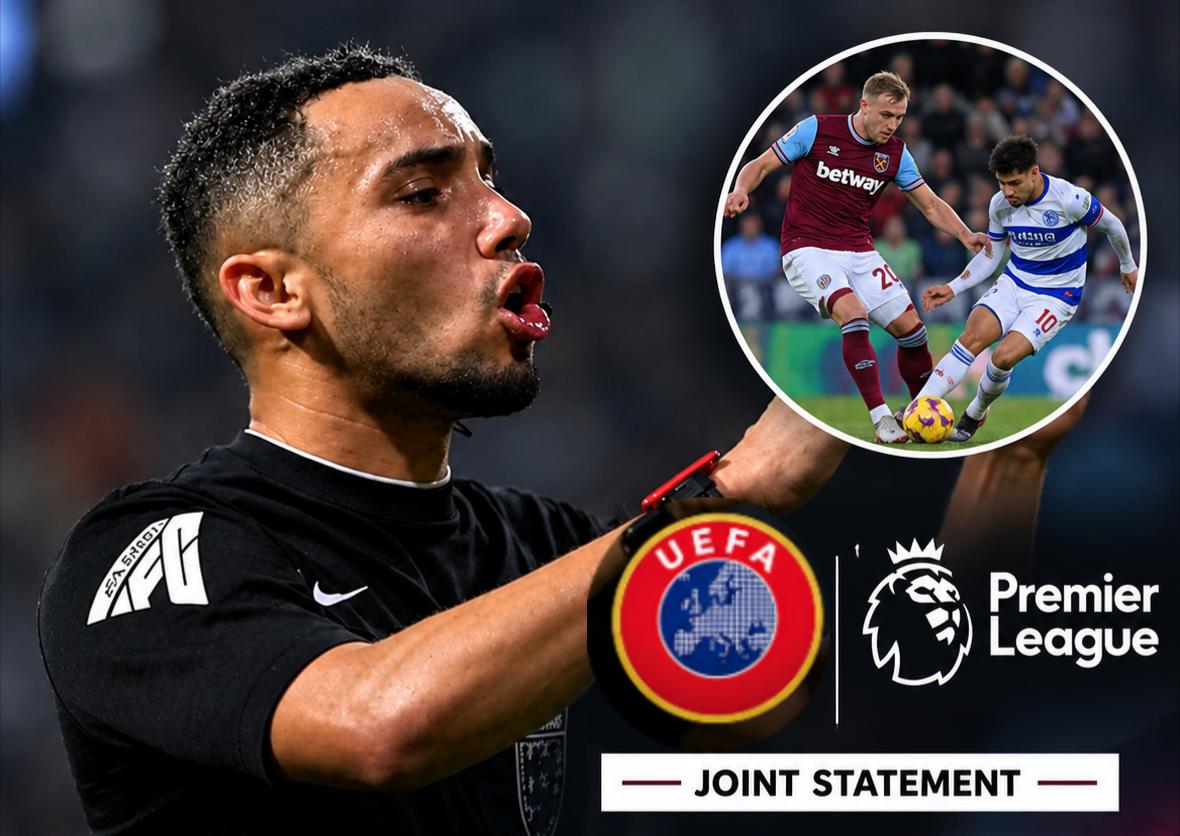
West Ham United’s controversial 1-1 draw with Queens Park Rangers has sparked a major debate over refereeing standards after a disputed first-half penalty left Nuno Espírito Santo furious, with supporters demanding answers over a decision that could have cost the Hammers two crucial points.
The controversy surrounding West Ham United’s Championship encounter with Queens Park Rangers has continued to attract attention following a night of drama, disputed officiating, and missed opportunities at the London Stadium.
What should have been a memorable evening of football turned into a heated discussion about the consistency of refereeing decisions, the absence of Video Assistant Referee (VAR) technology in the Championship, and the impact that a single controversial call can have on a team’s ambitions.
West Ham were held to a 1-1 draw by QPR on Friday, October 9, 2026, after Nicolas Madsen converted a first-half penalty awarded under contentious circumstances. Jarrod Bowen subsequently equalised for the Hammers before seeing a stoppage-time penalty saved by QPR goalkeeper Pierce Charles.
However, it was the opening penalty that generated the greatest controversy.
With replays suggesting that Tomáš Souček had played the ball during his challenge on Paul Smyth, while the contact appeared to occur outside the penalty area, questions quickly emerged about how such a decisive decision had been reached.
West Ham manager Nuno Espírito Santo did not hide his disappointment, and the debate has raised a broader question for football authorities: how can officials ensure that major decisions are made correctly when the consequences are so significant?
THE DECISION THAT CHANGED EVERYTHING
The controversy began during the first half at the London Stadium.
West Ham had started the match below their best, allowing QPR to settle into the contest and enjoy periods of possession. Nevertheless, the home side would have expected to remain competitive without conceding a goal through a disputed penalty.
The decisive incident involved Souček and QPR winger Paul Smyth.
After Souček lost possession, Smyth moved forward with the ball. The West Ham midfielder recovered and attempted to win it back with a sliding challenge.
Referee Ruebyn Ricardo awarded QPR a penalty.
The decision immediately attracted protests from West Ham players, who believed that Souček had won the ball and that the challenge had taken place outside the penalty area.
The absence of VAR meant there was no video review available to examine the incident and potentially recommend a change to the on-field decision.
QPR made the most of the opportunity.
Nicolas Madsen stepped forward and calmly converted the penalty, giving the visitors a 1-0 lead in the 18th minute.
For West Ham, the frustration was about more than conceding a goal. It was about the circumstances in which that goal had been awarded.
The Hammers were forced to chase the game, while QPR gained the advantage of being able to defend their lead and look for opportunities on the counterattack.
West Ham’s official match report described the decision as controversial, while the club’s subsequent account of Nuno’s reaction made clear that the manager believed the call had gone against his team.
The incident has since become the central talking point surrounding the fixture.
WHY WEST HAM FANS ARE DEMANDING ANSWERS
For supporters, the most frustrating aspect of the decision is the possibility that the referee penalised Souček for a challenge that did not warrant a penalty.
Football matches regularly contain difficult decisions, and referees must often make split-second judgments without the benefit of multiple camera angles.
However, penalties are among the most consequential decisions in the game because they provide the attacking team with a direct opportunity to score from the spot.
When a penalty is awarded incorrectly, the consequences can be enormous.
West Ham supporters will argue that the decision changed the atmosphere of the match, forced their team to alter its approach, and gave QPR an advantage that might otherwise never have existed.
The question is particularly relevant because the match finished 1-1.
Had West Ham avoided conceding the opening penalty, the game might have developed differently. The Hammers could have played with greater confidence, while QPR would have had to work harder to create a breakthrough.
Of course, nobody can establish what the final result would have been under different circumstances.
Nevertheless, the incident illustrates why supporters demand consistency and accountability from match officials.
The debate is not simply about whether a referee can make a mistake. It is about whether the system provides adequate opportunities to identify and correct major mistakes before they determine the outcome of a match.
NUNO ESPÍRITO SANTO BREAKS HIS SILENCE
Following the final whistle, Nuno made his disappointment clear.
The West Ham manager acknowledged that his side had not started the game well enough but insisted that the controversial penalty had affected the contest.
He was particularly critical of the decision involving Souček.
Speaking after the match, Nuno said:
“I think it’s clear, the images speak for themselves.”
He also described the decision as a mistake that had gone against his team.
Those comments reflected the frustration felt by West Ham supporters, many of whom believed the available footage supported their argument.
However, Nuno also acknowledged that his players needed to improve.
West Ham had struggled to create clear opportunities during the opening period, and the manager recognised that his team could not use the penalty decision as an excuse for every weakness in its performance.
His message was therefore twofold.
First, he believed the referee had made a significant error.
Second, he expected his players to respond more effectively when faced with adversity.
That distinction matters because even when a controversial decision changes the course of a match, teams must still find ways to recover.
West Ham eventually did exactly that, although their late push was not enough to secure all three points.
THE PREMIER LEAGUE AND UEFA QUESTIONS
The suggestion that the Premier League and UEFA could issue a joint statement has attracted attention because it raises the possibility of football’s governing bodies addressing a controversial refereeing decision.
However, it is important to understand the responsibilities of the organisations involved.
The Premier League operates England’s top-flight competition, while UEFA governs football competitions across Europe.
West Ham and QPR were competing in the English Championship, not the Premier League, during this match.
Consequently, the incident falls within the context of the English Football League competition rather than a Premier League fixture.
The distinction is important when considering who would ordinarily address questions about the officiating.
The English Football League oversees the Championship, while the relevant refereeing authorities are responsible for the administration and assessment of match officials.
UEFA would not ordinarily issue a joint statement with the Premier League about a disputed decision in an EFL Championship match.
Neither organisation should be portrayed as having announced an investigation, admitted an officiating error, or promised disciplinary action without a verified official announcement.
Nevertheless, the controversy raises questions that extend beyond one competition.
Football supporters across England and Europe regularly debate whether refereeing decisions are sufficiently consistent, whether available technology is being used effectively, and whether the consequences of mistakes are adequately addressed.
The West Ham-QPR incident provides another example of why those discussions remain important.
THE VAR DEBATE RETURNS WITH A VENGEANCE
One of the most significant aspects of the controversy is the absence of VAR in the Championship.
In the Premier League, penalties awarded on the pitch are automatically checked by the Video Assistant Referee. The VAR can also examine potential penalties that the referee has not awarded.
For subjective decisions involving challenges or possible fouls, intervention depends on the established threshold for a clear and obvious error.
The Championship operates under different arrangements, and VAR was not available to review the Souček incident during this match.
That meant the referee’s decision stood.
For supporters who believe Souček won the ball outside the penalty area, the absence of a review was particularly frustrating.
They were left watching a decision that they believed was incorrect without any mechanism available during the match to reconsider it.
However, the debate over VAR is not entirely straightforward.
Introducing video technology can help officials correct significant mistakes, but it also requires financial investment, technical infrastructure, trained personnel, and arrangements that work consistently across the competition.
There are also questions about delays, the interpretation of subjective incidents, and the possibility that different officials may still reach different conclusions after reviewing the same footage.
The central issue is therefore not simply whether VAR should exist.
It is whether football authorities can provide an officiating system that is accurate, consistent, transparent, and appropriate for the competition in which it operates.
For West Ham supporters, Friday night’s incident demonstrated the potential cost of having no video review available.
For the wider football community, it renewed the debate about whether additional safeguards are necessary.
WEST HAM FIGHT BACK AS JARROD BOWEN EQUALISES
Despite the controversy, West Ham eventually found a way back into the contest.
Nuno made changes at half-time, introducing Pablo and Edvin Austbø as the Hammers looked for greater attacking intensity.
The hosts enjoyed more of the ball but initially struggled to break down QPR’s organised defensive structure.
The visitors defended with discipline and looked for opportunities to threaten on the counterattack.
West Ham’s breakthrough finally arrived in the 70th minute.
Bowen helped initiate the move before the attack developed through Maximilian Kilman, Pablo and Taty. Bowen’s initial effort was blocked, but the West Ham captain reacted quickly to score from the rebound.
The goal brought the London Stadium to life.
For the first time since conceding the controversial penalty, West Ham had restored parity and given themselves a realistic opportunity to win the match.
The equaliser also demonstrated the team’s ability to respond to a difficult situation.
Yet the Hammers were not finished.
With the match approaching its conclusion, they continued pushing forward in search of a decisive goal.
That attacking intent would produce another penalty incident, although the outcome would be very different.
THE SECOND PENALTY ADDS MORE DRAMA
In the closing stages, West Ham were awarded a penalty after QPR substitute Amadou Mbengue pulled Pablo’s shirt inside the penalty area.
Bowen stepped forward with the opportunity to complete the comeback.
The moment appeared to offer West Ham a chance to turn their frustration into a memorable victory.
Instead, QPR goalkeeper Pierce Charles produced a remarkable intervention.
Charles dived low to his left and saved Bowen’s penalty before reacting quickly enough to deny Arne Engels’ follow-up effort.
The goalkeeper’s double save preserved QPR’s point and left the West Ham players visibly disappointed.
The contrast between the two penalty incidents was striking.
West Ham believed the first decision should never have been awarded against them, yet their own late penalty presented an opportunity to win the match.
Even after the Hammers had recovered from their deficit, they could not find a way past Charles.
For QPR, the goalkeeper’s performance was a major positive.
For West Ham, the missed opportunity made the opening penalty feel even more costly.
The Hammers had recovered from the setback but could not complete the comeback.
COULD THE DECISION HAVE COST WEST HAM TOP SPOT?
The result carried implications beyond the immediate disappointment of failing to win at home.
West Ham had the opportunity to move to the top of the Championship table, but the draw meant they missed that chance.
That is why the penalty controversy has attracted so much attention.
In a competitive league, every point can matter. A single result can influence a team’s position, confidence, and momentum as the season develops.
Supporters may reasonably wonder whether West Ham would have secured three points had the first penalty not been awarded.
However, it would be impossible to establish that outcome with certainty.
Even without the controversial decision, the match might have unfolded differently. QPR could have scored another goal, West Ham might have struggled to break them down, or another incident could have determined the result.
The fairest conclusion is that the penalty had a direct impact on the scoreline, while the precise effect on the final result cannot be known.
What is clear is that West Ham lost the opportunity to claim victory and move top of the table.
That will make the incident particularly difficult for the club and its supporters to forget.
WHAT HAPPENS NEXT?
The controversy leaves several questions for football authorities and supporters to consider.
Should the relevant authorities publish an assessment of the decision?
Would additional transparency help supporters understand how referees reach important judgments?
Should there be further discussion about the availability of video technology in the Championship?
These are legitimate questions, but they should not be confused with confirmed disciplinary proceedings or an official investigation.
There is currently no verified basis for claiming that UEFA and the Premier League have jointly launched an investigation into the incident or issued an official apology to West Ham.
Any genuine statement would need to be published or confirmed by the relevant organisations.
For West Ham, the immediate priority will be preparing for the next fixture and ensuring that frustration over the penalty does not affect the team’s performances.
Nuno has already acknowledged that his side must start matches better and become more effective in possession.
Those improvements remain necessary regardless of the refereeing controversy.
For QPR, the draw represents a hard-earned result after Charles’ outstanding late saves.
The visitors will also be encouraged by the organisation and discipline they displayed for much of the contest.
FINAL VERDICT: A CONTROVERSY THAT REFUSES TO DISAPPEAR
West Ham’s 1-1 draw with QPR was a match defined by two penalties, two very different outcomes, and a first-half decision that continues to fuel debate.
Nicolas Madsen converted the spot-kick that gave QPR the lead, while Bowen later equalised before seeing his own penalty saved in stoppage time.
Between those moments, West Ham fought back but could not secure the victory they wanted.
Nuno Espírito Santo’s criticism ensured that the opening decision would remain a major talking point after the final whistle.
For supporters, the incident raises familiar concerns about refereeing accuracy, accountability, and the absence of VAR in the Championship.
For football authorities, it illustrates why clear communication about major decisions can be important in maintaining public confidence.
The biggest question is no longer simply whether West Ham deserved a penalty decision to go their way. It is whether supporters can have confidence that similarly decisive incidents will be judged consistently in the future.
Until the relevant authorities provide a verified assessment of the incident, claims of a joint UEFA and Premier League statement should be treated with caution.
One thing is certain: West Ham’s frustration over the controversial penalty is likely to remain a talking point long after the final whistle at the London Stadium.