Premier League Releases Statement as Referee Faces Backlash Over Brennan Johnson’s Disallowed Goal Against Hull City
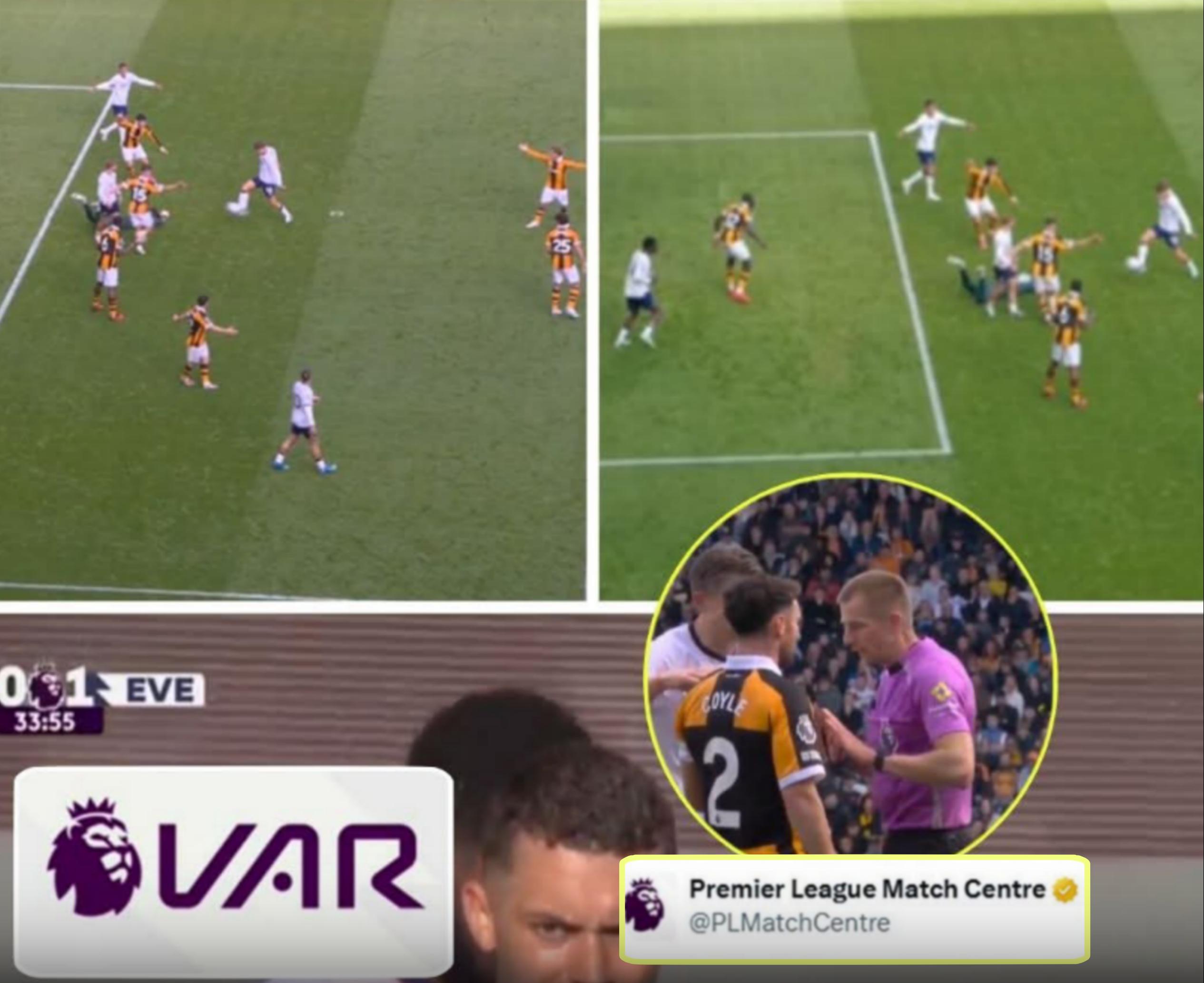
The Premier League has reportedly issued a statement explaining why Brennan Johnson’s goal for Everton was disallowed against Hull City, with referee Michael Salisbury facing scrutiny following the controversial decision at the MKM Stadium.
The incident sparked frustration among Everton players and manager David Moyes, who questioned the officials’ interpretation of the offside rule. However, the explanation attributed to the Premier League Match Centre maintains that the decision was checked and confirmed by VAR.
The controversy has also reignited debate about the interpretation of offside, particularly when a player does not touch the ball but is judged to have interfered with an opponent.
### The Goal That Sparked Controversy
Everton believed they had taken the lead in the 34th minute when Brennan Johnson found the back of the net with a clinical finish.
The forward appeared to have given the visitors the breakthrough they wanted, prompting celebrations among Everton’s players and travelling supporters.
However, those celebrations were short-lived.
The assistant referee’s flag indicated an offside infringement, and the incident subsequently became the focus of a VAR review. Salisbury was reportedly sent to the pitchside monitor before the goal was ruled out.
The decision immediately generated debate, with Everton’s players questioning the officials’ interpretation of the incident.
For the visitors, it was a frustrating moment in a match in which they were looking to take control. For Hull City, the decision provided an important reprieve as they attempted to keep Everton’s attack at bay.
The length of the review and the explanation behind the final decision only added to the discussion surrounding the incident.
### What the Premier League Statement Said
The statement supplied in the report attributed the following explanation to the Premier League Match Centre:
“Brennan Johnson was in an offside position and deemed to be challenging an opponent for the ball. The referee’s decision to disallow the goal was checked and confirmed by VAR.”
The key issue was not necessarily whether Johnson touched the ball. Instead, the decision centred on whether his position and actions interfered with an opponent’s ability to play it.
Under the offside law, a player in an offside position can be penalised for interfering with an opponent, including by challenging an opponent for the ball or preventing an opponent from playing or being able to play the ball.
This means that simply avoiding contact with the ball does not automatically make a player onside in the context of an attacking move.
In Johnson’s case, the officials reportedly judged that his involvement met the threshold for an offside offence.
The phrase “subjective offside” has also become a talking point in the aftermath of the incident. Such decisions can require officials to interpret a player’s actions and their impact on an opponent, rather than simply determine whether a player was positioned beyond the relevant defensive line.
That distinction helps explain why some offside decisions generate considerably more debate than others.
### David Moyes Questions the Decision
Everton manager David Moyes was reportedly unhappy with the decision and questioned the terminology used to explain it.
Moyes was quoted as saying:
“I don’t know what subjective offside is, and I don’t think any of you do either. I’ve been in football a long time. I’ve never heard of that term before tonight.”
The Everton boss also expressed frustration at losing what his team believed was a legitimate goal.
“We scored a goal that looked perfectly fine. The boys are frustrated. I’m frustrated. It’s a decision that has cost us.”
His comments reflected Everton’s disappointment with the officials’ interpretation of the incident.
For a manager, decisions involving disallowed goals can be particularly difficult to accept when the team believes it has executed an attacking move successfully. The involvement of VAR can intensify that frustration, especially when the review requires the referee to reconsider an initial decision.
Nevertheless, disagreement from a manager does not by itself establish whether a decision was correct. The crucial question remains whether Johnson’s involvement met the criteria for an offside offence under the Laws of the Game.
### What the Experts Said
The decision reportedly divided opinion among football analysts and former officials.
Former Premier League assistant referee Darren Cann was said to have backed Salisbury’s intervention, describing it as an “excellent and correct intervention”.
Don Goodman, speaking on Sky Sports, was also quoted as agreeing with the decision.
“In my opinion, the goal was correctly ruled out.”
However, Pat Nevin reportedly expressed confusion while discussing the incident on BBC Radio 5 Live, questioning why it took the officials so long to reach their conclusion.
These differing reactions highlight the difficulty supporters can face when trying to understand decisions involving interference with an opponent.
Offside decisions involving a player’s physical position can often be explained through lines and measurements. Decisions involving interference, however, require an assessment of what the player did and whether that action affected an opponent’s ability to play the ball.
That element of interpretation can leave room for disagreement, even when officials believe the laws have been applied correctly.
### How the Decision Affected Hull City and Everton
The disallowed goal became one of the defining talking points of the match, adding tension to an already competitive encounter.
For Everton, Johnson’s effort represented a potentially important breakthrough. Having the goal overturned meant the visitors had to continue searching for a way past Hull City’s defence.
For the Tigers, the decision offered a reprieve and allowed them to remain in contention.
According to the supplied match report, Everton subsequently found another route to goal, while Hull City responded through Joe Gelhardt, who reportedly produced a clever chip over Jordan Pickford.
The teams eventually drew 1-1, leaving both sides with reasons to reflect on the outcome.
Hull could take encouragement from earning a point against Everton, while the visitors were left frustrated by the controversy surrounding Johnson’s disallowed effort.
Although it would be difficult to quantify exactly how much the decision affected the match, it clearly became a major talking point in the aftermath.
### Why ‘Subjective Offside’ Has Become a Talking Point
The controversy illustrates a wider challenge facing football officials: explaining decisions that depend on interpreting a player’s involvement in an attacking move.
The offside law does not automatically penalise every player who is standing in an offside position. The player must become involved in active play in one of the ways defined by the laws.
That can include interfering with an opponent, even when the player does not make contact with the ball.
For supporters watching from the stands or at home, the distinction can be difficult to identify in real time. A player may appear not to touch the ball, yet still be judged to have affected a goalkeeper or defender.
This is why the explanation for a disallowed goal matters almost as much as the decision itself.
Clear communication from officials and the relevant authorities can help supporters understand the reasoning behind contentious calls and reduce confusion over how the rules are applied.
In the case involving Johnson, the reported explanation focused on his offside position and his involvement in challenging an opponent for the ball.
Whether supporters agree with that interpretation or not, understanding the distinction between being in an offside position and committing an offside offence is central to the debate.
### The Verdict
The controversy surrounding Brennan Johnson’s disallowed goal against Hull City has placed referee Michael Salisbury’s decision under scrutiny and prompted renewed discussion about offside interpretation.
The statement provided in the report says the decision was checked and confirmed by VAR, with the officials judging that Johnson had interfered with an opponent while in an offside position.
Moyes’ reported reaction demonstrates Everton’s frustration, while the differing opinions attributed to former officials and pundits underline why the incident has attracted attention.
For Hull City, the match ended in a 1-1 draw, with Gelhardt reportedly scoring against Pickford. For Everton, the disallowed goal became a significant talking point after the final whistle.
Ultimately, the debate centres on a key question: did Johnson’s involvement interfere with an opponent in a way that constituted an offside offence?
That is the issue supporters will continue to discuss as they examine the decision.
What do you think about Brennan Johnson’s disallowed goal against Hull City? Was the referee right to rule it out, or should Everton’s goal have stood? Share your thoughts in the comments below. 🐯