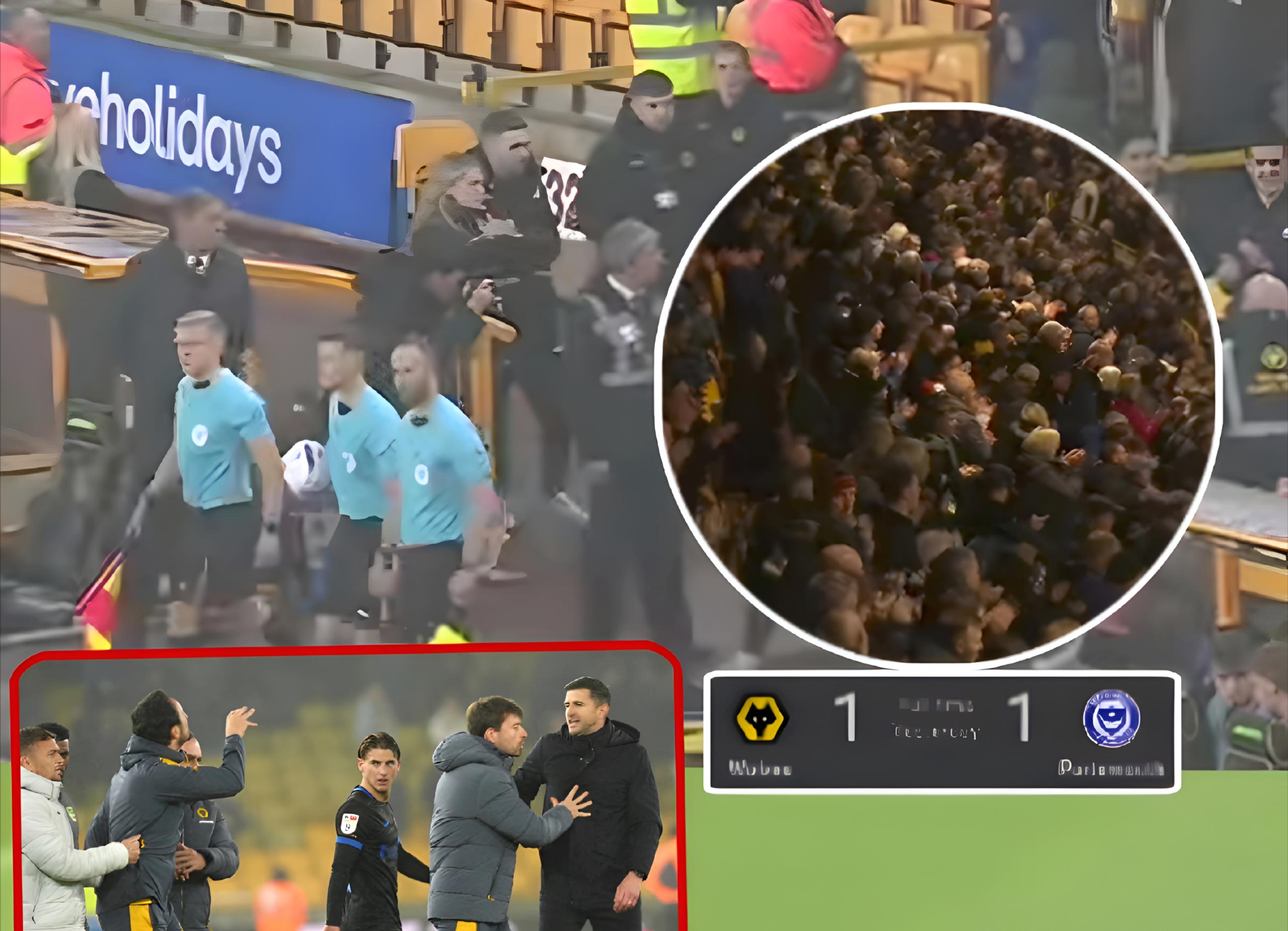
The football world has been drawn into a heated discussion following Wolverhampton Wanderers’ 1–1 draw with Portsmouth, with attention turning away from the result and towards the tense exchange between the two managers after the final whistle.
What should have been a conversation about the football played at Molineux quickly became a talking point about discipline, respect, and the responsibilities that come with managing professional football clubs.
Wolves had looked on course to claim all three points after taking the lead in the second half, but Portsmouth refused to surrender. Their late equaliser changed the atmosphere inside the stadium, leaving the home side frustrated and the visitors celebrating a valuable result.
However, the most talked-about moment came after the referee ended the contest.
Wolves boss César Peixoto and Portsmouth manager John Mousinho were involved in a heated exchange, creating a tense scene after a match that had already delivered plenty of emotion. Their confrontation raised questions about what had caused the disagreement and whether the incident could have consequences beyond the final score.
The reaction has centred on the importance of maintaining professional standards, particularly when managers are dealing with the disappointment of dropping points or the excitement of rescuing a result.
The message at the heart of the controversy is clear: emotions are part of football, but disagreements between managers can quickly become bigger than the match itself.
THE MATCH THAT SET THE STAGE FOR THE CONTROVERSY
Wolves entered the contest hoping to deliver a strong performance in front of their supporters. Playing at Molineux gave them an opportunity to take control, create chances, and secure a result that could provide momentum for their campaign.
Portsmouth, meanwhile, arrived determined to make life difficult for the home side.
The first half proved frustrating for Wolves, who struggled to turn possession into clear opportunities. Portsmouth remained organised and worked to limit the space available to the home team’s attacking players.
Neither side managed to break the deadlock before the interval, leaving the contest finely balanced.
The situation changed after the break when Wolves made attacking substitutions in an attempt to increase their intensity.
Jordan James and Tawanda Chirewa were introduced, giving the home side additional energy and a different attacking threat.
The changes soon appeared to pay off.
Wolves began to put greater pressure on Portsmouth, moving the ball forward with more purpose and looking increasingly capable of finding the opening goal.
For the home supporters, the second half offered renewed hope that their team could secure the victory they wanted.
JORDAN JAMES GIVES WOLVES THE LEAD
The breakthrough arrived in the 62nd minute.
Fer López supplied the pass, and Jordan James finished with a powerful strike that beat Portsmouth goalkeeper Nicolas Schmid.
Wolves had finally found a way through.
The goal lifted the atmosphere at Molineux and appeared to put the home side in a strong position to claim the victory.
James had entered the game at half-time, and his contribution highlighted the potential value of the changes made by the Wolves coaching staff.
For Portsmouth, the challenge was now to respond before time ran out.
The visitors needed to find a way through Wolves’ defence while remaining careful not to leave too much space for the home side to exploit.
As the minutes passed, the tension increased.
Wolves were looking to protect their advantage, while Portsmouth continued searching for an opportunity that could change the outcome.
The match was approaching its decisive stages, and the home supporters had every reason to believe that their team could hold on.
But football often produces its most painful moments when a team believes victory is almost secured.
PORTSMOUTH’S LATE EQUALISER CHANGES EVERYTHING
In the 86th minute, Portsmouth found the goal they desperately needed.
A free-kick from Adrian Segečić struck the Wolves defensive wall before the ball fell to Terry Devlin.
The Portsmouth defender reacted quickly, controlled the ball, and fired a shot into the bottom corner.
Suddenly, the score was 1–1.
The equaliser transformed the mood at Molineux.
Wolves had spent much of the second half working towards a victory, only to see their advantage disappear in the closing minutes.
Portsmouth, by contrast, had found a way back into the contest when defeat appeared increasingly likely.
The late goal also placed enormous pressure on the final moments of the match.
Wolves pushed forward in search of another breakthrough, but Portsmouth defended their position and prevented the home side from finding a winner.
When the final whistle arrived, both teams had to settle for a point.
For Wolves, it was a frustrating conclusion to a match in which they had taken the lead.
For Portsmouth, the result represented a determined fightback.
Yet the drama did not end with the referee’s whistle.
HEATED EXCHANGE BETWEEN PEIXOTO AND MOUSINHO
The attention soon shifted towards the two managers.
César Peixoto and John Mousinho were involved in a heated exchange after the match, creating an uncomfortable ending to an already emotional evening.
Managers frequently experience intense pressure during competitive matches. They must make tactical decisions, respond to changing circumstances, manage their players, and deal with the expectations of supporters.
When a result goes against them, frustration can be difficult to hide.
Wolves had conceded a late equaliser after taking the lead, making the draw particularly disappointing from their perspective.
Portsmouth, on the other hand, had fought back to secure a point, but the closing moments had clearly been emotionally charged.
The confrontation between the managers became a major talking point because of the standards expected from people occupying such prominent positions in professional football.
Managers are not simply responsible for selecting teams and directing tactics. They are also public representatives of their clubs.
Their behaviour can influence the atmosphere around a match, the reactions of supporters, and the way disagreements are handled within the game.
That is why incidents involving managers often attract considerable attention.
Supporters want their teams to compete fiercely, but they also expect those in charge to demonstrate composure when emotions are running high.
EFL DISCIPLINE BECOMES THE CENTRE OF ATTENTION
The controversy has prompted discussion about the disciplinary standards expected within the English Football League.
The central issue is whether a confrontation between two managers should result in formal action when the conduct involved is considered to have crossed the line.
A disciplinary response would depend on the circumstances of the incident, the available evidence, and the applicable competition regulations.
Possible consequences in football disciplinary cases can include formal warnings, fines, touchline suspensions, or other sanctions, depending on the nature and seriousness of the conduct.
For managers, such consequences can have practical implications.
A touchline suspension, for example, can prevent a coach from directing the team from the technical area during a subsequent fixture. A financial penalty can also create unwanted attention for the manager and club.
More broadly, disciplinary proceedings can place the behaviour of both individuals under greater scrutiny.
The situation raises a question that extends beyond this particular fixture: where should football draw the line between competitive passion and unacceptable conduct?
Football is an emotional sport. Managers are expected to care deeply about results, defend their players, and challenge decisions when they believe something has gone wrong.
However, that passion must operate within the rules governing professional football.
The challenge for disciplinary authorities is to distinguish between a heated disagreement and behaviour that warrants formal punishment.
WHY BOTH MANAGERS COULD FACE PRESSURE
When a confrontation involves two managers, the attention naturally turns towards both individuals.
Neither position offers immunity from the standards expected in professional football.
For Peixoto, the disappointment of watching Wolves surrender their lead could form part of the context surrounding the post-match tension.
The Wolves manager must also contend with the consequences of a result that left his team unable to secure victory despite scoring first.
For Mousinho, the situation presents a different challenge.
Portsmouth rescued a point late in the match, but any controversy surrounding the final whistle risks overshadowing the team’s achievement on the pitch.
Both managers have responsibilities to their players, clubs, and supporters.
They must ensure that frustration does not distract from the work required to prepare their teams for upcoming fixtures.
The possibility of disciplinary action would add another layer of pressure, especially if either manager were required to miss a future match or respond to formal proceedings.
That possibility also highlights why managers must exercise care during emotionally charged moments.
A brief disagreement can become a much larger issue when it attracts the attention of the football authorities and the wider sporting community.
SUPPORTERS DIVIDED OVER THE INCIDENT
The reaction among supporters has centred on competing views about passion and professionalism.
Some fans believe heated exchanges are an unavoidable part of football. They argue that managers are competing under enormous pressure and that strong emotions are to be expected when important results are at stake.
Others believe managers must be held to a higher standard.
From that perspective, professional football requires discipline not only from players but also from the coaches responsible for leading them.
Supporters who favour a stricter approach argue that disagreements should be handled without allowing them to overshadow the match itself.
The debate is particularly relevant because managers often speak publicly about discipline, respect, and accountability when discussing their players.
Fans therefore expect those principles to apply to the people in charge as well.
At the same time, the circumstances surrounding any confrontation matter.
A heated exchange does not automatically establish that a disciplinary offence has occurred. The details of the conduct, rather than the mere existence of disagreement, determine whether formal action is appropriate.
That distinction is important when assessing the consequences of an incident.
WHAT HAPPENS NEXT FOR WOLVES AND PORTSMOUTH?
The immediate priority for both clubs is to move forward from the draw.
Wolves must examine why they were unable to protect their lead and identify the changes needed to become more effective in the closing stages of matches.
Conceding an equaliser in the 86th minute can be particularly painful because it leaves little time to recover.
The coaching staff will want the players to learn from the experience, improve their defensive concentration, and manage late-game situations more effectively.
Portsmouth, meanwhile, can take encouragement from their persistence.
The visitors continued competing after falling behind and were rewarded when Devlin found the net.
Their challenge now is to build on that resilience and carry the same determination into their next fixture.
The managers must also ensure that the post-match controversy does not become a distraction for their squads.
Players need clear preparation, tactical direction, and a stable environment in which to perform.
Any disciplinary developments would need to be handled separately from the work required on the training ground.
Ultimately, the draw will be remembered for the late equaliser, but the confrontation after the final whistle has added another dimension to the discussion.
FINAL VERDICT: FOOTBALL NEEDS PASSION, BUT DISCIPLINE MATTERS
The 1–1 draw between Wolves and Portsmouth delivered late drama, frustration, and a result that neither side could completely celebrate.
Jordan James gave Wolves the lead in the 62nd minute, only for Terry Devlin to equalise four minutes from the end of normal time.
The late goal denied Wolves victory and ensured Portsmouth left Molineux with a point.
The subsequent heated exchange between Peixoto and Mousinho then shifted attention towards the conduct expected from professional managers.
The broader lesson is that football can be fiercely competitive without losing sight of discipline and respect.
Managers are entitled to feel disappointed, challenge decisions through appropriate channels, and demand the best from their teams. But their responsibilities extend beyond the technical area.
For Wolves and Portsmouth, the focus must now return to football.
For the supporters, questions remain about the confrontation and whether it should lead to further consequences.
Should both managers face punishment if their conduct crossed the line, or should the EFL allow them to move on after an emotional match?
That is the question likely to keep the debate alive long after the final whistle at Molineux.