The controversy surrounding Everton’s meeting with Coventry City has taken another dramatic turn after a former PGMOL chief reportedly delivered a strong assessment of the officiating, questioning several important decisions made during the encounter at Hill Dickinson Stadium.
What initially appeared to be a discussion about Everton’s victory has now developed into a major debate about VAR, refereeing standards and the decisions that influenced the match.
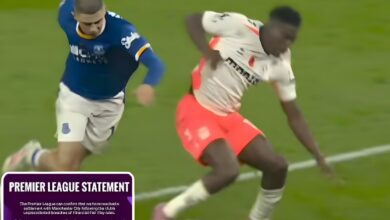
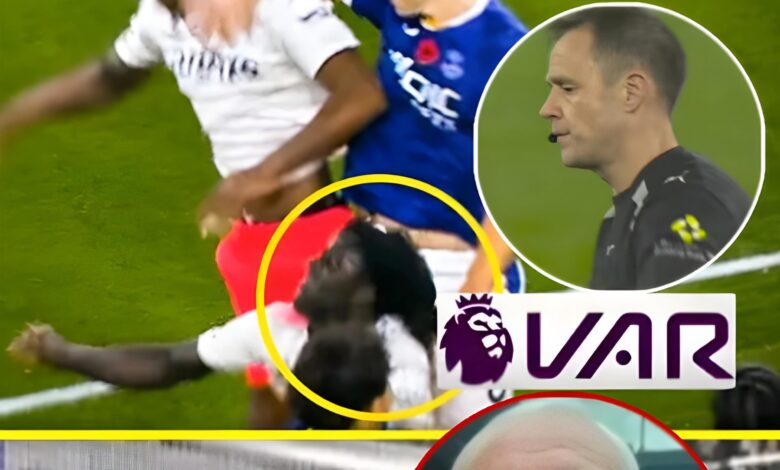
Coventry supporters have been particularly vocal following the controversial penalty appeal involving Taiwo Awoniyi and Everton defender Vitalii Mykolenko. Many believed the incident deserved a penalty, while others argued that the officials should have considered further disciplinary action.
However, the biggest talking point is the suggestion that the referee made a serious mistake by failing to award Coventry a penalty and send off an Everton player.
The former PGMOL chief’s criticism has added another dimension to the debate, with Coventry supporters believing that their complaints deserve to be taken seriously.
For many fans, this is no longer simply about the result. It is about whether the officials made the correct decisions when the most important incidents occurred.
THE AWONIYI INCIDENT THAT STARTED EVERYTHING
The controversy surrounding the match centred on an incident involving Coventry striker Taiwo Awoniyi and Everton defender Vitalii Mykolenko.
During the second half, Awoniyi attempted to drive into the Everton penalty area before going down following contact with the defender.
The Coventry players immediately appealed for a penalty.
Their reactions showed how strongly they believed an offence had occurred.
However, the referee did not award a spot-kick.
VAR subsequently examined the incident, with the explanation focusing on the location of the contact and whether the offence occurred inside or outside the penalty area.
Coventry were left frustrated after the officials maintained their decision.
But the incident has now become the biggest subject of discussion following the former PGMOL chief’s criticism.
The central argument from the Coventry perspective is that the contact deserved a penalty and that the officials failed to recognise the seriousness of the challenge.
Some supporters have gone further, arguing that the incident should have resulted in a red card for the Everton player involved.
That is an enormous accusation because a penalty and a dismissal could have completely changed the direction of the match.
EX-PGMOL CHIEF QUESTIONS THE REFEREE’S DECISION
The strongest criticism has focused on the referee’s handling of the incident.
A former PGMOL chief has become the centre of attention after questioning the decision-making during the Everton encounter.
The criticism is particularly significant because PGMOL is responsible for overseeing professional match officials in English football.
Former officials understand the importance of positioning, timing, contact and the laws governing penalty decisions.
They also understand that VAR should intervene when a clear and obvious error has occurred.
For Coventry supporters, the criticism represents an opportunity to highlight what they believe was a major injustice.
The argument is straightforward: if the challenge deserved a penalty and the disciplinary consequences were serious enough, why did the officials fail to take the appropriate action?
The possibility of a red card makes the situation even more controversial.
A dismissal would have left Everton with ten players and potentially changed the balance of the contest.
Instead, Coventry had to continue playing without receiving the decision they wanted.
WHY COVENTRY BELIEVE IT SHOULD HAVE BEEN A PENALTY AND RED CARD
There are two separate questions surrounding the incident.
The first concerns whether a foul occurred inside the penalty area.
The second concerns whether the nature of the challenge justified a red card.
Under football’s laws, a penalty is awarded when a direct-free-kick offence is committed by a defending player inside their own penalty area.
However, the location of the offence is crucial.
If the contact begins outside the area and continues inside, the referee must assess the circumstances carefully.
The disciplinary question is equally important.
A red card can be appropriate for serious foul play, violent conduct or denying an obvious goal-scoring opportunity when the relevant conditions are satisfied.
Coventry supporters believe the incident deserved much stronger punishment.
They argue that the officials should have examined every available angle before reaching their conclusion.
The controversy has also raised questions about whether the VAR team adequately communicated the seriousness of the situation to the referee.
For supporters, these are not minor details.
They are decisions that could have changed the entire match.
MORE CONTROVERSIAL DECISIONS LEAVE COVENTRY FANS FRUSTRATED
The Awoniyi incident was not the only moment that generated criticism.
Another major talking point involved Everton defender James Tarkowski and Coventry’s Caleb Yirenkyi.
During the first half, Tarkowski became involved in an incident that resulted in Coventry players appealing for punishment.
Questions were raised about possible hair-pulling and whether the defender should have received a more serious disciplinary sanction.
Coventry supporters wanted the officials to examine the situation carefully.
VAR reviewed the incident, but Tarkowski escaped further punishment.
That decision generated another wave of discussion.
Supporters began comparing the different incidents and questioning the consistency of the officials.
For Coventry fans, the frustration was not simply about one penalty appeal.
It was about several important moments in which they believed Everton should have faced stronger punishment.
The feeling among some supporters was that the referee had too much influence over the match.
THIERNO BARRY’S SECOND GOAL ADDS ANOTHER LAYER TO THE DEBATE
Everton’s attacking performance also produced a controversial moment.
Thierno Barry scored twice during the comeback, helping his team recover after Coventry had initially taken the lead through Yann Gboho.
Barry’s first goal came from a delivery by Kiernan Dewsbury-Hall.
His second followed shortly afterwards, giving Everton further momentum.
However, Coventry players questioned whether there had been a handball during the attacking move leading to the second goal.
VAR examined the situation, and the goal was allowed to stand.
That decision created another talking point among supporters.
Coventry fans questioned the consistency of the officials, particularly when comparing the treatment of Everton’s attacking incidents with their own penalty appeals.
For Everton supporters, Barry’s performance was a reason to celebrate.
For Coventry supporters, the circumstances surrounding the goals became another reason to question the officiating.
The former PGMOL chief’s criticism has therefore arrived at a time when several decisions are already under intense discussion.
THE RED-CARD ARGUMENT THAT HAS CAPTURED ATTENTION
Perhaps the most explosive part of the controversy is the suggestion that an Everton player should have been sent off.
A red card changes everything.
It affects a team’s defensive structure, attacking options and ability to control possession.
Had Everton been reduced to ten players, David Moyes would have faced a completely different tactical challenge.
Coventry could have enjoyed more space, pushed additional players forward and attempted to take greater control of the match.
Instead, Everton maintained their full complement of players and continued attacking.
That is why Coventry supporters are particularly frustrated.
They believe the referee missed an opportunity to make a decision that could have significantly affected the contest.
The debate also raises an important question about VAR’s responsibilities.
VAR is not designed to replace the referee for every decision. However, it can recommend an on-field review when a potential red-card incident or another qualifying situation involves a clear and obvious error.
Supporters want to know whether the officials applied the correct process.
FRANK LAMPARD FACES QUESTIONS AFTER THE CONTROVERSY
Coventry manager Frank Lampard will also be under pressure to address the wider implications of the match.
His team showed attacking quality, particularly through Yann Gboho and Taiwo Awoniyi, but the result has left supporters discussing missed opportunities and controversial decisions.
Lampard will need his players to remain focused.
There is no doubt that frustration can affect a dressing room, especially when players believe important decisions have gone against them.
However, Coventry must also examine their own performance.
Defensive organisation, concentration and the ability to protect leads remain important areas.
The controversy should not distract from the footballing improvements required.
Nevertheless, supporters will expect their manager to stand up for the team when they believe something has gone wrong.
PREMIER LEAGUE REFEREEING UNDER THE SPOTLIGHT AGAIN
The incident has reopened the wider debate about the standard of refereeing in English football.
VAR was introduced to reduce major mistakes, but supporters continue to question some of the decisions made during important matches.
The biggest problem is the difference between what supporters see on television and what the officials decide on the pitch.
Multiple camera angles can create the impression that a decision should be straightforward.
However, referees must interpret the laws, assess the location of contact and determine whether an incident meets the required threshold for intervention.
That does not mean every decision will satisfy supporters.
But when a former senior officiating figure questions a major decision, the discussion becomes even more intense.
Coventry fans want consistency.
They want penalties awarded when offences occur inside the box, appropriate disciplinary action for serious challenges and clear communication whenever VAR becomes involved.
Above all, they want the same standards applied to both teams.
COVENTRY FANS SEND A STRONG MESSAGE
The reaction among Coventry supporters has centred on one major demand: they want the officiating decisions from the Everton encounter examined carefully.
Many believe the Awoniyi incident deserved a penalty and that the Everton player involved should have received a red card.
Others have pointed towards the Tarkowski incident and Barry’s second goal as further examples of moments that deserve discussion.
The former PGMOL chief’s criticism has given the controversy another dimension.
What began as frustration immediately after the match has developed into a much wider debate about refereeing standards and VAR.
For Everton, the focus will be on building on their performance and maintaining their momentum.
For Coventry, the challenge is to move forward without allowing the controversy to overshadow their football.
But supporters are unlikely to forget the disputed decisions anytime soon.
One controversial challenge, one major penalty appeal, a possible red card and several other disputed moments have turned Everton versus Coventry into a major refereeing debate.
And the question Coventry supporters continue to ask is simple:
If the officials got such an important decision wrong, who is going to take responsibility?