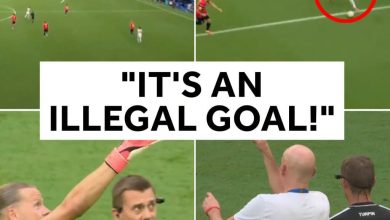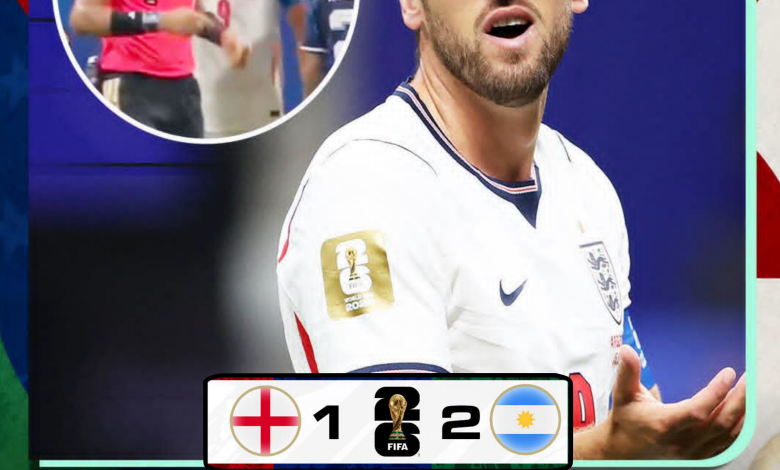
England captain Harry Kane found himself at the centre of another controversial moment during the Three Lions’ World Cup semi-final against Argentina after appearing to cover his mouth while speaking to referee Ismail Elfath.
For a brief moment, it looked as though the Bayern Munich striker could be in serious trouble.
Argentina midfielder Leandro Paredes immediately rushed towards referee Elfath, seemingly reminding him of one of FIFA’s newest World Cup regulations — a rule that has already resulted in players being sent off during the tournament.
Despite the protests, Kane escaped without punishment, leaving many fans confused over why the England captain wasn’t shown a red card.
So why was Kane allowed to continue playing?
The New FIFA Rule
Ahead of the 2026 FIFA World Cup, football’s governing body introduced one of the tournament’s most talked-about regulations.
The law, often referred to as the “Prestianni Rule,” was introduced following controversy involving Benfica youngster Gianluca Prestianni and Real Madrid star Vinicius Jr.
During a Champions League fixture, Prestianni was accused of racially abusing Vinicius while covering his mouth, making it impossible for cameras or lip readers to determine what had been said.
Following the incident, FIFA decided to crack down on players who deliberately hide conversations by covering their mouths.
Under the new rule, players who intentionally cover their mouths during confrontational conversations with opponents can receive a straight red card.
The regulation has already been enforced during this World Cup.
The Rule Has Already Produced Red Cards
One of the biggest examples came earlier in the tournament when Paraguay’s Miguel Almiron was sent off against Turkey.
The Newcastle United midfielder covered his mouth while speaking to a Turkish player during a heated confrontation.
Officials reviewed the incident before showing Almiron a straight red card.
The dismissal demonstrated that FIFA were prepared to enforce the new law strictly throughout the competition.
Because of that previous decision, many supporters expected Harry Kane could face the same punishment against Argentina.
Kane’s Conversation Sparked Confusion
During England’s semi-final, Kane was seen speaking with referee Ismail Elfath while briefly placing his hand over his mouth.
Almost immediately, Argentina midfielder Leandro Paredes reacted.
The experienced midfielder hurried over to the referee, appearing to remind him about FIFA’s mouth-covering rule and suggesting Kane should be punished.
However, Elfath showed little interest in the protests.
Instead of reaching for a red card, the American official waved away Paredes’ complaints and continued dealing with the original incident.
The referee appeared far more focused on managing the match than entertaining Argentina’s appeals.
Why Kane Escaped Punishment
Although the wording of the new law sounds extremely strict, FIFA officials have repeatedly explained that context is crucial.
Before the tournament began, FIFA’s Head of Referees, Pierluigi Collina, clarified exactly how referees should interpret the regulation.
Speaking about the new rule, Collina explained:
“Players can continue to cover their mouth with an arm and a shirt because they may chat with friends. It’s normal for players to chat with their friends before, during, or after the match.”
He added:
“So if the conversation is a friendly conversation, they can continue to do it without any problem.”
Collina then outlined when the law actually applies.
“When the conversation is confrontational, covering the mouth means that you are doing something very wrong, potentially, and the sanction is the red card.”
Those comments make FIFA’s position much clearer.
The law is not designed to punish every player who briefly covers their mouth.
Instead, it specifically targets players attempting to hide abusive, discriminatory or confrontational language.
Kane’s Situation Was Different
Harry Kane’s conversation did not meet the criteria for a dismissal.
Firstly, he was speaking directly to referee Ismail Elfath rather than an opposing player.
Secondly, there was no confrontation taking place.
As England captain, Kane regularly communicates with referees throughout matches.
Captains are expected to discuss decisions, clarify incidents and ask questions during games.
Nothing about Kane’s interaction suggested he was attempting to hide offensive or discriminatory language.
For that reason, Elfath allowed play to continue without taking disciplinary action.
Bellingham Avoided the Same Punishment Earlier
Interestingly, Kane is not the first England player to avoid punishment under the new regulation.
Earlier in the tournament, Jude Bellingham found himself in a similar situation during England’s match against Ghana.
The Real Madrid midfielder briefly covered his mouth while talking to an opponent.
Following a VAR review, officials concluded that neither player was involved in a confrontation.
Instead, the pair appeared to be having a normal conversation.
As a result, Bellingham was also allowed to continue without receiving a red card.
The Rule Continues to Divide Opinion
The mouth-covering regulation has become one of the most debated rule changes introduced at this World Cup.
Some supporters believe it is a necessary step to help combat racism and discriminatory abuse on football pitches.
Others argue that the law leaves too much room for interpretation, creating inconsistency from one match to another.
Critics also believe it places enormous pressure on referees, who must judge not only a player’s actions but also the context surrounding every conversation.
Supporters of the rule, however, argue that FIFA’s intention is clear.
The regulation is not designed to punish innocent conversations.
Instead, it exists to discourage players from hiding potentially abusive comments behind a covered mouth.
A Common-Sense Decision
Although Argentina players attempted to convince referee Ismail Elfath to dismiss Harry Kane, the decision to keep the England captain on the pitch was fully consistent with FIFA’s own guidance.
Kane was speaking calmly with the referee in his role as captain rather than engaging in a heated confrontation with an opponent.
Under the interpretation provided by FIFA’s Head of Referees, that situation does not warrant a red card.
While the rule will likely continue generating debate throughout the remainder of the tournament, this particular incident demonstrated that officials are expected to apply common sense rather than enforce the law blindly.
For England, it meant their captain remained on the pitch as they continued their battle with Argentina for a place in the 2026 FIFA World Cup final.