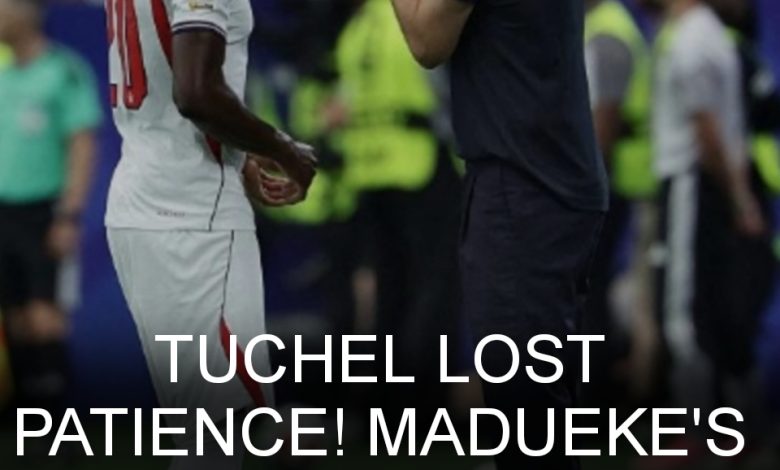
Thomas Tuchel’s ruthless decision proved decisive as Noni Madueke endured nightmare display in England’s World Cup win over Norway
England booked their place in the World Cup semi-finals after a dramatic 2-1 extra-time victory over Norway, but while Jude Bellingham’s match-winning brace dominated the headlines, the quarter-final also exposed one of Thomas Tuchel’s biggest selection dilemmas.
Noni Madueke was handed another opportunity to impress on the biggest stage, but the Chelsea winger struggled from the opening whistle and produced a performance that ultimately forced Tuchel into an early tactical change. By the time the first half ended, the England manager had seen enough, withdrawing Madueke and introducing Bukayo Saka in a move that transformed England’s attacking threat.
It was a harsh decision, but one that was difficult to argue against given how little impact Madueke had on proceedings.
England entered the contest expecting a difficult evening against a Norway side inspired by Erling Haaland and Martin Ødegaard. The Scandinavians looked organised, aggressive and dangerous on the counterattack, taking the lead through Andreas Schjelderup before Jude Bellingham rescued England with an equaliser just before the break.
However, the scoreline only told part of the story.
England’s right flank, where Madueke started, failed to function throughout the opening 45 minutes. Attacks repeatedly broke down, Norway found little difficulty dealing with his dribbling, and Tuchel became increasingly animated on the touchline as his side struggled to create meaningful chances.
One of Madueke’s biggest strengths has always been his ability to beat defenders in one-on-one situations. Whether at PSV Eindhoven or Chelsea, he has built his reputation on explosive acceleration and direct running.
Against Norway, those qualities were largely absent.
Every time England looked to release him down the right, Norway’s defence remained composed. Instead of driving beyond his marker, Madueke frequently slowed attacks, allowing defenders to recover their shape before eventually losing possession or playing the ball backwards.
For a player selected to stretch the opposition and create space for teammates, it was a frustrating display.
Decision-making was another major issue.
Several promising England attacks came to nothing because Madueke either delayed the final pass, attempted an unnecessary dribble, or chose the wrong option in dangerous areas.
There were moments when teammates made intelligent runs into space, but the winger failed to release the ball quickly enough. On other occasions he tried to force his way through multiple defenders despite simpler passing options being available.
At this level, those split-second decisions often determine the outcome of matches.
England simply could not afford those mistakes in a World Cup quarter-final.
Madueke also offered very little end product.
His crosses failed to trouble Norway’s back line, his final passes rarely found their intended targets, and he created almost no clear-cut opportunities before leaving the pitch.
England’s forwards were often left isolated because the supply from wide areas simply wasn’t there.
That lack of creativity became increasingly noticeable as Norway grew in confidence.
The defensive side of Madueke’s game also came under scrutiny.
Modern international football demands that wide players contribute both in possession and without the ball. Tuchel has repeatedly emphasised the importance of pressing, tracking runners and maintaining defensive discipline.
Against Norway, Madueke struggled in those areas.
His defensive recovery runs lacked urgency at times, allowing Norway opportunities to progress down England’s right-hand side. When possession was lost, England often found themselves exposed because the winger was slow to get back into shape.
Those moments added extra pressure on England’s defenders and contributed to Norway enjoying one of their best spells during the first half.
His movement away from the ball was equally disappointing.
Instead of constantly looking to stretch Norway’s defensive line or attack spaces behind the full-back, Madueke often drifted into crowded central areas where he became easier to mark.
England’s attack consequently became predictable.
Without runners threatening in behind, Norway were able to maintain a compact defensive shape and limit England’s attacking options.
Perhaps the clearest indication of Tuchel’s frustration came before half-time.
Television cameras repeatedly showed the England manager gesturing towards his players, demanding greater intensity and quicker movement.
By the interval, he had already made up his mind.
Bukayo Saka replaced Madueke for the second half, and the difference was immediately obvious.
Saka brought energy, directness and composure to England’s attacks. He stretched Norway’s defence, linked effectively with teammates and gave England a much greater attacking outlet on the right flank.
The substitution changed the rhythm of the contest.
England looked more balanced, more threatening and far more capable of breaking Norway’s defensive structure.
While Saka did not grab the headlines, his introduction played an important role in shifting momentum back in England’s favour.
The winning goal eventually arrived in extra time.
After Norway goalkeeper Ørjan Nyland failed to deal cleanly with Morgan Rogers’ effort, Jude Bellingham reacted quickest to score his second goal of the evening and send England into the semi-finals.
As celebrations began, Tuchel’s earlier decision to remove Madueke looked increasingly justified.
Football can often be unforgiving.
Madueke is undoubtedly a talented player capable of producing moments of brilliance. His pace, technical ability and confidence remain major assets, and performances over the past year have shown why he continues to earn opportunities at both club and international level.
But tournament football leaves little room for off-days.
Managers are judged by results rather than sentiment, and Tuchel recognised that England needed greater intensity and better execution if they were to overturn Norway’s impressive first-half display.
His willingness to make a decisive substitution at the interval demonstrated exactly why England have continued progressing through the tournament.
Madueke now faces an important response.
One disappointing performance should not define his international career, but it will almost certainly increase competition for places ahead of England’s semi-final.
With Saka making an immediate impact after replacing him, Tuchel has another difficult selection decision approaching.
England ultimately progressed thanks to Bellingham’s brilliance, but the quarter-final also served as a reminder that every player must perform when given the opportunity.
For Madueke, this was a night to forget.
His dribbling rarely succeeded, his decision-making let him down, his attacking contribution was limited, and his defensive work failed to meet the standards expected in a World Cup knockout match.
England survived because others stepped up.
Whether Madueke starts again in this tournament may now depend less on his reputation and more on how convincingly he responds to one of the toughest evenings of his England career.