FIFA is preparing to introduce one of the most controversial innovations in World Cup history after confirming plans for the first-ever Super Bowl-style half-time show during the 2026 FIFA World Cup final.
The decision has already generated significant debate across the football world because it will reportedly require FIFA to extend the traditional half-time interval beyond what is outlined in the Laws of the Game.
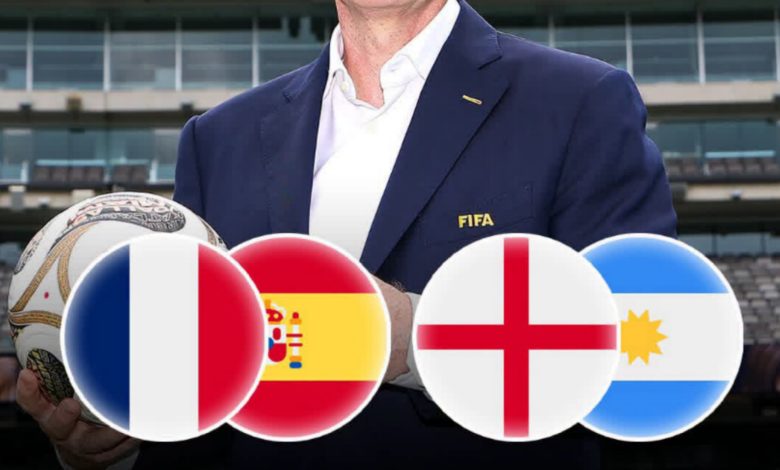
With the tournament entering its final week, football fans are eagerly anticipating the semi-finals involving France, Spain, England and Argentina before attention shifts to Sunday’s showpiece final at New Jersey’s MetLife Stadium.
However, while discussions have largely focused on the teams still competing for football’s biggest prize, FIFA’s entertainment plans have unexpectedly become one of the tournament’s biggest talking points.
FIFA introducing historic half-time show
For the first time in World Cup history, spectators inside the stadium and millions watching around the globe will be treated to a full-scale musical performance during the interval of the final.
Inspired by the hugely successful Super Bowl half-time show in the NFL, FIFA has partnered with Global Citizen to stage what promises to be one of the biggest entertainment spectacles ever seen at a football match.
The performance will reportedly feature a star-studded line-up including Justin Bieber, Shakira, Burna Boy, Madonna and members of BTS.
Coldplay frontman Chris Martin has been heavily involved in producing the event, while additional appearances are expected from beloved characters associated with Sesame Street and The Muppets, creating an entertainment package aimed at audiences of all ages.
It represents another example of FIFA attempting to transform the World Cup into a broader global entertainment event rather than simply a football tournament.
Why the decision is controversial
Despite the excitement surrounding the musical performances, the decision has raised eyebrows because it appears to conflict with football’s established laws regarding the duration of half-time.
According to the IFAB (International Football Association Board) Laws of the Game, the half-time interval should last no longer than 15 minutes unless altered with the referee’s permission.
Law 7 of the Laws of the Game states that players are entitled to a half-time interval not exceeding 15 minutes, although competitions can determine precise arrangements provided they comply with the regulations.
Introducing an elaborate stage performance presents an obvious logistical challenge.
Not only must performers take to the stage, but crews also need sufficient time to construct and dismantle the performance area before players can safely resume the match.
That process inevitably extends the interval.
How long will half-time last?
FIFA has not officially confirmed the exact duration of the break.
However, several reports suggest it will be considerably longer than the traditional 15-minute interval.
According to multiple sources cited by The Athletic, organisers are targeting a total half-time period of approximately 20 minutes.
Meanwhile, The Times has reported that the interval could last as long as 30 minutes depending on production requirements.
Should those reports prove accurate, it would represent the longest scheduled half-time in World Cup history.
The extended break would allow enough time for the stage to be assembled, the performances to take place and the pitch to be cleared before the second half begins.
FIFA following the American sports model
The decision reflects FIFA president Gianni Infantino’s desire to embrace aspects of American sports entertainment.
Throughout the 2026 tournament, FIFA has already introduced numerous innovations designed to appeal to audiences beyond traditional football supporters.
Among the biggest changes seen during the competition have been:
Enhanced pre-match entertainment ceremonies.
New player introductions.
Expanded television graphics.
Longer hydration breaks.
Several experimental refereeing regulations.
Increased use of Connected Ball Technology.
Adding a Super Bowl-inspired half-time show continues that trend.
It also demonstrates FIFA’s willingness to blend football tradition with entertainment concepts commonly associated with North American sports.
Similar events have already taken place
Although this is the first time a World Cup final will feature a dedicated half-time concert, similar events have taken place during recent international tournaments.
During the 2025 FIFA Club World Cup final at the same stadium, halftime lasted approximately 24 minutes while performers Doja Cat, Tems and J Balvin entertained spectators.
Unlike the upcoming World Cup show, those performances took place in the stands rather than on the playing surface.
The 2024 Copa América final between Argentina and Colombia also featured an extended interval after Shakira delivered a headline performance at Miami’s Hard Rock Stadium.
That break reportedly lasted around 26 minutes.
Those events provided FIFA with valuable experience in managing large-scale entertainment during football matches.
Artists reportedly not receiving appearance fees
One surprising aspect of the event is that none of the performers are expected to receive payment.
Much like the NFL’s Super Bowl halftime show, the enormous global exposure is considered sufficient compensation for many artists.
According to reports, performers including Justin Bieber and Shakira have agreed to participate without appearance fees.
Instead, the event is being organised in partnership with Global Citizen as part of FIFA’s wider charitable initiatives.
The FIFA Global Citizen Education Fund is attempting to raise $100 million to improve children’s access to education and organised sport around the world.
Funds generated through the initiative will also support FIFA’s Football for Schools programme.
Additionally, Shakira recently announced that $500,000 would be donated to children affected by earthquakes in Venezuela.
Entertainment extends beyond half-time
The halftime show will not be the only entertainment planned for the final.
FIFA is also organising an extensive closing ceremony following the presentation of the World Cup trophy.
Among those expected to perform are:
Robbie Williams
Laura Pausini
Nicole Scherzinger
IShowSpeed
Hollywood actor Tom Cruise is also expected to make a special appearance, while Jennifer Hudson will perform the United States national anthem before kick-off.
The scale of the entertainment package underlines FIFA’s ambition to make the World Cup final one of the biggest sporting and entertainment events ever staged.
Traditionalists remain divided
Not everyone has welcomed FIFA’s latest innovation.
Many football supporters believe the simplicity of the sport is part of its appeal and argue that extending half-time purely for entertainment undermines football’s traditions.
Critics also worry that a significantly longer interval could affect player preparation, recovery and concentration during the biggest match in world football.
Managers typically use the 15-minute break to make tactical adjustments, address fitness concerns and prepare players mentally for the second half.
A prolonged interruption could alter the rhythm of the game and potentially influence performances.
Others, however, believe the change represents a natural evolution of football’s biggest event.
With the World Cup attracting billions of viewers worldwide, supporters of the idea argue that combining elite football with world-class entertainment could broaden the tournament’s global appeal even further.
Another bold step for FIFA
Whether fans embrace or reject the concept, the introduction of a halftime concert marks another major milestone in FIFA’s ongoing transformation of the World Cup.
The 2026 edition has already become the first tournament featuring 48 teams, expanded knockout rounds, new technology, revised officiating procedures and numerous commercial innovations.
Now, the World Cup final itself is set to become an entertainment spectacle unlike anything previously seen in football.
As England, Argentina, France and Spain battle for a place in Sunday’s final, attention will soon turn not only to who lifts the famous trophy but also to how FIFA’s most ambitious halftime production is received by football fans across the globe.
Regardless of opinion, the decision ensures that the 2026 World Cup final will be remembered for much more than the football played on the pitch.