CELTIC FANS WON’T BELIEVE THIS! SAME REFEREE APPOINTED FOR DUNDEE UNITED CLASH AFTER PREVIOUS CELTIC PENALTY ERROR WAS CONFIRMED!
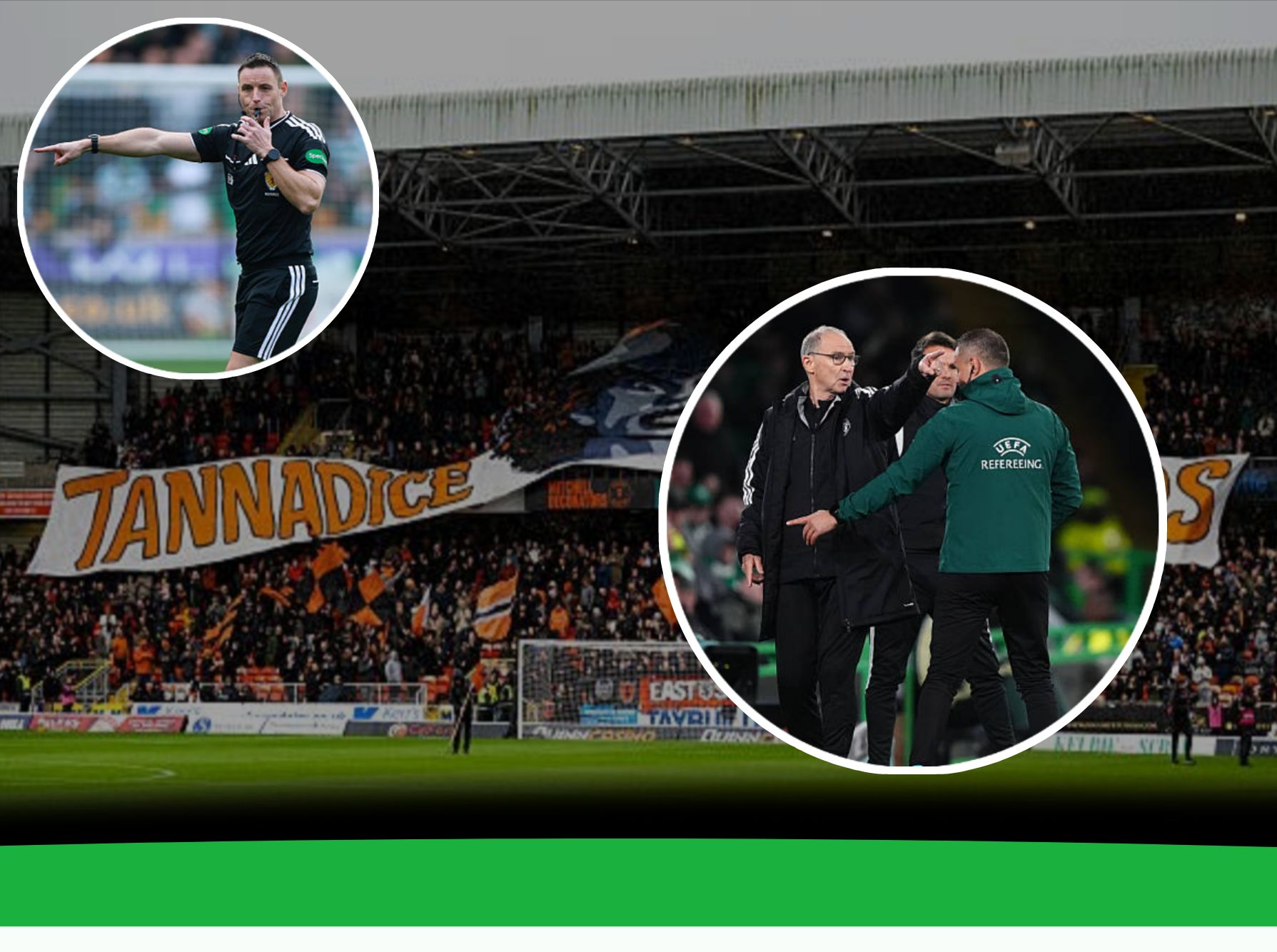
Celtic fans have been handed another major talking point ahead of Wednesday’s Scottish Premiership clash with Dundee United after referee Steven McLean was appointed to take charge of the match, despite being involved in a controversial penalty decision during Celtic’s previous league meeting with Motherwell.
The appointment has already attracted attention, particularly because the Scottish FA’s head of refereeing, Willie Collum, has publicly confirmed that Celtic should have been awarded a penalty during that October 11 encounter at Fir Park.
For many supporters, the timing of the announcement raises an obvious question: why has the same referee been selected for another Celtic match so soon after an incorrect decision involving the Hoops was acknowledged?
Celtic will welcome Dundee United to Celtic Park on Wednesday, October 28, with kick-off scheduled for 7:45 pm. Martin O’Neill’s side will be looking to build on their recent victories and maintain their push in the Scottish Premiership, but the latest refereeing development has added another layer of discussion ahead of the fixture.
The focus is no longer simply on the players, the manager or the three points at stake. Supporters are also talking about the officials, the previous incident at Fir Park and the decision to appoint McLean again.
While the appointment does not automatically mean another controversial decision will occur, the circumstances surrounding it have understandably attracted attention.
And with Celtic preparing for another important domestic fixture, supporters will be hoping that the biggest talking point after Wednesday’s match is the football itself.
THE REFEREEING DECISION THAT STARTED THE CONTROVERSY
To understand why this appointment has attracted so much attention, it is important to look back at Celtic’s league meeting with Motherwell on October 11.
Celtic travelled to Fir Park for a match in which they eventually secured a 2-0 victory. However, one incident involving captain Callum McGregor became a significant talking point after the final whistle.
During the match, McGregor attempted to send a shot towards goal, only for the ball to strike the arm of Motherwell player Lukas Fadinger inside the penalty area.
Celtic were not awarded a penalty. Instead, the decision was a corner, leaving the Hoops without the opportunity to take a spot-kick from the incident.
Steven McLean was the referee in charge, while Don Robertson was operating as the video assistant referee.
Although Celtic went on to win the match, the incident did not disappear. Questions remained about whether the officials had made the correct decision, particularly given the position of Fadinger’s arm when the ball struck him.
For supporters, the issue was straightforward: if the incident should have resulted in a penalty, why was it not awarded during the match?
The fact that Celtic won 2-0 did little to end the debate. A favourable final score does not necessarily remove questions about an important refereeing decision.
More importantly, the incident became even more significant when the Scottish FA subsequently reviewed it.
WILLIE COLLUM CONFIRMS CELTIC SHOULD HAVE RECEIVED A PENALTY
The controversy took another turn when Willie Collum, the Scottish FA’s head of refereeing, addressed the incident publicly.
Following a review of the decision, Collum confirmed that Celtic should have been awarded a penalty against Motherwell.
His explanation focused on the position of Fadinger’s arm and the circumstances surrounding the contact with McGregor’s shot.
The conclusion was that the officials should have awarded the spot-kick.
That confirmation gave Celtic supporters an important piece of information: their concerns about the decision were supported by the official review.
It also placed the performance of the match officials under renewed scrutiny.
In modern football, referees and VAR officials are expected to make difficult decisions in real time. Not every incident is straightforward, and the interpretation of handball can be particularly complicated because officials must consider the player’s actions, the position of the arm and the circumstances of the contact.
However, when a subsequent review concludes that the wrong decision was made, questions about the process are inevitable.
Why was the incident not correctly identified during the match? Could VAR have intervened? And what can be done to prevent similar mistakes in future fixtures?
These are legitimate questions for supporters to ask.
For Celtic, the immediate consequence was that a penalty they should have received was missed. The team still secured the victory, but that does not change the conclusion reached by the Scottish FA.
And now, just over two weeks after that match, the same referee has been appointed to take charge of another Celtic league fixture.
That is the development that has placed the upcoming Dundee United match under an additional spotlight.
WHY STEVEN McLEAN’S NEW APPOINTMENT IS ATTRACTING ATTENTION
The announcement that McLean will referee Celtic against Dundee United has generated debate because of the recent history between the official and the club.
The appointment comes only 17 days after the Motherwell match on October 11, when McLean was in charge of the incident that the Scottish FA subsequently ruled should have resulted in a Celtic penalty.
For supporters who believe refereeing appointments should take recent controversies into account, the timing is difficult to ignore.
Some will question whether appointing another referee for the match might have prevented the latest debate before it began.
Others may argue that referees should not automatically be excluded from future fixtures because they have made an incorrect decision, particularly when the relevant authorities have already reviewed the incident.
Both perspectives raise an important question about how refereeing appointments should be managed in Scottish football.
The appointment itself does not establish that Celtic will be treated unfairly, nor does it prove that the officials have any preference against the club.
However, the Scottish FA must understand why the decision has attracted attention.
When an official has recently been involved in a significant mistake affecting a particular team, another appointment involving that same team will naturally invite questions.
For Celtic supporters, confidence in the officiating is an important part of the matchday experience. They want to believe that decisions will be made consistently, that VAR will be used appropriately and that mistakes will be acknowledged when they occur.
The latest appointment therefore presents an opportunity for the officials to ensure that attention returns to the football rather than remaining focused on the controversy.
Ultimately, McLean’s performance on Wednesday will be judged by the decisions he makes during the game.
CELTIC HAVE ANOTHER IMPORTANT MATCH TO CONCENTRATE ON
Despite the discussion surrounding the referee, Celtic cannot afford to lose sight of what matters most on the pitch.
Martin O’Neill’s team will be determined to continue collecting points as the Scottish Premiership campaign progresses.
Celtic enter the fixture after a 2-1 victory over Hibernian at Easter Road on October 25. That result followed their emphatic 7-1 victory over Hearts on October 18, demonstrating the team’s ability to produce attacking football and find the back of the net.
The win over Hearts was particularly impressive because Celtic scored seven goals in a dominant performance at Celtic Park.
However, the match against Dundee United presents a different challenge.
Every league fixture brings its own difficulties, and Celtic will need to approach the game with concentration, discipline and a clear plan.
Dundee United will not arrive at Celtic Park simply to admire their opponents. They will want to compete, frustrate Celtic where possible and take advantage of any opportunities that arise.
That means O’Neill’s players must remain focused from the opening whistle until the final minutes.
The manager will want his team to move the ball quickly, create opportunities and make effective use of their attacking players.
Celtic’s supporters will also expect the team to show the confidence and intensity that helped produce their recent victories.
With the season continuing to develop, every point can be important. Dropping points at home would be a disappointment, especially when Celtic have the opportunity to build momentum through a run of positive results.
The referee controversy may dominate the pre-match conversation, but the players still have a job to do.
MARTIN O’NEILL WILL WANT THE SPOTLIGHT ON HIS PLAYERS
For O’Neill, the immediate challenge is ensuring that the discussion surrounding the referee does not become a distraction for his squad.
Managers are often asked about refereeing decisions before and after matches, particularly when their teams have been involved in controversial incidents.
However, O’Neill will know that the best response is to prepare his players properly and ensure they deliver a strong performance.
Celtic need to be organised defensively, decisive in possession and clinical when opportunities arise.
They must also remain composed when decisions do not go their way.
Football matches can change quickly. A disputed foul, an offside decision or a penalty appeal can alter the mood inside a stadium, especially when supporters are already paying close attention to the officials.
Celtic will need to avoid allowing frustration to affect their concentration.
At the same time, the team must be prepared to take advantage of any opportunities that come their way.
O’Neill’s experience will be important in maintaining that balance.
The manager can remind his players that they cannot control every decision made by the officials, but they can control their effort, discipline and response to difficult moments.
If Celtic perform well and secure another victory, the main conversation could quickly shift back to their progress in the league.
But if another controversial incident occurs, the existing scrutiny surrounding the appointment could intensify.
That is one reason why Wednesday’s match is attracting attention beyond the usual pre-match discussion.
WHAT ABOUT VAR? THAT IS ANOTHER IMPORTANT QUESTION
The Motherwell incident also raises questions about the role of VAR in Scottish football.
The technology was introduced to help officials review important incidents and correct clear mistakes that may have been missed during the match.
Penalty decisions are among the situations in which VAR can make a significant difference.
However, the system depends on effective communication between the referee on the pitch and the officials responsible for reviewing the available footage.
In the Motherwell match, Don Robertson was the VAR official, but Celtic were not awarded a penalty.
The subsequent review concluded that a penalty should have been given.
That naturally raises questions about why the incident did not lead to the correct outcome at the time.
Supporters want to understand how these decisions are assessed and what happens when an error is identified afterwards.
They also want reassurance that lessons are being learned.
VAR cannot eliminate every mistake in football. Some incidents remain open to interpretation, and the speed of the game can make certain decisions particularly challenging.
Nevertheless, when an official review identifies an incorrect decision, explaining the reasoning behind the original call and the review process can help supporters understand what happened.
Transparency is important because trust in refereeing is built not only on making the correct decisions but also on explaining mistakes honestly.
Ahead of Celtic’s match against Dundee United, the officials will know that supporters are paying close attention.
The priority must be to apply the laws consistently, communicate effectively and ensure that any reviewable incidents are handled appropriately.
DUNDEE UNITED WILL BE FOCUSED ON THEIR OWN OPPORTUNITY
While the refereeing appointment has become a major talking point among Celtic supporters, Dundee United will have their own objectives heading into the match.
They will know that Celtic Park is a difficult place to visit, particularly when the home side is enjoying a positive run of results.
Nevertheless, the visitors will believe they have an opportunity to test Celtic and potentially leave Glasgow with something to show for their efforts.
Dundee United’s approach will be crucial.
They may look to remain compact defensively, limit the space available to Celtic’s attackers and use quick transitions when possession is recovered.
If Celtic dominate the ball, United will need to remain disciplined and avoid giving the home side unnecessary opportunities around the penalty area.
At the other end, they must be ready to exploit any defensive mistakes.
The visitors will also want to avoid allowing the atmosphere inside Celtic Park to influence their decision-making.
For them, the referee’s appointment is simply one part of the match preparations. Their primary responsibility is to execute their game plan and compete for the result.
That is what makes the fixture interesting.
Celtic will be seeking another victory to maintain momentum, while Dundee United will hope to frustrate the hosts and take advantage of any weaknesses.
With both teams having their own ambitions, the match promises to provide plenty of talking points.
WILL THE REFEREEING CONTROVERSY AFFECT WEDNESDAY’S MATCH?
This is the question many Celtic supporters will be asking.
The short answer is that nobody can predict how the officiating will unfold.
McLean’s previous involvement in the Motherwell incident does not mean that another mistake is inevitable.
Equally, the fact that the Scottish FA has acknowledged the earlier error does not mean supporters should stop asking questions about the appointment.
The important issue is whether the match officials can deliver a consistent performance.
Celtic will expect decisions to be made fairly, Dundee United will expect the same, and both teams will want the result to be determined by their performances rather than avoidable officiating errors.
If a penalty appeal arises, supporters will naturally examine the decision closely because of the recent history.
If VAR becomes involved, the process will attract particular attention.
But it is important to distinguish between legitimate scrutiny and assumptions about what might happen.
There is currently no basis for claiming that McLean will deliberately favour one side or disadvantage the other.
The focus should remain on the quality and consistency of the decisions made during the match.
For the Scottish FA, the appointment is another reminder that confidence in refereeing requires both accountability and clear communication.
For Celtic, it is an opportunity to put the controversy aside and concentrate on securing three valuable points.
And for supporters, Wednesday’s match will provide the evidence they need to judge the officials’ performance for themselves.
CELTIC FANS WILL BE WATCHING CLOSELY
The appointment of Steven McLean has added an unexpected storyline to Celtic’s preparations for Dundee United.
The previous penalty incident at Fir Park was already controversial, but the Scottish FA’s subsequent confirmation that Celtic should have received a spot-kick gave the debate greater significance.
Now, with McLean returning to referee another Celtic league fixture only 17 days later, supporters have fresh questions about the appointment process.
Some will believe the decision creates unnecessary controversy. Others will argue that the referee deserves the opportunity to officiate another match without being judged solely on his previous mistake.
Whatever their views, one thing is certain: attention will be firmly on the officials when Celtic take to the pitch at Celtic Park.
However, the match will not be decided by headlines or social media debates.
Celtic must perform, Dundee United must compete, and the officials must do their jobs to the highest possible standard.
For O’Neill, the objective is clear: guide his team towards another important victory and keep their league campaign moving in the right direction.
For the referee, the challenge is to ensure that the game is remembered for the football rather than another major controversy.
And for Celtic supporters, the hope will be that there is no repeat of the kind of incident that has dominated the conversation in the days leading up to this fixture.
FINAL THOUGHTS: A BIG GAME WITH AN EXTRA STORYLINE
Celtic’s meeting with Dundee United was always going to be an important fixture, but the latest refereeing appointment has added another dimension to the build-up.
Steven McLean will take charge despite the recent Motherwell penalty incident, which the Scottish FA subsequently confirmed should have resulted in a spot-kick for Celtic.
That decision has understandably prompted discussion about the timing of the appointment and whether the process should have been handled differently.
Nevertheless, the real test will come on Wednesday night.
Celtic must focus on their football, Dundee United will look to challenge them, and the match officials will need to demonstrate consistency throughout the contest.
The appointment has created a talking point, but it does not predetermine what will happen.
Will Celtic get the decisions they deserve this time? Can Martin O’Neill guide his team to another important victory? And will the refereeing remain out of the headlines when the final whistle blows?
Those are the questions supporters will be watching closely as Celtic prepare to face Dundee United at Celtic Park.
One thing is clear: after the controversy at Fir Park, the spotlight will be on Steven McLean once again. 🍀