Derek McInnes in Deep Trouble; Explosive Hearts Handshake Drama Sparks Fresh Suspension Fears After Rangers Draw
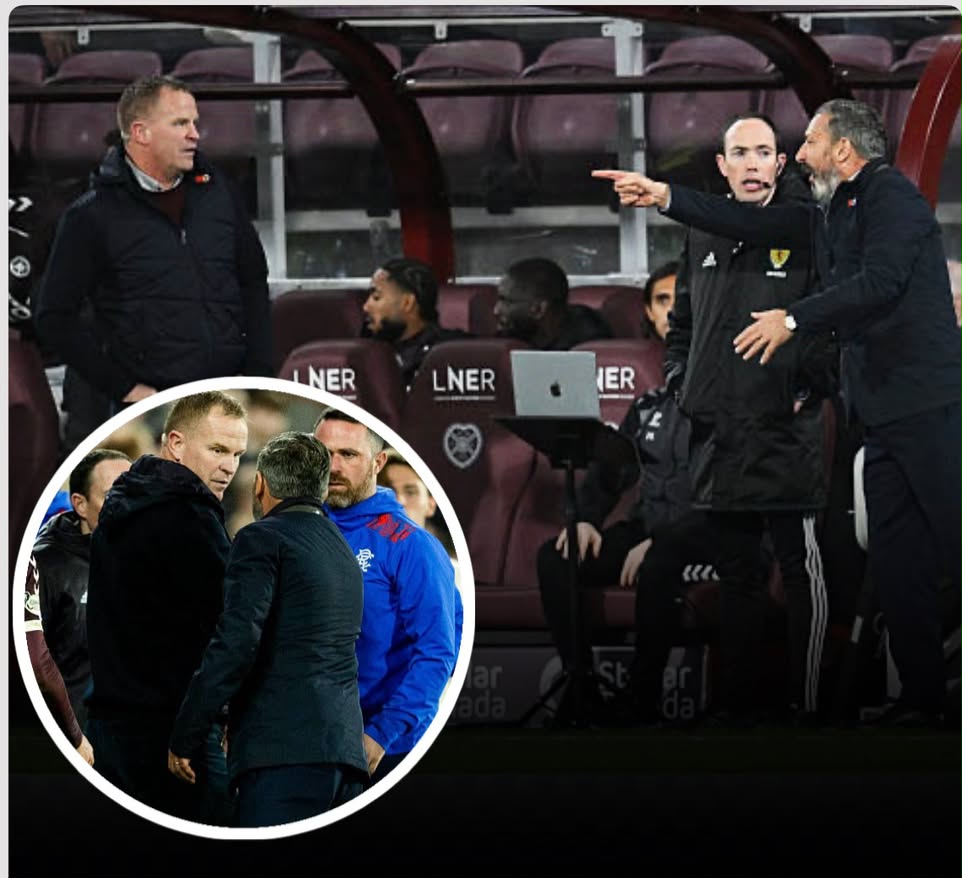
Derek McInnes has found himself at the centre of another Scottish football controversy after an awkward post-match handshake with Hearts manager Wouter Vrancken overshadowed Rangers’ dramatic 2–2 draw at Tynecastle. With tensions surrounding his return to Hearts, his previous disciplinary battle with the Scottish FA and his outspoken comments about the end of last season’s title race still fresh in the minds of supporters, the latest incident has raised questions about what really happened between the two managers.
Scottish football has witnessed another dramatic evening, and once again, Rangers manager Derek McInnes is at the centre of the conversation.
What should have been remembered primarily as an entertaining Premiership encounter became a talking point after the final whistle, when McInnes and his successor at Hearts, Wouter Vrancken, appeared to exchange tense words during an unusually prolonged handshake.
The incident immediately attracted attention because of the circumstances surrounding McInnes’ return to Tynecastle.
The 55-year-old left Hearts during the summer to take charge of Rangers after guiding the Edinburgh club through a remarkable campaign that ended in disappointment as Celtic secured the Premiership title.
His departure had already created a difficult relationship with sections of the Hearts support. The reception he received on his return, combined with the dramatic events of the match and the apparent tension between the two managers, ensured that the post-match exchange would attract considerable scrutiny.
But is this simply a case of two frustrated managers reacting emotionally after a fiercely contested game, or does the incident reveal deeper tensions between McInnes and the club he left behind?
Rangers and Hearts Deliver a Dramatic 2–2 Encounter
The controversy unfolded after Rangers and Hearts played out a thrilling 2–2 draw at Tynecastle on Wednesday, 28 October.
McInnes’ Rangers initially took control of the contest when Kevin Kelsy gave the visitors the lead in the first half.
However, Hearts responded after the interval. Claudio Braga restored parity before Calvin Miller put the home side ahead, leaving Rangers facing the possibility of a damaging defeat.
With the home supporters anticipating a significant victory, Rangers desperately searched for a response.
Their persistence eventually paid off when Olwethu Makhanya scored a late equaliser, rescuing a point for McInnes and preventing his return to Tynecastle from ending in defeat.
The result, however, did little to remove the tension surrounding the occasion.
Hearts had come close to defeating their former manager’s new team, while Rangers needed a late goal to escape with a point.
That frustration appeared to carry into the moments after the final whistle.
As the managers approached each other for the customary handshake, the exchange looked unusually tense. They appeared to hold on to the handshake, exchange words and briefly come into close physical contact before separating.
Although the footage prompted widespread discussion, the incident alone does not establish that either manager committed a disciplinary offence.
Nevertheless, the timing and circumstances made it particularly intriguing.
The Awkward Handshake That Stole the Headlines
Post-match handshakes are usually routine formalities in football. Managers congratulate each other, exchange a few words and move towards their respective dressing rooms.
This one appeared different.
McInnes and Vrancken seemed to have more to say to each other than would normally be expected after a match. Their expressions and body language attracted attention, and the exchange quickly became one of the main talking points from Tynecastle.
For supporters who had watched the game unfold, the question was obvious: what exactly was said between the two managers?
Vrancken subsequently addressed the situation, indicating that managers naturally fight for their respective teams. He also stressed his respect for McInnes and said they had spoken at the end and that matters were fine.
His comments offered some reassurance, but they did not prevent further speculation about the exchange.
McInnes, meanwhile, played down the apparent tension with a humorous explanation.
He joked that he had been telling Vrancken how grateful the Hearts manager should be for inheriting such a strong squad from him.
The remark was characteristic of the light-hearted response McInnes offered when questioned about the incident.
However, the contrast between the apparent intensity of the handshake and the managers’ subsequent explanations ensured that the story continued to attract attention.
Was it simply frustration following a fiercely contested draw, or was there more personal history behind the exchange?
At present, there is no confirmed evidence establishing that the handshake was the result of a deeper dispute.
Why Derek McInnes’ Return to Hearts Was Already Explosive
To understand why the incident generated so much attention, it is necessary to consider the background to McInnes’ departure.
His final season at Hearts had placed him in a difficult position.
The club had competed for the Scottish Premiership title and entered the closing stages of the campaign with the opportunity to achieve something historic.
However, the championship ultimately went to Celtic, leaving Hearts supporters disappointed after a season in which their team had come so close to the ultimate prize.
The conclusion of that campaign was particularly controversial because of disputed refereeing decisions.
McInnes publicly criticised the decision to award Celtic a stoppage-time penalty during their match against Motherwell, describing the decision as “disgusting”.
He also expressed the feeling that Hearts were fighting against circumstances beyond their control.
His remarks attracted widespread attention and eventually resulted in disciplinary action from the Scottish Football Association.
The controversy intensified the debate surrounding the title race and the responsibilities of managers when publicly criticising match officials.
McInnes subsequently left Hearts to take charge of Rangers, a move that created another source of tension.
For Hearts supporters, watching their former manager return in the dugout of a major rival was always likely to provoke a strong reaction.
The handshake incident therefore occurred against a background of disappointment, disputed decisions and an emotionally charged managerial departure.
Could McInnes Face Another Suspension?
This is the question likely to interest supporters most, particularly given the manager’s previous disciplinary problems.
McInnes has already faced punishment from the Scottish FA for his comments about match officials during his time at Hearts.
The original sanction was a four-match touchline ban, with one match suspended. Following Rangers’ appeal, the immediate portion of the ban was reduced from three matches to two, while the overall sanction remained in place.
The disciplinary case concerned comments about refereeing decisions, including the controversial penalty awarded to Celtic against Motherwell.
It did not arise from a handshake dispute.
That distinction is important when assessing the latest incident.
The tense exchange between McInnes and Vrancken has attracted attention, but there is no confirmed announcement that the Scottish FA has opened a new disciplinary case against McInnes because of the handshake.
Nor has a new suspension over this particular incident been established.
Any suggestion that he is certain to face another ban would therefore go beyond the available evidence.
However, the incident may still generate discussion about the conduct expected of managers after emotionally charged matches.
Football authorities can examine incidents when there is a credible reason to do so, but an awkward handshake does not automatically amount to a disciplinary offence.
For Rangers supporters, the immediate question is whether the matter will end with the managers’ public explanations or attract further scrutiny.
For now, there is no confirmed new suspension to report.
The Celtic Connection: Why Last Season’s Controversy Still Matters
Although the latest incident involved Hearts, the wider context extends beyond the two clubs.
McInnes’ previous dispute with the Scottish FA was closely connected to Celtic’s successful title campaign.
The controversy began when Celtic received a late penalty against Motherwell in a match that had significant implications for the championship.
McInnes, who was managing Hearts at the time, strongly criticised the decision.
His comments subsequently became the subject of disciplinary proceedings because of the rules governing public criticism of match officials.
The case sparked a wider debate about how managers can express frustration over important refereeing decisions without crossing disciplinary boundaries.
Rangers also challenged the punishment, arguing that McInnes’ remarks should be considered in context and raising questions about consistency in the application of the rules.
That dispute ensured the issue remained prominent as McInnes began his Rangers tenure.
Consequently, the latest handshake controversy arrives at a time when the manager’s conduct and public comments have already attracted considerable attention.
However, the two matters must not be confused.
The earlier disciplinary action concerned criticism of match officials. The latest controversy concerns an apparent exchange between two managers after a match.
There is no established basis for describing the handshake itself as hate speech or claiming that it has resulted in a new suspension.
The distinction matters because the story is already dramatic without overstating what has been confirmed.
What Did Wouter Vrancken Actually Say?
Vrancken’s response provides an important part of the story.
Rather than presenting the incident as a major personal dispute, the Hearts manager spoke about the competitive nature of football and the importance of a genuine handshake.
He also expressed respect for McInnes and acknowledged the work the Rangers manager had done, both at Hearts and in his current position.
His comments suggested that the apparent tension should not automatically be interpreted as evidence of a lasting breakdown in relations.
McInnes’ humorous explanation also offered a different perspective on the exchange.
Nevertheless, the contrasting reactions have left supporters discussing the moment and debating whether the body language told a different story from the subsequent comments.
Without a complete, verified account of the words exchanged, it would be premature to claim that either manager made a particular threat or issued an insult.
The most responsible conclusion is that the handshake appeared tense, the incident attracted attention, and both managers subsequently offered comments that played down the suggestion of a serious ongoing dispute.
Rangers Have Their Own Problems to Solve
While the handshake has attracted headlines, McInnes must also concentrate on Rangers’ performance.
His side initially took the lead but struggled to maintain control after the interval.
Hearts scored twice to turn the game around, exposing defensive weaknesses that Rangers will need to address.
Although Makhanya’s late header rescued a point, the performance left questions about the team’s consistency and ability to manage difficult periods in matches.
McInnes acknowledged that Rangers had not shown enough authority and criticised aspects of their defending.
He also recognised that Hearts had performed strongly and that Rangers had not done enough to deserve a victory.
The result left Rangers four points behind Celtic in the Premiership standings, according to reports following the match.
That gap means every dropped point matters as the season develops.
For McInnes, the immediate priority is to improve Rangers’ performances and maintain focus on the title race.
The last thing the club needs is for a post-match controversy to overshadow the footballing issues that require attention.
However, managing the media spotlight is part of the job, particularly when a manager returns to a former club under difficult circumstances.
What Happens Next?
The handshake controversy has created plenty of discussion, but the next development will depend on whether any new information emerges.
At present, neither a new suspension over the incident nor a fresh disciplinary charge arising from the handshake has been confirmed.
Vrancken has spoken about the exchange, and McInnes has offered a light-hearted explanation.
Those comments suggest that the managers are not publicly presenting the incident as a major ongoing dispute.
Nevertheless, supporters will continue to debate the footage, particularly given the complicated history surrounding McInnes’ departure from Hearts and his previous disciplinary case.
The incident also raises a familiar question in Scottish football: how much significance should be attached to moments of visible frustration after high-pressure matches?
Managers are competitors. They invest considerable emotion in their teams, and a dramatic draw can produce tense exchanges.
Not every disagreement signals a major feud, and not every awkward handshake warrants disciplinary action.
Equally, public figures in football should expect their conduct to attract scrutiny when a moment appears unusual.
The challenge is to distinguish what can be seen from what remains speculation.
Final Verdict: A Handshake Controversy, but No Confirmed New Ban
Derek McInnes’ return to Tynecastle delivered everything Scottish football supporters could have expected from a high-stakes encounter: goals, a late equaliser, an intense atmosphere and a dramatic post-match moment.
The 2–2 draw between Rangers and Hearts ensured that the football itself remained significant, but the handshake between McInnes and Vrancken provided another talking point.
The incident has attracted attention because of McInnes’ complicated departure from Hearts, the hostility surrounding his return and the previous disciplinary case linked to his criticism of match officials during the title race with Celtic.
Those connections explain why the footage has generated so much interest.
However, the available evidence does not establish that the handshake involved hate speech or that a new suspension is imminent.
For now, the story is one of visible tension, competing interpretations and a manager whose return to his former club was always likely to attract scrutiny.
Whether the controversy fades or develops further remains to be seen.
One thing is certain: after such a dramatic night at Tynecastle, the conversation surrounding Derek McInnes is far from over.