“TOO MANY UNNECESSARY CALLS FROM THE REFEREE!” — GRANIT XHAKA’S BRUTAL VERDICT
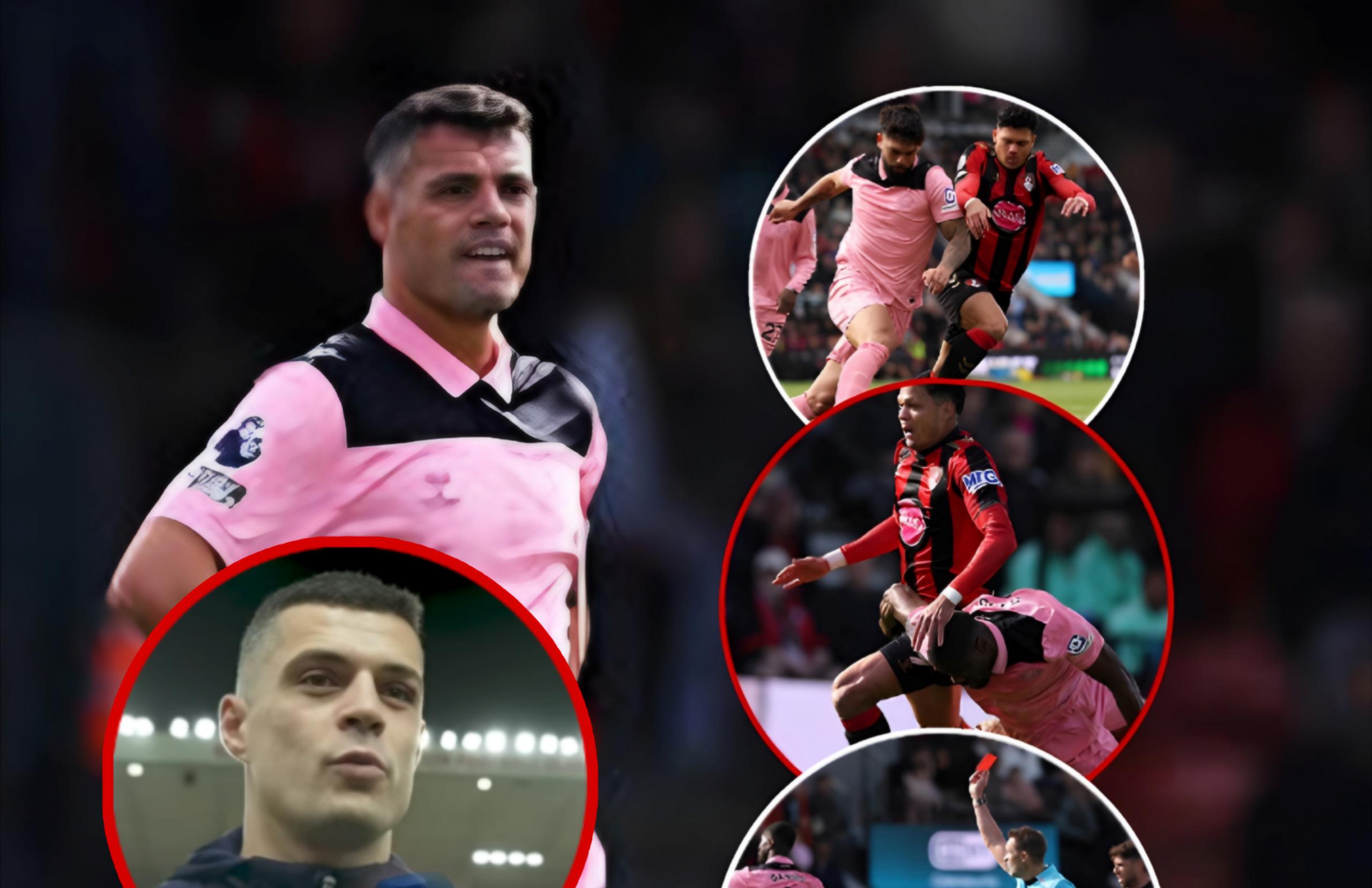
The atmosphere surrounding Sunderland’s disappointing 2–0 defeat to Bournemouth has intensified following a match filled with defensive mistakes, a controversial red-card moment, missed opportunities, and heated exchanges on the pitch.
For Sunderland supporters, Sunday’s defeat at the Vitality Stadium was about much more than the final score. The Black Cats struggled to maintain their defensive organisation, lost Kevin Danso to an early red card, and conceded a second goal shortly after half-time. Meanwhile, Bournemouth capitalised on Sunderland’s problems to secure a valuable Premier League victory.
Granit Xhaka, Sunderland’s influential midfielder and captain, found himself at the centre of the discussion after an afternoon in which his team struggled to impose itself on the contest.
“TOO MANY UNNECESSARY CALLS FROM THE REFEREE!”
The debate focuses on the officiating decisions, the circumstances surrounding Danso’s dismissal, and the wider problems that left Sunderland unable to recover against an increasingly confident Bournemouth side.
But with the final whistle confirming a 2–0 defeat, the biggest question facing Sunderland is whether the team can recover quickly enough to prevent this disappointing run from damaging its Premier League campaign further.
AN EARLY GOAL PUTS SUNDERLAND UNDER PRESSURE
Sunderland arrived at the Vitality Stadium needing a positive result, but Bournemouth immediately demonstrated its attacking intentions.
The home side pressed aggressively and looked to exploit the spaces behind Sunderland’s defensive line. With Marco Rose searching for his first Premier League victory as Bournemouth manager, his players had every reason to start the contest with intensity.
Their approach paid off in the sixth minute.
Bournemouth sent a long ball forward that caused problems for Kevin Danso and Omar Alderete. Evanilson managed to get ahead of the Sunderland defenders before delivering a pass across the penalty area.
Marcus Tavernier was perfectly positioned to take advantage, heading the ball into the net from close range.
Bournemouth had taken a 1–0 lead, and Sunderland were immediately forced to reconsider their approach.
The goal was particularly frustrating because it resulted from a situation the visitors should have handled more effectively. Instead of clearing the danger or maintaining their defensive shape, Sunderland allowed Evanilson to find space and create a straightforward scoring opportunity.
For Xhaka, the early setback meant Sunderland’s midfield had to work harder to regain control of the match.
The captain needed to help his teammates settle down, retain possession, and prevent Bournemouth from building further momentum.
However, the home side continued to threaten, and Sunderland’s defensive difficulties soon produced an even more damaging incident.
KEVIN DANSO’S RED CARD CHANGES THE ENTIRE MATCH
The most significant moment of the first half arrived in the 17th minute.
Evanilson again found himself in a dangerous position after getting beyond the Sunderland defence. Danso attempted to stop the Brazilian striker, who was moving towards goal with an opportunity to threaten goalkeeper Robin Roefs.
Danso brought Evanilson down outside the penalty area.
Referee Craig Pawson immediately showed the Sunderland defender a straight red card for denying an obvious goalscoring opportunity. VAR checked the decision and confirmed it.
Sunderland were now trailing 1–0 and facing the prospect of playing with ten men for almost the entire match.
The dismissal created an enormous tactical problem for manager Régis Le Bris.
With one defender removed, Sunderland had to reorganise its defensive line while attempting to protect the spaces Bournemouth wanted to exploit.
The remaining defenders were required to cover more ground, while the midfield had to contribute additional defensive work.
Xhaka’s responsibilities became even more important because Sunderland needed leadership and composure in the middle of the pitch.
The captain had to help his teammates remain organised despite the setback.
The red card also intensified the discussion surrounding the referee’s decisions.
Supporters could debate the circumstances, but the key consideration was whether Danso’s challenge had denied Evanilson an obvious goalscoring opportunity.
The officials concluded that it had.
That decision left Sunderland with a difficult task, and Bournemouth immediately began looking for ways to take advantage of its numerical superiority.
DID THE REFEREE HAVE TOO MUCH INFLUENCE?
The headline about unnecessary refereeing calls has become a major talking point because Sunderland’s afternoon was shaped by several important incidents.
However, the red card was not the only factor in the defeat.
The early goal had already placed Sunderland under pressure, while defensive errors continued to create opportunities for Bournemouth.
Nevertheless, the dismissal naturally became the focus of attention because it changed the balance of the match.
For Sunderland supporters, losing a defender so early meant their team had little opportunity to execute its original tactical plan.
Le Bris had to make adjustments, the midfield had to work harder, and the remaining defenders faced an increasingly difficult assignment.
Xhaka was among those expected to help Sunderland regain some control.
The captain’s experience was particularly valuable in a match where emotions could easily take over.
When a team goes behind and loses a player, frustration can quickly spread throughout the side. Players may begin making hurried passes, abandoning their positions, or committing unnecessary fouls.
Sunderland needed to avoid that situation.
Instead, Bournemouth continued to create chances, forcing Roefs to make several important saves.
The officials’ decision to dismiss Danso remained a significant talking point, but the visitors also had to confront the mistakes that had put them in such a difficult position.
That distinction matters.
Even when a team disagrees with a refereeing decision, it must still find a way to compete with the circumstances it faces.
Sunderland could not afford to allow frustration about the red card to distract them from the remaining 73 minutes of football.
ROBIN ROEFS KEEPS SUNDERLAND IN THE CONTEST
Despite Bournemouth’s advantage, Sunderland had opportunities to make the match more difficult for the hosts.
Goalkeeper Robin Roefs produced several important saves as Bournemouth attempted to extend its lead.
Rayan tested the Sunderland goalkeeper, who reacted well to keep the ball out. Bournemouth also created a rebound opportunity for Adam Smith, but the defender failed to convert.
Roefs continued to demonstrate his quality as the home side looked for a second goal.
He saved another attempt from Rayan and dealt with further efforts as Bournemouth attempted to make its numerical advantage count.
These interventions were crucial because Sunderland were struggling to maintain defensive control.
Without Roefs’ saves, the match could have been effectively decided before half-time.
His performance also highlighted the pressure placed on Sunderland’s defence.
A goalkeeper can make outstanding saves, but he cannot prevent every opportunity when opponents repeatedly find space in dangerous areas.
Sunderland needed its defenders and midfielders to offer greater protection.
Xhaka, as the experienced captain, was expected to help maintain that structure.
However, Bournemouth continued to look dangerous whenever it moved forward, leaving Sunderland under considerable pressure.
EVANILSON PUNISHES ANOTHER DEFENSIVE ERROR
Any hope Sunderland had of mounting a second-half comeback suffered a major blow just three minutes after the restart.
In the 48th minute, Bournemouth doubled its lead through Evanilson.
The goal came after Alderete attempted a backpass that lacked sufficient pace.
Evanilson anticipated the mistake, intercepted the ball, rounded Roefs, and calmly finished into the empty net.
Bournemouth were now 2–0 ahead.
The goal was a devastating moment for Sunderland because it followed an afternoon already dominated by defensive problems.
The opening goal had exposed confusion between the defenders.
Danso’s dismissal had left the team with ten men.
Now Alderete’s underhit backpass had handed Bournemouth another opportunity to score.
Evanilson deserves credit for recognising the danger and finishing confidently, but Sunderland’s defensive decision-making made his task considerably easier.
The goal also underlined Evanilson’s influence throughout the contest.
He had helped create Tavernier’s opener, won the situation that led to Danso’s dismissal, and then scored Bournemouth’s second goal.
It was an outstanding individual contribution.
For Sunderland, however, the second goal left the team facing an almost impossible recovery task.
Xhaka and his teammates now needed to find a way to prevent the scoreline from becoming even worse while searching for an opportunity to reduce the deficit.
GRANIТ XHAKA’S LEADERSHIP UNDER THE SPOTLIGHT
Xhaka’s role became particularly important as Sunderland attempted to manage the match after conceding twice.
The experienced midfielder has built his career around demanding standards, competitive intensity, and leadership.
Those qualities were badly needed in a match where Sunderland struggled to maintain its composure.
However, even a strong individual performance from the captain could not resolve every problem affecting the team.
Sunderland needed collective discipline.
The midfield had to protect the defence, the defenders needed to communicate more effectively, and the attacking players had to find opportunities without leaving their teammates exposed.
Playing with ten men made all those responsibilities more difficult.
Bournemouth could move the ball across the pitch and force Sunderland to defend for longer periods.
Every time the visitors attempted to push forward, they risked leaving additional space behind them.
The challenge for Xhaka was to help the team remain organised while ensuring the players did not surrender their attacking ambition entirely.
It was a difficult balance.
Sunderland needed to create chances, but they also had to prevent Bournemouth from scoring again.
The captain’s influence could help with communication and organisation, yet the team still needed every player to make better decisions.
The defeat therefore raised questions about Sunderland’s collective response to adversity.
BOURNEMOUTH MISS CHANCES TO MAKE IT THREE
Although Bournemouth had established a comfortable advantage, the hosts continued searching for additional goals.
Tavernier came close to scoring again, but Roefs reacted quickly to deny him.
Evanilson also threatened to add another goal, while Rayan continued to create problems for the Sunderland defence.
Bournemouth’s attacking movement repeatedly exposed the visitors’ difficulties.
The home side created enough opportunities to suggest that the final score could have been more emphatic.
Yet Roefs continued to make important interventions, preventing Sunderland from suffering an even heavier defeat.
His performance was one of the few positive aspects of the afternoon for the Black Cats.
The goalkeeper’s saves also demonstrated why Sunderland’s defensive organisation must improve.
When opponents can repeatedly create dangerous opportunities, the goalkeeper becomes the team’s final line of protection.
That is not a sustainable way to collect Premier League points.
Sunderland must reduce the number of chances they concede and make it more difficult for opponents to enter dangerous positions.
Otherwise, even strong goalkeeping performances will not always be enough.
SUNDERLAND’S ATTACK FAILS TO RESPOND
One of the most disappointing aspects of the match was Sunderland’s limited attacking threat.
Playing with ten men was undoubtedly a major disadvantage, but the visitors still needed to find ways to trouble Bournemouth.
Instead, Sunderland struggled to create meaningful opportunities.
The team managed only three attempts, none of which was on target.
That statistic reflected the difficulty Sunderland experienced in building attacks capable of testing Bournemouth goalkeeper Djordje Petrovic.
The situation was made more complicated by the absence of established attacking options, including Brian Brobbey.
Young forward Timur Tutierov was among those required to shoulder greater responsibility in a difficult match.
With Sunderland trailing by two goals, Le Bris had to consider how to introduce attacking energy without leaving the defence completely exposed.
Substitutions provided an opportunity to change the team’s approach, but Bournemouth remained in control.
Sunderland’s midfield struggled to create the consistent supply required for the forwards to threaten the opposition goal.
Xhaka’s experience could help the team retain possession and organise its movements, but Sunderland needed more penetration in the final third.
The lack of shots on target was a major concern because it meant Bournemouth were rarely forced to defend against a sustained attacking threat.
For a team hoping to recover its Premier League form, that is an area requiring urgent attention.
FOUR CONSECUTIVE DEFEATS INCREASE THE PRESSURE
The Bournemouth defeat marked Sunderland’s fourth consecutive loss in the Premier League.
That run has increased pressure on Le Bris and raised concerns among supporters about the team’s domestic form.
Sunderland have shown that they can compete in European competition, but their league performances have become increasingly difficult to defend.
The challenge of balancing domestic and European commitments is considerable.
Players must travel, recover, train, and prepare for opponents with different tactical approaches.
Squad rotation becomes necessary, and injuries can make those decisions even more complicated.
However, the problems against Bournemouth were not simply the result of a demanding schedule.
The early defensive error, Danso’s dismissal, and Alderete’s backpass all played important roles in the defeat.
Sunderland must address those issues regardless of the fixture list.
The team cannot afford to enter every match knowing that one mistake could immediately place it under enormous pressure.
That is why discipline, concentration, and communication must become priorities.
The players must learn to manage difficult moments without allowing them to develop into a chain of costly incidents.
WHAT MUST CHANGE BEFORE SUNDERLAND’S NEXT MATCH?
Le Bris now faces the challenge of rebuilding confidence while preparing his squad for another demanding fixture.
The first priority must be defensive organisation.
Sunderland need to improve their response to long balls, communicate more effectively between defenders, and avoid risky passes when opponents are pressing.
The second priority is discipline.
Players must recognise the consequences of individual decisions, particularly when an opponent is moving towards goal.
The third priority is attacking efficiency.
Sunderland cannot depend entirely on defensive resilience and goalkeeping saves. They must create chances and put opposition goalkeepers under pressure.
Finally, the team needs stronger leadership when matches become difficult.
Xhaka’s experience makes him an important figure in that process, but responsibility must be shared throughout the squad.
Every player must understand the importance of remaining composed after a setback.
The next opportunity to respond will arrive quickly, with Sunderland preparing for their Europa League meeting with Lech Poznań before returning to Premier League action against Leeds United.
Those matches will provide an opportunity to demonstrate whether the team can learn from its mistakes.
FINAL VERDICT: SUNDERLAND NEED ANSWERS, NOT MORE SETBACKS
Bournemouth’s 2–0 victory was built on clinical finishing, intelligent movement, and the ability to exploit Sunderland’s defensive mistakes.
Tavernier’s sixth-minute goal gave the hosts an early advantage.
Danso’s 17th-minute red card left Sunderland with ten players.
Evanilson’s 48th-minute finish punished another defensive error and effectively settled the contest.
Roefs prevented a heavier defeat, but Sunderland struggled to create a meaningful attacking response.
The referee’s decision to dismiss Danso became a major talking point because of its impact on the match. However, Sunderland must also confront the mistakes that contributed to their downfall.
For Xhaka, Le Bris, and the rest of the squad, the challenge is now to turn frustration into improvement.
The captain must help restore composure, the defenders must improve their decision-making, and the attacking players must find ways to create more opportunities.
Sunderland’s supporters deserve a response that demonstrates the team has learned from this painful afternoon.
The Premier League is unforgiving, and another poor performance could deepen the problems already facing the Black Cats.
The final question is whether Sunderland can turn their frustration into a determined response—or whether the mistakes at Bournemouth will continue to haunt their season.