Frank Lampard’s Post-Match Reaction After Coventry’s Painful Night Against Tottenham!
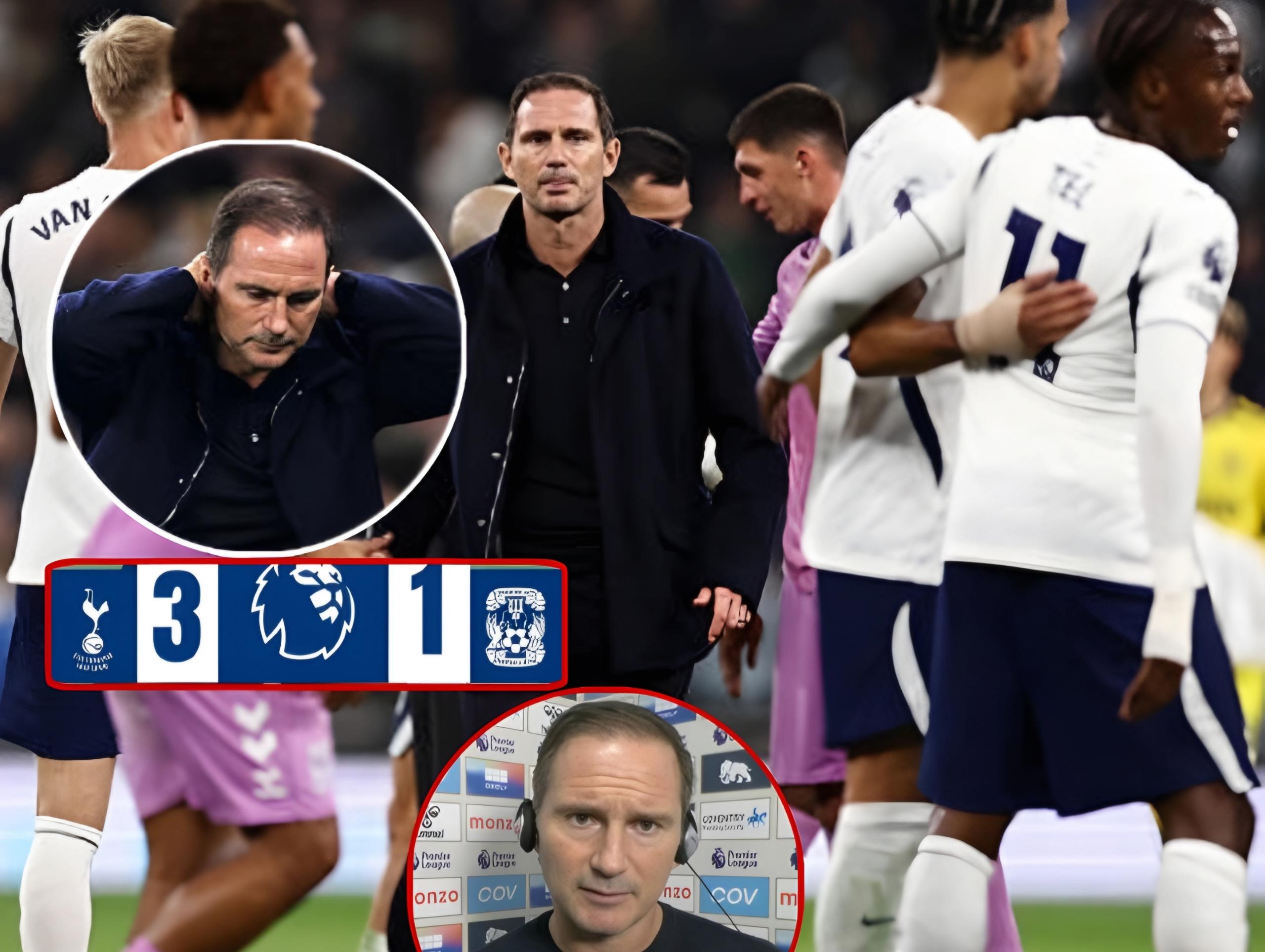
Frank Lampard has been left facing serious questions after Coventry City’s 3–1 defeat to Tottenham Hotspur, but it was the message surrounding responsibility, tactics and the need to learn from mistakes that could prove most important for the Sky Blues moving forward.
Coventry travelled to north London determined to show that their impressive attacking football could trouble Premier League opposition. Having recently produced a commanding 4–1 victory over Newcastle United, Lampard’s side arrived with confidence and a belief that they could compete against Tottenham.
For long periods, Coventry showed exactly why their supporters have been encouraged by the team’s approach. They attacked with purpose, looked for opportunities to move the ball forward and refused to allow Tottenham to control every phase of the contest.
However, the final score told a painful story.
Tottenham won 3–1, with James Maddison opening the scoring, Jack Rudoni bringing Coventry level, Omar Marmoush restoring the home side’s advantage and Ben Davies scoring a late third goal.
For Coventry supporters, the defeat raised difficult questions. Why did their team fail to protect the momentum gained from Rudoni’s equaliser? Could different tactical decisions have changed the outcome? And what must Lampard do to turn promising performances into results against stronger opposition?
The central issue is not whether Coventry can attack. They have already demonstrated that they can create problems for opposing defences. The challenge is finding the right balance between attacking ambition and defensive organisation.
A PROMISING START ENDS WITH A FRUSTRATING RESULT
Coventry entered the contest knowing that Tottenham would attempt to impose themselves early. Playing away from home against a team with quality across the pitch required concentration, organisation and confidence in possession.
The Sky Blues were not interested in spending the entire match defending around their own penalty area. They wanted to compete, move forward and test Tottenham whenever opportunities appeared.
That attacking intention was one of the most noticeable features of the contest.
Nevertheless, Tottenham found the breakthrough in the 14th minute when James Maddison scored to put the home side ahead.
The goal immediately placed Coventry in a difficult position. Chasing a match against Tottenham meant Lampard’s players had to decide whether to remain patient or increase their attacking commitment in search of an equaliser.
Going forward was necessary, but it also created the possibility of leaving spaces that Tottenham could exploit.
For Lampard, the opening goal offered an important lesson about the fine margins involved in these matches. A team can have an ambitious game plan and still be punished if its defensive structure breaks down at the wrong moment.
Coventry needed a response, and they eventually delivered one.
JACK RUDONI GIVES COVENTRY HOPE
Coventry supporters received something to celebrate when Jack Rudoni scored in the 49th minute to make it 1–1.
The equaliser changed the atmosphere around the contest. Coventry had found a way back into the game, and their players had a reason to believe that they could leave north London with a positive result.
Rudoni’s goal also demonstrated the value of Coventry’s willingness to attack rather than surrender possession and territory without a fight.
At that moment, the contest was balanced again.
The responsibility then shifted to the entire team. Coventry needed to use the equaliser as a platform, maintain their concentration and make Tottenham work hard to regain the lead.
Instead, the match turned against them again.
THE GOAL THAT CHANGED THE DIRECTION OF THE MATCH
Tottenham restored their advantage in the 58th minute through Omar Marmoush, leaving Coventry trailing 2–1.
The goal became one of the major talking points because of the circumstances surrounding the challenge involving Milan van Ewijk. Lampard was unhappy with the contact he believed had taken place, and the incident raised questions among Coventry supporters about whether the goal should have stood.
For Coventry, the frustration was understandable. They had worked hard to recover from Maddison’s opening goal, only to find themselves behind again less than ten minutes after the restart.
However, the incident also highlighted a broader issue.
A team cannot afford to allow frustration over a decision to consume the rest of its performance. Players must remain focused, continue competing and avoid allowing one difficult moment to influence the next several minutes.
That does not mean a manager must remain silent about decisions he considers questionable. Lampard has every reason to review the incident and explain his concerns. But Coventry’s response after conceding was equally important.
They needed composure, organisation and a clear plan for finding another equaliser.
Instead, Tottenham maintained their advantage and eventually added a third goal.
LAMPARD MUST TAKE RESPONSIBILITY FOR THE TACTICAL BALANCE
The biggest lesson from the defeat concerns the balance between attacking football and defensive security.
Coventry have shown that they can threaten teams when they move the ball quickly, commit players forward and attack spaces. Their 4–1 victory over Newcastle demonstrated the potential of their approach.
But one strong performance does not automatically mean the same tactical structure will work against every opponent.
Tottenham possess players capable of punishing defensive gaps. When Coventry pushed forward, they needed to ensure that enough players remained in positions to deal with counterattacks and second balls.
This is where Lampard must examine his decisions.
Taking responsibility as a manager means looking beyond individual mistakes and considering whether the overall plan gave the team the best possible chance of winning.
Did Coventry maintain the correct distances between their midfield and defence? Were the full-backs given enough protection when they moved forward? Did the team have a clear response when Tottenham regained possession? And were the substitutions capable of changing the match’s direction?
These are the questions that matter after a defeat.
Lampard must also consider whether his formation allowed Coventry’s attacking players to influence the match without leaving the defence exposed.
A formation is not simply a collection of names written on a team sheet. It determines how players support one another, how the team presses and how quickly it can recover when possession is lost.
Coventry need an approach that allows them to attack confidently while remaining difficult to play through.
That does not mean abandoning their attacking identity. It means improving the organisation that supports it.
WHY COVENTRY SUPPORTERS SHOULD NOT LOSE FAITH
Despite the disappointment, Coventry supporters have reasons to remain behind their team.
The Sky Blues did not travel to Tottenham simply to defend for 90 minutes. They attempted to compete, created attacking situations and scored through Rudoni.
Those qualities should not be dismissed because the final result was disappointing.
Supporters understand that competing against Premier League opposition requires more than enthusiasm. It requires quality, discipline, concentration and the ability to make the right decisions under pressure.
Coventry showed ambition, but they were unable to turn that ambition into a result.
The distinction matters.
A team that creates opportunities and attacks with purpose has something to build on. A team that repeatedly exposes itself defensively must also recognise where improvements are necessary.
The challenge for Lampard is ensuring that encouragement does not become complacency.
He must acknowledge the positive aspects of the performance while being honest about the weaknesses that contributed to the defeat.
Supporters are more likely to remain patient when they can see that the manager understands the problems and has a plan to address them.
THE LATE GOAL MADE THE DEFEAT EVEN HARDER TO ACCEPT
Coventry’s hopes of rescuing something from the contest were finally extinguished when Ben Davies scored in the 90th minute, with the goal arriving in stoppage time at 90+6.
The late strike made the score 3–1 and left Coventry facing a two-goal defeat after a match in which they had managed to draw level.
For the players, conceding so late would have been particularly frustrating. By that stage, Coventry needed to find a way back into the contest, but the additional goal made the task impossible.
Late goals often reveal the importance of concentration and decision-making. Even when a team is chasing an equaliser, it must remain organised enough to avoid conceding another goal.
Lampard will need to examine how Coventry managed the closing stages.
Were players positioned correctly? Did the team maintain enough defensive cover? Was there a clear understanding of who should remain behind the ball while others pushed forward?
These details can make the difference between a narrow defeat and a result that leaves a team with even more work to do.
The answer is not necessarily to become defensive whenever a match becomes difficult. Coventry still need to attack when they are behind. But they must know how to do so without losing their structure completely.
WHAT LAMPARD MUST CHANGE BEFORE THE NEXT CHALLENGE
Lampard’s next task is to turn the frustration of the Tottenham defeat into practical improvements.
First, Coventry must work on their defensive transitions. When an attack breaks down, players need to react immediately, close passing lanes and prevent opponents from moving into dangerous spaces.
Second, the midfield must provide consistent protection. Attacking midfielders and wide players cannot always remain ahead of the ball when possession changes hands. They must understand when to press and when to recover into defensive positions.
Third, Coventry need to manage important moments better. After Rudoni’s equaliser, the team had an opportunity to settle into the match and force Tottenham to work for another goal. Conceding again soon afterwards made their task considerably harder.
Fourth, Lampard must assess his substitutions and tactical adjustments according to the state of the game. Changes should provide fresh energy, strengthen vulnerable areas or introduce a new attacking threat when the existing plan is no longer working.
Finally, the manager must make sure his players understand that attacking courage and defensive discipline are not opposing ideas. The strongest teams combine both.
Coventry do not have to stop playing positive football. They have to become more intelligent about when to commit players forward, when to slow the match down and how to protect an advantage when they find themselves in front.
A DEFEAT THAT CAN BECOME A TURNING POINT
The 3–1 defeat to Tottenham will hurt Coventry City, especially because Rudoni’s equaliser briefly gave them hope of taking something away from the contest.
But the result does not have to define their season.
Lampard has a responsibility to identify the mistakes, improve the tactical structure and ensure the players return to the next match with greater understanding.
The most important response is not simply to promise that things will improve. It is to demonstrate that improvement through better organisation, sharper decision-making and more control during decisive periods.
Coventry supporters want a team that competes, attacks and believes it can challenge stronger opponents. They also want a side that learns from its setbacks rather than repeating the same mistakes.
The performance against Tottenham offered evidence of Coventry’s attacking potential, but it also exposed the work still required.
For Lampard, taking responsibility means accepting that the manager must be part of the solution. He must examine his own decisions as carefully as he examines the performances of his players.
The defeat was shared by the team, but the responsibility for preparing that team rests with the manager.
Coventry now have a choice. They can allow the disappointment to linger, or they can use it as motivation to become more disciplined, more organised and more effective in both penalty areas.
The message for Lampard is clear: Coventry’s attacking ambition is worth protecting, but it must be supported by a stronger tactical foundation.
And for the supporters, the hope is that their manager can turn the lessons from north London into performances that deliver the results their commitment deserves.