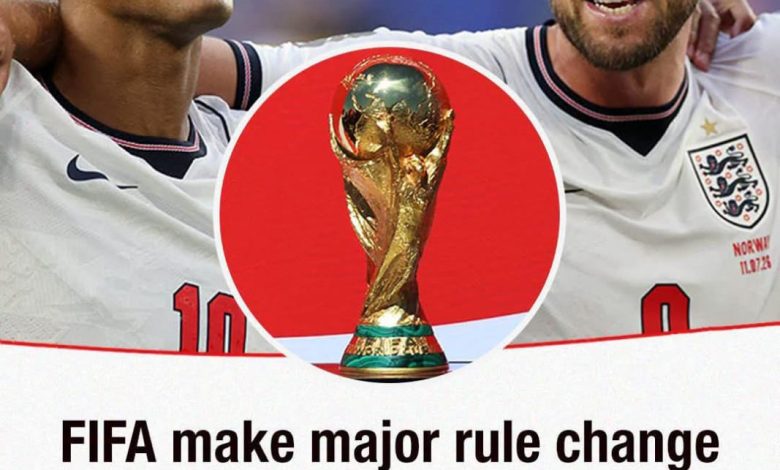
FIFA has announced a significant last-minute equipment change ahead of the closing stages of the 2026 FIFA World Cup, confirming that a brand-new official match ball will be used for the semi-finals and the final.
The decision means England, Argentina, France and Spain will all play with a different ball than the one used throughout the earlier rounds of the tournament.
The move comes after growing criticism of the Adidas Trionda match ball from players, goalkeepers and pundits, many of whom questioned its unpredictable flight during several high-profile matches.
New ball to debut in the semi-finals
According to reports, FIFA and Adidas have unveiled the Trionda Final, a redesigned version of the tournament ball that will make its debut in the semi-finals.
The first match to feature the new ball will be France’s clash with Spain, before England face Argentina a day later. It will also be used in both the third-place play-off and Sunday’s World Cup final.
Rather than making changes to the technology inside the ball, Adidas has introduced a special edition design inspired by the FIFA World Cup trophy.
The updated ball features:
A gold, black and white colour scheme
Graphics celebrating the host cities of the decisive matches
The same four-panel construction used throughout the tournament
Connected Ball Technology, including the embedded sensor used by VAR officials
Why FIFA decided to make the change
Although FIFA has not officially stated that the redesign is a response to criticism, the announcement follows weeks of complaints regarding the original Adidas Trionda ball.
Several goalkeepers claimed the ball moved unpredictably through the air, making long-range shots and crosses difficult to judge.
Former England goalkeeper Joe Hart was among the most outspoken critics, comparing the Trionda to the infamous Jabulani ball used during the 2010 World Cup in South Africa.
The Jabulani became one of football’s most controversial match balls after numerous goalkeepers complained about its erratic movement.
Similar concerns have resurfaced during this tournament, particularly following several spectacular long-range goals and goalkeeping mistakes.
Technology remains unchanged
Despite the new appearance, FIFA has confirmed that the Trionda Final retains the same Connected Ball Technology used throughout the tournament.
The embedded sensor records data hundreds of times every second and assists VAR officials with decisions involving:
Ball touches
Offside incidents
Deflections
Potential handballs
Other close match situations
The technology recently became a major talking point following England’s controversial equaliser against Norway.
Norwegian players argued that Jude Bellingham’s goal should have been disallowed because the ball appeared to strike a spidercam cable before dropping to Elliot Anderson.
FIFA defended the decision by releasing Connected Ball data, stating there was no recorded impact and therefore no evidence that the ball had touched the overhead cable.
Adidas explains the new design
In a statement announcing the ball, Adidas said the Trionda Final celebrates the cities hosting the tournament’s biggest matches.
The company explained:
“Trionda Final celebrates the host cities of the tournament’s decisive matches through a bold typographic approach integrated directly into the panel graphics.”
The special edition therefore serves as both a commemorative ball and the official match ball for the final week of the competition.
England and Argentina face fresh adjustment
While professional footballers regularly adapt to different match balls, introducing a new one at such a crucial stage inevitably creates another variable for players.
England will begin using it immediately when they take on Argentina in Atlanta.
Thomas Tuchel’s side have built their World Cup campaign around resilience rather than spectacular long-range shooting.
Interestingly, England have yet to score from outside the penalty area during the tournament, despite Jude Bellingham and Harry Kane each contributing six goals.
Argentina have also relied more on combination play than long-distance efforts, managing only two goals from outside the box.
The biggest adjustment may therefore fall on the goalkeepers.
Jordan Pickford, Emiliano Martínez, Mike Maignan and Unai Simón will all spend training sessions becoming familiar with the ball’s movement before stepping onto the pitch.
Tournament has produced goals
Whether or not the Trionda contributed to attacking football, the tournament has produced plenty of entertainment.
Statistics show:
More than three goals per game on average
Ten goals scored from outside the penalty area
Numerous spectacular strikes and unexpected goalkeeping errors
Some observers believe the ball has played a role in increasing attacking excitement, while others argue the quality of football has simply been exceptionally high.
Semi-finals promise huge spectacle
The introduction of the Trionda Final comes just before four of world football’s biggest nations battle for a place in Sunday’s final.
The semi-final schedule is:
France vs Spain – Tuesday
England vs Argentina – Wednesday
England will attempt to reach their first World Cup final since 1966, while Argentina hope to defend the title they won in Qatar four years ago.
France are chasing a third consecutive World Cup final appearance, while Spain continue their impressive run under a new generation of stars.
More than just a cosmetic change
Although the updated ball appears primarily to be a commemorative edition rather than a complete redesign, its arrival has generated considerable discussion because of the criticism surrounding the original Trionda.
Players often insist that even subtle differences in grip, flight and feel can affect performances, particularly at the highest level where margins are incredibly small.
Whether the Trionda Final behaves differently from its predecessor remains to be seen.
What is certain is that every pass, save and shot during the semi-finals and final will now be made using FIFA’s newest World Cup ball, adding another intriguing subplot to what promises to be a dramatic conclusion to the 2026 tournament.