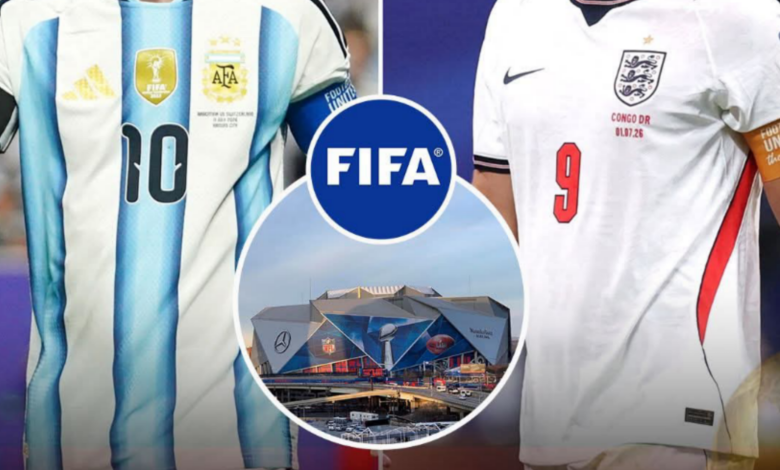
FIFA is set to make an unusual exception to one of its long-standing World Cup regulations when England and Argentina meet in Wednesday’s blockbuster 2026 FIFA World Cup semi-final at Atlanta Stadium.
The match is already packed with storylines. England are aiming to reach their first World Cup final since 1966, while reigning champions Argentina are looking to defend the title they won in Qatar four years ago. However, attention has now shifted away from the players after it emerged that FIFA has been forced to relax one of its own commercial rules because of a unique feature at the venue.
Unlike every other stadium being used during the tournament, Atlanta Stadium contains a sponsor logo that FIFA has been unable to remove or conceal, creating a rare exception to its strict branding policies.
FIFA’s strict World Cup branding policy
One of FIFA’s most closely enforced commercial rules during every World Cup concerns stadium branding.
Because FIFA has exclusive commercial partnerships with tournament sponsors, host venues are required to remove or completely cover any branding belonging to companies that are not official World Cup partners.
The rule applies to everything from advertising boards and corporate signage to stadium names, logos and sponsor branding.
This explains why fans have noticed that many famous NFL stadiums are using temporary names throughout the tournament.
For example:
MetLife Stadium has become New York New Jersey Stadium
AT&T Stadium is officially Dallas Stadium
Hard Rock Stadium is known simply as Miami Stadium
Gillette Stadium has become Boston Stadium
Mercedes-Benz Stadium is referred to as Atlanta Stadium
The aim is to ensure only FIFA-approved sponsors receive worldwide exposure during the competition.
The problem FIFA couldn’t solve
Despite these strict regulations, Atlanta Stadium presents FIFA with a unique challenge.
According to reports, the enormous Mercedes-Benz logo mounted on top of the stadium roof cannot be removed or hidden.
Unlike external signs or stadium naming rights that can be temporarily altered, the iconic three-pointed Mercedes star forms part of the building’s roof structure itself.
After lengthy discussions lasting around 18 months, FIFA reportedly accepted that covering or removing the logo was not practically possible.
As a result, the governing body has allowed the logo to remain visible throughout the tournament.
That makes Atlanta Stadium the only American World Cup venue where a non-tournament commercial sponsor remains openly displayed.
A rare exception to FIFA’s own rules
Normally, FIFA enforces its commercial regulations without compromise.
Host cities invest significant time and money ensuring venues comply with tournament requirements before the World Cup begins.
In Atlanta’s case, however, FIFA concluded there was no realistic solution that wouldn’t involve major structural work to the stadium itself.
Rather than delay preparations or undertake expensive engineering work, officials agreed to make a one-off exception.
The decision is particularly notable because FIFA has spent years protecting the exclusivity of its commercial partnerships.
Allowing a globally recognised automotive brand such as Mercedes-Benz to remain visible during World Cup matches is something the organisation would ordinarily avoid.
Why the stadium is still called Atlanta Stadium
Although the Mercedes logo remains on the roof, FIFA has still renamed the venue throughout the tournament.
Officially, it is known simply as Atlanta Stadium, removing the Mercedes-Benz name from all fixtures, broadcasts and tournament documentation.
This follows the same approach used across the United States, Canada and Mexico, where stadium naming rights linked to commercial sponsors have been temporarily suspended for the duration of the World Cup.
So while television viewers may still spot the Mercedes emblem on aerial shots, all official FIFA materials refer to the venue using its neutral tournament name.
England and Argentina prepare for huge showdown
The commercial issue has become another talking point ahead of what promises to be one of the biggest matches of the tournament.
England arrive full of confidence after overcoming Norway 2-1 in extra time, with Jude Bellingham scoring both goals to send Thomas Tuchel’s side into the last four.
Argentina, meanwhile, continue their defence of the World Cup title after eliminating Switzerland following an earlier victory over Egypt.
The two footballing nations share one of international football’s richest rivalries, stretching back decades.
From Diego Maradona’s “Hand of God” and “Goal of the Century” in 1986 to David Beckham’s redemption penalty in 2002, meetings between England and Argentina have rarely lacked drama.
Wednesday’s encounter will also mark Lionel Messi’s first senior international appearance against England.
Argentina granted another FIFA request
The stadium branding exception isn’t the only unusual FIFA decision involving Argentina ahead of the semi-final.
Earlier this week, FIFA approved Argentina’s request to wear their navy-blue away kit instead of their traditional sky-blue and white stripes.
Many supporters believe the darker shirt brings good fortune against England, recalling famous World Cup victories in both 1986 and 1998 while wearing similar colours.
England, designated as the home team, will wear their traditional white kit.
Security expected to be among the tightest of the tournament
The significance of the fixture extends beyond football.
Reports have suggested authorities consider England versus Argentina one of the highest-risk matches of the World Cup because of the historic rivalry between the two nations.
Security around Atlanta Stadium is therefore expected to be among the strongest seen during the competition.
Thousands of police officers, private security staff and tournament officials will be deployed to manage supporters arriving at the 71,000-capacity venue.
Focus remains on football
While the Mercedes logo has unexpectedly become part of the pre-match discussion, it is unlikely to distract either side from the task ahead.
England are chasing only their second World Cup final appearance, hoping stars such as Jude Bellingham, Harry Kane and Declan Rice can guide them past the reigning champions.
Argentina, led by Lionel Messi and Lionel Scaloni, are aiming to move one step closer to retaining the trophy and cementing another historic chapter in the nation’s football story.
For FIFA, however, the semi-final represents something slightly different.
After years of carefully protecting its commercial rules, the governing body has reluctantly accepted that one iconic piece of branding simply could not be hidden.
It is an extraordinary exception during a tournament where almost every detail has been meticulously controlled—and one that ensures Atlanta Stadium will stand out from every other venue used at the 2026 FIFA World Cup.