Why Jude Bellingham wasn’t sent off for covering his mouth but Miguel Almiron was
Bellingham escaped a red card during England’s 0-0 draw against Ghana.
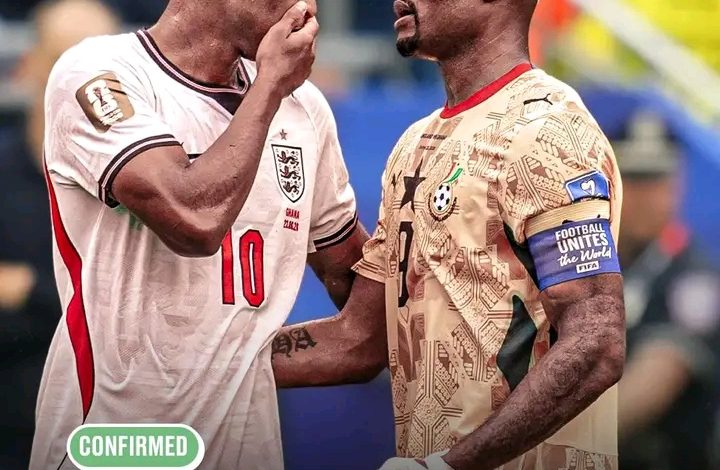
Jude Bellingham avoided the same punishment as Paraguay star Miguel Almiron when he covered his mouth while talking during England’s 0-0 World Cup draw against Ghana.
Bellingham, who was given FIFA’s ‘Superior Player of the Match’ award for his performance in Boston, played 73 minutes for England before being replaced by Morgan Rogers.
He was involved in an angry half-time exchange with Ghana head coach Carlos Queiroz, who was unhappy with a challenge that the Real Madrid star committed on one of his players.
Queiroz said he believed that Bellingham was fortunate to avoid a yellow card, and potentially even a red card, over the incident.
Separately, he was also spotted in conversation with Ghana captain Jordan Ayew before both players were substituted in the second half.
The 22-year-old covered his mouth with his hand while talking to Ayew – something that, in specific circumstances, was outlawed by FIFA ahead of the 2026 World Cup.
During Paraguay’s 1-0 win over Turkey, former Newcastle winger Almiron was shown a straight red card after he covered his mouth while in a verbal altercation with opposition defender Mert Muldur.
Almiron became the first player to fall foul of FIFA’s new rule and was given a one-match suspension, meaning he will miss Paraguay’s final group match against Australia.
Why Bellingham avoided red card vs Ghana
The reason why Bellingham did not receive a red card is because of FIFA’s intentional framing of what constitutes a red card for a player covering their mouth.
A player covering their mouth to talk has not been banned by FIFA, with the rule instead covering instances where there are more aggressive confrontations.
It was brought in after Benfica winger Gianluca Prestianni received a six-match ban by UEFA for using a homophobic slur during his side’s Champions League play-off clash against Real Madrid in March.
The Argentinian had initially been accused of making a racist remark towards Vinicius Junior, but UEFA could not reach the threshold required for the burden of proof – partially because Prestianni had covered his mouth with his shirt while talking.
FIFA’s head of referees, Pierluigi Collina, explained the rule in a pre-World Cup briefing.
“Players can continue to cover their mouth with an arm and the shirt, because they may chat with friends,” the Italian said.
“It’s normal to chat before, during or after the match. So if the conversation is a friendly conversation, they can continue to do it without any problem.
“When the conversation is confrontational, covering the mouth means that you are doing something very wrong, potentially, and the sanction is the red card.”
“When the conversation is confrontational, covering the mouth means that you are doing something very wrong, potentially, and the sanction is the red card.”
The wording of the rule also applied to Lionel Messi, who covered his mouth with his hand during Argentina’s 3-0 win over Algeria in their opening World Cup group stage match.
Because Messi, who is now the World Cup’s all-time leading goalscorer, was simply communicating with his team-mates during a pitch-side team talk, no sanction was necessary.