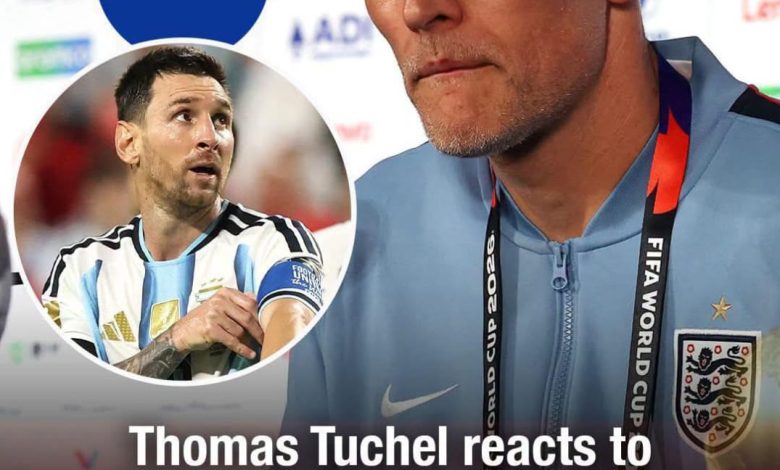
England manager Thomas Tuchel has brushed aside any concerns over FIFA’s decision to grant Argentina’s special kit request ahead of Wednesday’s highly anticipated FIFA World Cup semi-final, insisting he understands why the reigning champions would lean into superstition if they believe it offers even the smallest psychological edge.
The two football giants are set to renew one of international football’s most iconic rivalries when they meet at Atlanta Stadium, with a place in the 2026 FIFA World Cup final at stake. The clash carries huge historical significance, marking the first competitive meeting between England and Argentina since the 2002 World Cup group stage, while Lionel Messi is preparing to face England for the first time in his extraordinary senior career.
In the build-up to the semi-final, however, much of the discussion has shifted away from tactics and team selection after Argentina successfully requested permission from FIFA to wear their navy blue away kit instead of their traditional sky-blue and white stripes.
Argentina’s unusual request approved by FIFA
Earlier this week, reports from Argentina revealed that Lionel Scaloni’s side had formally asked FIFA if they could wear their dark blue strip for the semi-final.
Normally, Argentina would have been expected to wear their famous striped home shirt. However, FIFA’s official Match Colour Designation document later confirmed that the South American champions would instead line up in navy blue shirts, black shorts and black socks, while England would wear their traditional white kit.
The decision immediately sparked debate among supporters, with many linking the request to Argentina’s long-standing belief in football superstitions.
There was no issue regarding a colour clash, meaning FIFA had little reason to reject the request.
Why Argentina wanted the blue kit
Many Argentine fans believe the navy blue shirt has become something of a lucky charm whenever their national team faces England.
The country’s two most famous World Cup victories over the Three Lions both came while wearing dark blue.
The first occurred during the unforgettable 1986 World Cup quarter-final in Mexico, when Diego Maradona produced arguably the most famous individual performance in football history.
Within minutes, Maradona scored both the infamous “Hand of God” goal and the stunning solo effort later dubbed the “Goal of the Century,” helping Argentina secure a dramatic 2-1 victory before eventually lifting the World Cup.
Twelve years later, Argentina again eliminated England at the 1998 World Cup in France.
That Round of 16 encounter is remembered for David Beckham’s red card after his altercation with Diego Simeone before Argentina progressed on penalties.
Those victories have helped turn the navy blue shirt into something of a symbol of good fortune whenever England stand on the opposite side of the pitch.
Although neither Argentina nor FIFA officially confirmed superstition as the reason behind the request, many observers believe it played a major role.
Thomas Tuchel gives relaxed response
Despite the attention surrounding Argentina’s decision, England boss Thomas Tuchel appeared completely unfazed when asked about it during his pre-match press conference.
In fact, the German admitted he had not even realised which colours either team would be wearing until journalists brought the subject to his attention.
Speaking to reporters, Tuchel joked that he was only just learning about Argentina’s request.
“You’re talking to the one person who was not aware until tomorrow’s warm-up in which colour we play,” Tuchel said.
“Argentina plays in blue? And we play in white? And that is because Argentina is superstitious, or it’s a lucky shirt, or they chose this?”
His answer drew laughter from those present before he surprisingly admitted he would probably have made exactly the same decision.
“I would have done the same if there was any superstition combined with it. So credit to them. I was not aware of that.”
Rather than dismissing Argentina’s beliefs, Tuchel acknowledged that rituals and routines are common throughout elite sport.
Tuchel admits he has his own superstitions
The England manager then revealed that he also follows personal routines before matches, although he refused to explain exactly what they involve.
According to Tuchel, revealing them might ruin their effectiveness.
“I have my superstitious routines. I will not tell you because another superstition is that if I tell you, it will not work.”
He continued by explaining how such habits help coaches and players remain focused during major occasions.
“We have routines that keep you grounded and calm through the day, and that will not change.”
“We have, of course, also our lucky charms, and these things are just normal in high-level sport.”
His comments highlighted the psychological side of elite football, where players and managers often cling to familiar routines regardless of whether there is any scientific evidence supporting them.
England focused on football, not symbolism
While Argentina’s kit choice has generated headlines across the football world, England’s camp appears determined not to allow it to become a distraction.
Tuchel’s response suggested he views the issue as little more than an interesting subplot ahead of one of the biggest matches of his managerial career.
England arrive in the semi-final after battling past Norway in a dramatic quarter-final that required extra time before Jude Bellingham’s brace secured a 2-1 victory.
The performance attracted criticism from Tuchel himself, who admitted his team had been fortunate during certain moments despite ultimately progressing.
Argentina, meanwhile, have once again demonstrated the resilience that carried them to World Cup glory four years earlier.
Led by Lionel Messi, the defending champions are aiming to reach consecutive World Cup finals and remain one of the favourites to retain the trophy.
A rivalry rich in history
Wednesday’s meeting adds another chapter to one of international football’s fiercest rivalries.
Political history, unforgettable World Cup clashes and generations of legendary players have ensured matches between England and Argentina carry emotional weight far beyond the football itself.
From Maradona’s heroics in 1986 to Beckham’s redemption in 2002, almost every meeting between the nations has produced memorable moments.
Now another generation has the opportunity to write its own chapter.
England will look to Jude Bellingham, Harry Kane and Bukayo Saka to inspire them to a first World Cup final since 1966, while Argentina will once again rely on the experience and brilliance of Lionel Messi as he attempts to guide his country to another global triumph.
Whether Argentina’s navy blue shirt proves to be another lucky omen remains to be seen.
But if Tuchel’s comments are anything to go by, England’s manager is far more concerned about stopping Messi and his teammates than worrying about the colour of their shirts.
Ultimately, once the whistle blows in Atlanta, neither superstition nor symbolism will determine the outcome. The team that performs best over 90 minutes—or perhaps even longer—will earn the right to compete for football’s biggest prize in Sunday’s World Cup final.