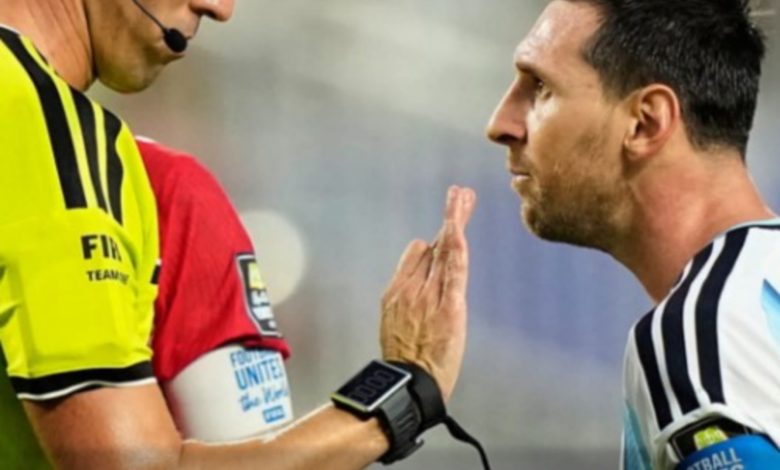
FIFA issue response to IFAB statement addressing key refereeing error during Argentina World Cup game.
The controversy surrounding the 2026 FIFA World Cup continues, with FIFA responding after the International Football Association Board (IFAB) clarified how VAR should be used in incidents involving mistaken identity.
The debate stems from Switzerland captain Breel Embolo’s dismissal during his side’s World Cup quarter-final against Argentina. With the match level at 1-1 in the 72nd minute, Embolo went down under a challenge from Leandro Paredes. The referee initially booked Paredes, but after a VAR review, the yellow card was withdrawn and instead shown to Embolo for simulation. As it was Embolo’s second caution of the match, he was sent off.
Argentina capitalized on the numerical advantage, eventually securing a 3-1 victory to book their place in the semi-finals.
On July 28, IFAB issued updated guidance after discussions with refereeing officials from all 55 UEFA member associations. The organization emphasized that VAR should only overturn yellow-card decisions to correct the identity of the player who committed the offence, not to reassess the offence itself.
In its statement, IFAB explained that while the use of the mistaken identity rule in simulation cases during the World Cup had received positive feedback, it has not yet been formally incorporated into the VAR protocol. Until the ongoing review is completed, referees should not apply the law in that manner. IFAB also acknowledged that situations like Embolo’s should not have resulted in a dismissal under the current interpretation of the Laws of the Game.
FIFA, however, defended the officiating, insisting that its interpretation of the law was applied consistently throughout the tournament.
A FIFA spokesperson said there were two occasions during the World Cup where the wrong player was initially cautioned, prompting VAR to intervene and correct a factual case of mistaken identity caused by an opponent’s simulation.
FIFA maintained that while the act of simulation itself was not reviewable, allowing an innocent player to keep a yellow card that could later lead to a second booking or suspension would be unjust. The governing body argued that the VAR intervention corrected the factual mistake rather than re-refereeing the incident.
The statement added that FIFA does not view the decisions as refereeing or VAR errors, describing them instead as actions that restored fairness. FIFA also confirmed it has remained in close contact with IFAB and said the interpretation used during the World Cup will be considered as part of future discussions on revisions to the VAR protocol.
UEFA also weighed in on the debate, stressing that referees should return to the principle of “minimum interference, maximum benefit” when using VAR.
European football’s governing body reiterated that VAR should only intervene in cases of clear and obvious errors or when a match official has missed a significant incident. UEFA added that the technology is designed to support referees rather than replace their authority, warning that lengthy and highly detailed reviews often indicate the original decision was not clearly wrong and should therefore be avoided.